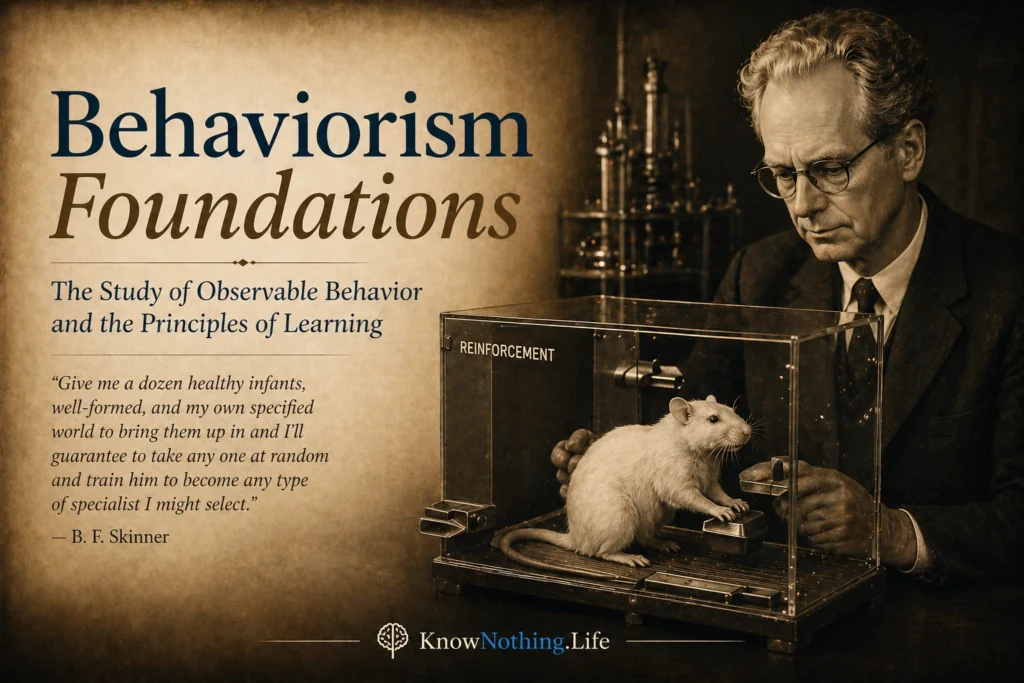
Behaviorism foundations lie in a radical shift in how psychology defined itself as a science. Rather than focusing on introspection, consciousness, or subjective mental states, early behaviorists argued that psychology should concern itself only with observable, measurable behavior. This move was not merely methodological; it represented a philosophical commitment to objectivity, prediction, and control. By restricting inquiry to what could be seen and tested, behaviorism sought to align psychology with the empirical rigor of the natural sciences.
This foundational stance reframed the study of human and animal behavior as a system governed by environmental inputs and observable outputs. Behavior was understood as a function of stimuli and responses, shaped through interaction with the environment. The implications of this shift were profound. It allowed psychologists to design controlled experiments, generate replicable findings, and develop practical applications in education, therapy, and industry. Behaviorism, in its foundational form, did not deny the existence of mental processes outright, but it considered them beyond the scope of scientific analysis at the time.
Philosophical Roots and Scientific Context
The intellectual roots of behaviorism can be traced to broader philosophical movements that emphasized empiricism and positivism. Empiricism, associated with thinkers such as John Locke, argued that knowledge arises from sensory experience rather than innate ideas. This perspective laid the groundwork for viewing behavior as something that could be shaped by environmental input. Positivism further reinforced this stance by asserting that only observable phenomena should be considered legitimate subjects of scientific inquiry.
In the late nineteenth and early twentieth centuries, psychology was still struggling to establish itself as a scientific discipline. Methods such as introspection, used by early structuralists, relied heavily on subjective reports, which were difficult to verify and replicate. Behaviorism emerged as a response to these limitations, offering a more objective framework for studying behavior. By focusing on observable actions rather than internal experiences, behaviorists aimed to eliminate ambiguity and increase the reliability of psychological research.
This scientific context was crucial in shaping the foundational principles of behaviorism. The desire for objectivity, combined with advances in experimental methods, created an environment in which behaviorism could flourish. It provided a clear and testable approach to understanding behavior, aligning psychology more closely with disciplines such as biology and physics. These philosophical and scientific influences continue to underpin the core assumptions of behaviorism.
The Emergence of Behaviorism
The formal emergence of behaviorism is often associated with John B. Watson, who articulated its principles in the early twentieth century. Watson rejected the study of consciousness and argued that psychology should focus exclusively on observable behavior. In his view, behavior could be understood as a series of stimulus-response relationships, shaped entirely by environmental factors. This perspective challenged existing approaches and established a new direction for psychological research.
Watson’s work emphasized the predictive and controllable nature of behavior. He believed that by understanding the relationships between stimuli and responses, psychologists could anticipate and influence behavior in systematic ways. His famous claim that he could train any child to become any type of specialist, given the right environmental conditions, reflected the radical environmentalism at the heart of early behaviorism. This view minimized the role of innate factors and highlighted the power of learning and conditioning.
The emergence of behaviorism marked a turning point in psychology. It shifted the focus from internal mental life to external behavior, creating a framework that could be empirically tested and applied. While later developments would refine and expand its principles, the foundational ideas introduced by Watson established behaviorism as a dominant force in early twentieth-century psychology.
Classical Conditioning and Associative Learning
A key pillar of behaviorism foundations is the concept of classical conditioning, which demonstrates how behavior can be shaped through associations between stimuli. This principle was first systematically studied by Ivan Pavlov, whose experiments revealed that organisms can learn to associate neutral stimuli with biologically significant events. Through repeated pairings, a previously neutral stimulus becomes capable of eliciting a response on its own.
Classical conditioning illustrates how learning can occur without conscious awareness or deliberate intention. It shows that behavior is not solely the result of deliberate choices but can be shaped by patterns of association in the environment. This insight had far-reaching implications, suggesting that many behaviors, including emotional responses, could be understood in terms of learned associations. It also provided a methodological framework for studying learning in a controlled and systematic way.
The importance of classical conditioning within behaviorism lies in its demonstration that complex behaviors can emerge from simple processes. By identifying the mechanisms through which associations are formed, behaviorists were able to explain a wide range of phenomena, from reflexive responses to conditioned fears. This focus on associative learning became a cornerstone of behaviorist theory, reinforcing the idea that behavior is shaped by environmental experience.
Operant Conditioning and Behavioral Consequences
While classical conditioning focuses on associations between stimuli, operant conditioning emphasizes the role of consequences in shaping behavior. This concept was developed extensively by B. F. Skinner, who argued that behavior is influenced by the outcomes it produces. According to this framework, actions that lead to positive consequences are more likely to be repeated, while those that lead to negative consequences are less likely to occur.
Operant conditioning introduced the concepts of reinforcement and punishment, which are central to behaviorist theory. Reinforcement strengthens behavior by providing desirable outcomes or removing unpleasant ones, while punishment aims to reduce behavior by introducing negative consequences or removing positive ones. These mechanisms provide a powerful explanation for how behavior is maintained and modified over time.
The significance of operant conditioning lies in its applicability to real-world situations. It provides a framework for understanding how habits are formed, how behaviors can be changed, and how learning occurs in everyday contexts. From classroom management to workplace incentives, the principles of operant conditioning have been widely applied, demonstrating the practical value of behaviorist foundations.
Methodological Principles of Behaviorism
Behaviorism foundations are characterized by a strong commitment to scientific methodology. Central to this approach is the use of controlled experiments, in which variables can be systematically manipulated and measured. By isolating specific factors and observing their effects on behavior, researchers can establish causal relationships and generate reliable findings. This emphasis on experimentation distinguishes behaviorism from earlier, more speculative approaches to psychology.
Another key methodological principle is the focus on quantification. Behaviorists sought to measure behavior in precise terms, using metrics such as frequency, duration, and intensity. This allowed for the development of standardized procedures and statistical analysis, further enhancing the scientific rigor of the field. By translating behavior into measurable data, behaviorists were able to compare results across studies and build a cumulative body of knowledge.
The commitment to objectivity also meant minimizing the influence of subjective interpretation. Behaviorists avoided relying on introspective reports, instead focusing on observable actions that could be independently verified. This approach ensured that findings were based on empirical evidence rather than personal judgment, reinforcing the credibility of behaviorist research and its foundational principles.
Critiques and Evolution of Behaviorism
Despite its influence, behaviorism has faced significant criticism, particularly regarding its exclusion of mental processes. Critics argue that thoughts, emotions, and intentions play a crucial role in shaping behavior and cannot be ignored. By focusing exclusively on observable actions, early behaviorism was seen as offering an incomplete account of human experience. This critique led to the development of alternative approaches that sought to integrate cognitive factors into psychological theory.
The cognitive revolution of the mid-twentieth century marked a major shift in the field, reintroducing the study of mental processes as a legitimate area of inquiry. Rather than rejecting behaviorism entirely, many researchers built upon its foundations, incorporating its methodological strengths while expanding its theoretical scope. This integration gave rise to new approaches, such as cognitive-behavioral models, which combine insights from both traditions.
Behaviorism itself also evolved over time, with later theorists adopting more nuanced positions. Some forms of behaviorism acknowledged the existence of internal processes while maintaining a focus on observable behavior as the primary subject of study. This evolution reflects the adaptability of behaviorist principles and their continued relevance in contemporary psychology.
Conclusion
The foundations of behaviorism represent a transformative moment in the history of psychology, establishing a framework that emphasized objectivity, experimentation, and the study of observable behavior. By focusing on the relationships between stimuli, responses, and consequences, behaviorism provided a powerful model for understanding learning and adaptation. Its principles have influenced a wide range of fields, from education and therapy to organizational behavior and beyond.
Although behaviorism has been supplemented by cognitive and neuroscientific perspectives, its foundational ideas remain deeply embedded in modern psychology. The emphasis on empirical methods, measurable outcomes, and practical application continues to shape research and practice. As a result, behaviorism foundations not only define a historical movement but also contribute enduring insights into the nature of behavior and the processes that shape it.