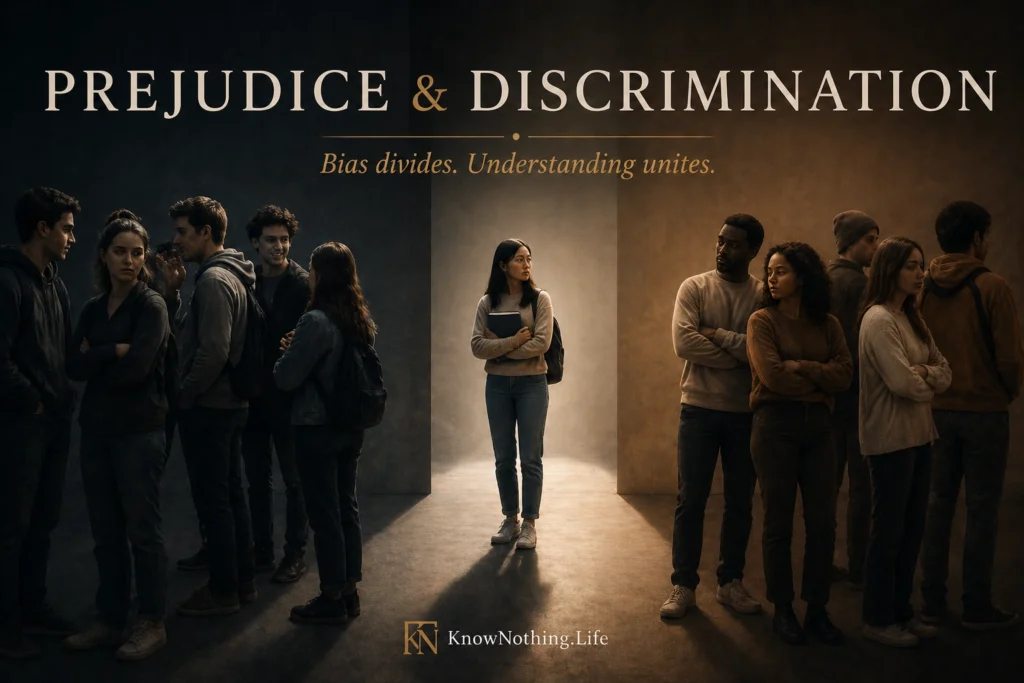
Prejudice and discrimination are central topics in social psychology, reflecting how individuals and groups form judgments about others and act upon those judgments. Prejudice refers to preconceived attitudes or evaluations—often negative—toward individuals based on their membership in a particular group. Discrimination, in contrast, involves behaviors that treat people differently because of those group-based perceptions. While related, the two are distinct: prejudice exists at the level of thought and feeling, while discrimination manifests in action.
Understanding prejudice and discrimination is essential for explaining social inequality, conflict, and cohesion. These phenomena influence opportunities, relationships, and societal structures, shaping experiences across domains such as education, employment, and justice. At the same time, they are not fixed or inevitable; they emerge from identifiable psychological and social processes. By examining their origins and mechanisms, psychology offers insight into how they can be reduced and how more equitable social systems can be fostered.
Historical Foundations and Theoretical Perspectives
The scientific study of prejudice gained momentum in the mid-twentieth century, particularly in response to global conflicts and civil rights movements. Early research focused on identifying personality traits associated with prejudice, such as authoritarianism. However, later perspectives shifted toward understanding prejudice as a product of social and cognitive processes rather than individual pathology.
One influential framework is Gordon Allport’s work on the nature of prejudice, which emphasized the role of categorization and generalization. Allport argued that prejudice arises from normal cognitive processes that simplify the social world but can lead to overgeneralization and bias. His work highlighted that prejudice is not limited to extreme cases but is a widespread human tendency.
Another key perspective comes from Henri Tajfel, whose Social Identity Theory explains how group membership contributes to in-group favoritism and out-group bias. Tajfel’s research demonstrated that even minimal group distinctions can produce preferential treatment for one’s own group. These theoretical perspectives provide a foundation for understanding how prejudice and discrimination develop and persist.
Cognitive Roots of Prejudice
Prejudice is deeply rooted in cognitive processes that help individuals navigate a complex social world. One of the most fundamental processes is categorization, which involves grouping people based on shared characteristics. While categorization simplifies perception, it also accentuates differences between groups and similarities within them, creating the conditions for stereotyping.
Stereotypes are generalized beliefs about members of a group, often based on limited or inaccurate information. They can influence perception, memory, and judgment, leading individuals to interpret behavior in ways that confirm existing beliefs. For example, ambiguous actions may be interpreted differently depending on the stereotype associated with a group, reinforcing biased perceptions.
Heuristics, or mental shortcuts, also contribute to prejudice. These shortcuts allow for quick judgments but can lead to systematic errors, such as the availability heuristic or confirmation bias. These cognitive tendencies highlight that prejudice is not simply a matter of intention but is embedded in the way people process information. Recognizing these processes is a crucial step in addressing bias.
Emotional and Motivational Factors
In addition to cognitive processes, emotions and motivations play a significant role in prejudice. Feelings such as fear, anger, and anxiety can intensify negative attitudes toward out-groups, particularly in situations perceived as threatening. These emotional responses can be shaped by personal experiences, social narratives, and cultural influences.
Motivational factors also contribute to prejudice, particularly the desire to maintain a positive self-concept. According to Social Identity Theory, individuals derive part of their self-esteem from their group memberships. Favoring one’s own group and devaluing others can enhance this sense of identity, reinforcing prejudice. This process does not necessarily require hostility but can arise from the pursuit of positive distinctiveness.
Scapegoating is another motivational factor, where individuals or groups project frustration and blame onto others. This can occur in times of economic or social stress, where out-groups are perceived as responsible for problems. Understanding the emotional and motivational dimensions of prejudice provides insight into why it can be so persistent and resistant to change.
Forms and Expressions of Discrimination
Discrimination can take many forms, ranging from overt actions to subtle, indirect behaviors. Overt discrimination includes explicit acts such as exclusion, harassment, or unequal treatment. These forms are often easier to identify and address, as they involve clear violations of norms or laws.
More subtle forms of discrimination, sometimes referred to as microaggressions or implicit bias, operate in less visible ways. These may include unconscious preferences, assumptions, or behaviors that disadvantage certain groups. While individually small, these actions can accumulate over time, contributing to systemic inequality.
Institutional discrimination occurs when policies, practices, or structures systematically disadvantage certain groups. This form of discrimination is embedded in social systems, making it more difficult to identify and change. Understanding the different forms of discrimination highlights the need for both individual and systemic approaches to addressing inequality.
Social and Cultural Influences
Prejudice and discrimination are shaped by broader social and cultural contexts. Cultural norms, media representations, and historical narratives influence how groups are perceived and treated. These influences can reinforce stereotypes and biases, making them appear natural or justified.
Socialization plays a key role in transmitting attitudes across generations. Individuals learn about group differences and social norms through family, education, and peer interactions. These early experiences can shape attitudes and behaviors, contributing to the persistence of prejudice.
Cultural differences also affect the expression of prejudice. In some contexts, prejudice may be openly expressed, while in others it may be more subtle or implicit. These variations reflect differences in social norms and values, highlighting the importance of context in understanding prejudice and discrimination.
Reducing Prejudice and Promoting Inclusion
Research in social psychology has identified several strategies for reducing prejudice and promoting more inclusive attitudes. One of the most effective approaches is intergroup contact, which involves interaction between members of different groups under conditions that promote equality and cooperation. This approach, supported by Gordon Allport, suggests that positive contact can reduce stereotypes and foster understanding.
Education and awareness are also important for addressing prejudice. By understanding the cognitive and social processes that contribute to bias, individuals can become more mindful of their attitudes and behaviors. Programs that encourage perspective-taking and empathy can help reduce prejudice and promote more inclusive interactions.
At a societal level, policies and practices that promote equality and diversity are essential for addressing discrimination. This includes efforts to ensure fair access to opportunities, challenge discriminatory practices, and create inclusive environments. These approaches demonstrate that reducing prejudice requires both individual and collective action.
Prejudice, Discrimination, and Social Change
The study of prejudice and discrimination is closely linked to broader efforts toward social change. Movements for civil rights, equality, and justice have highlighted the impact of discrimination and the need for systemic reform. Social psychology provides tools for understanding these dynamics and for developing strategies to promote change.
Understanding the psychological roots of prejudice can inform interventions that address both attitudes and behaviors. For example, campaigns that challenge stereotypes or promote positive representations can influence public perception. Similarly, policies that reduce inequality can create conditions that discourage discrimination.
Social change is often a gradual process, requiring sustained effort and collaboration. By integrating insights from psychology with broader social initiatives, it is possible to create more equitable and inclusive societies. This underscores the practical importance of studying prejudice and discrimination.
Conclusion
Prejudice and discrimination are complex phenomena that arise from the interplay of cognitive, emotional, and social factors. They shape individual experiences and societal structures, influencing relationships, opportunities, and outcomes. Theoretical contributions from figures such as Gordon Allport and Henri Tajfel have provided valuable frameworks for understanding these processes.
By examining the roots and expressions of prejudice and discrimination, psychology offers insights into how they can be reduced and addressed. This involves recognizing the role of cognitive biases, emotional influences, and social contexts, as well as implementing strategies that promote inclusion and equity. Ultimately, the study of prejudice and discrimination highlights the potential for change, emphasizing that attitudes and behaviors can be reshaped to create more just and cohesive societies.