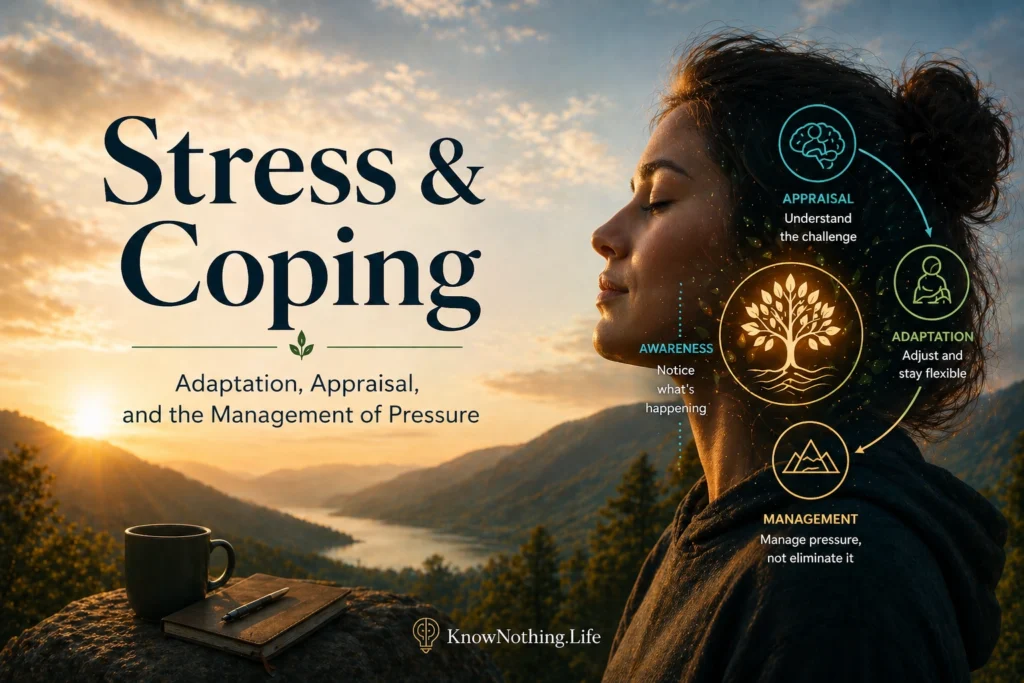
Stress is an inevitable part of human life, arising whenever individuals perceive that environmental demands exceed their ability to cope. It is not inherently negative; in moderate forms, stress can motivate action, sharpen attention, and promote adaptation. However, when stress becomes chronic or overwhelming, it can undermine physical health, emotional stability, and cognitive functioning. The study of stress and coping seeks to understand how individuals respond to challenges and how they manage the pressures of everyday life.
The modern scientific understanding of stress was shaped by Hans Selye, who defined stress as “the nonspecific response of the body to any demand.” In his work The Stress of Life, Selye emphasized that stress involves a general physiological reaction, regardless of the specific cause. While his model focused on biological processes, later researchers expanded the concept to include psychological and social dimensions, recognizing that stress is not only a bodily response but also a matter of perception and interpretation.
The Nature of Stress
Stress can be understood as a process that involves the interaction between an individual and their environment. It begins with a stressor—an event or condition that poses a challenge or threat—and is followed by an appraisal of that stressor. This appraisal determines whether the situation is perceived as harmful, threatening, or manageable, shaping the individual’s response.
Psychologist Richard Lazarus played a central role in developing this transactional model of stress. He argued that stress is not simply a property of the environment or the individual but arises from their interaction. In Psychological Stress and the Coping Process, Lazarus wrote, “Stress is not what happens to you, but how you react to it,” highlighting the importance of perception in determining stress.
This perspective emphasizes that the same situation can produce different levels of stress in different individuals. Factors such as personality, past experience, and social support influence how stressors are interpreted and managed. As a result, stress is a highly individualized experience, shaped by both internal and external factors.
Physiological Responses to Stress
The body’s response to stress involves a complex set of physiological processes designed to prepare the organism for action. When a stressor is perceived, the hypothalamus activates the sympathetic nervous system and the hypothalamic-pituitary-adrenal (HPA) axis, leading to the release of stress hormones such as adrenaline and cortisol.
These hormones increase heart rate, elevate blood pressure, and mobilize energy resources, enabling the individual to respond to the challenge. This response, often referred to as the “fight or flight” reaction, was first described by Walter Cannon, who emphasized its role in survival. The physiological changes associated with this response are adaptive in the short term, enhancing the body’s ability to cope with immediate demands.
However, prolonged activation of the stress response can have harmful effects. Chronic exposure to cortisol is associated with a range of health problems, including cardiovascular disease, weakened immune function, and cognitive impairment. This highlights the importance of effective coping mechanisms in regulating the physiological impact of stress.
The General Adaptation Syndrome
Hans Selye’s concept of the general adaptation syndrome (GAS) provides a framework for understanding the body’s response to prolonged stress. The GAS consists of three stages: alarm, resistance, and exhaustion. In the alarm stage, the body detects the stressor and initiates the fight-or-flight response. In the resistance stage, the body attempts to adapt to the ongoing stressor, maintaining heightened physiological activity.
If the stress continues without resolution, the body enters the exhaustion stage, in which resources are depleted and the risk of illness increases. This model highlights the cumulative effects of stress and the importance of recovery. It also underscores that while the stress response is adaptive in the short term, it can become maladaptive when sustained over time.
Selye’s work laid the foundation for modern stress research, emphasizing the biological dimension of stress while also pointing to its broader implications for health and well-being. His model continues to influence how stress is understood and managed in both clinical and everyday contexts.
Coping Strategies
Coping refers to the cognitive and behavioral efforts used to manage stress. According to Lazarus and his colleagues, coping strategies can be broadly categorized into problem-focused and emotion-focused approaches. Problem-focused coping involves addressing the source of stress directly, such as by finding solutions or taking action to change the situation.
Emotion-focused coping, on the other hand, involves managing the emotional response to the stressor. This may include strategies such as seeking social support, engaging in relaxation techniques, or reinterpreting the situation in a more positive light. Both types of coping can be effective, depending on the nature of the stressor and the individual’s resources.
Psychologist Susan Folkman, who collaborated extensively with Lazarus, emphasized that coping is a dynamic process that changes over time. Individuals may use different strategies at different stages of a stressful situation, reflecting the evolving nature of both the stressor and the individual’s appraisal of it.
Individual Differences in Coping
People vary widely in how they cope with stress, reflecting differences in personality, experience, and social context. Traits such as optimism, resilience, and self-efficacy are associated with more effective coping, while factors such as chronic anxiety or lack of social support can increase vulnerability to stress.
Resilience, in particular, has become a key focus of research. It refers to the ability to adapt and recover in the face of adversity, maintaining psychological well-being despite challenges. Resilient individuals are more likely to use adaptive coping strategies, such as problem-solving and positive reappraisal, which help mitigate the effects of stress.
Social support is another critical factor in coping. Relationships with family, friends, and community members provide emotional and practical resources that can buffer against stress. This highlights that coping is not only an individual process but also a social one, embedded within networks of support and interaction.
Stress, Coping, and Health
The relationship between stress, coping, and health is a central concern in psychology and medicine. Chronic stress has been linked to a wide range of physical and mental health problems, including heart disease, depression, and anxiety disorders. Effective coping strategies can reduce these risks by moderating the impact of stress on the body and mind.
Health psychologist Shelley E. Taylor introduced the concept of “tend-and-befriend” as an alternative to the fight-or-flight response, particularly in social contexts. This model suggests that individuals may respond to stress by seeking social support and nurturing relationships, highlighting the role of social behavior in coping.
The study of stress and coping has also informed interventions aimed at improving health outcomes. Techniques such as mindfulness, cognitive-behavioral therapy, and stress management training have been shown to enhance coping skills and reduce the negative effects of stress. These approaches emphasize the importance of both psychological and behavioral factors in maintaining well-being.
Conclusion
Stress and coping are fundamental aspects of human experience, reflecting the ongoing interaction between individuals and their environment. While stress is an inevitable part of life, its impact depends largely on how it is managed. By understanding the processes of appraisal, physiological response, and coping, individuals can develop strategies to navigate challenges more effectively.
The study of stress and coping highlights the complexity of human adaptation, integrating biological, psychological, and social perspectives. It underscores that resilience is not simply a trait but a process, shaped by experience and supported by relationships. Ultimately, understanding stress and coping provides valuable insights into how individuals can maintain balance and well-being in the face of life’s demands.