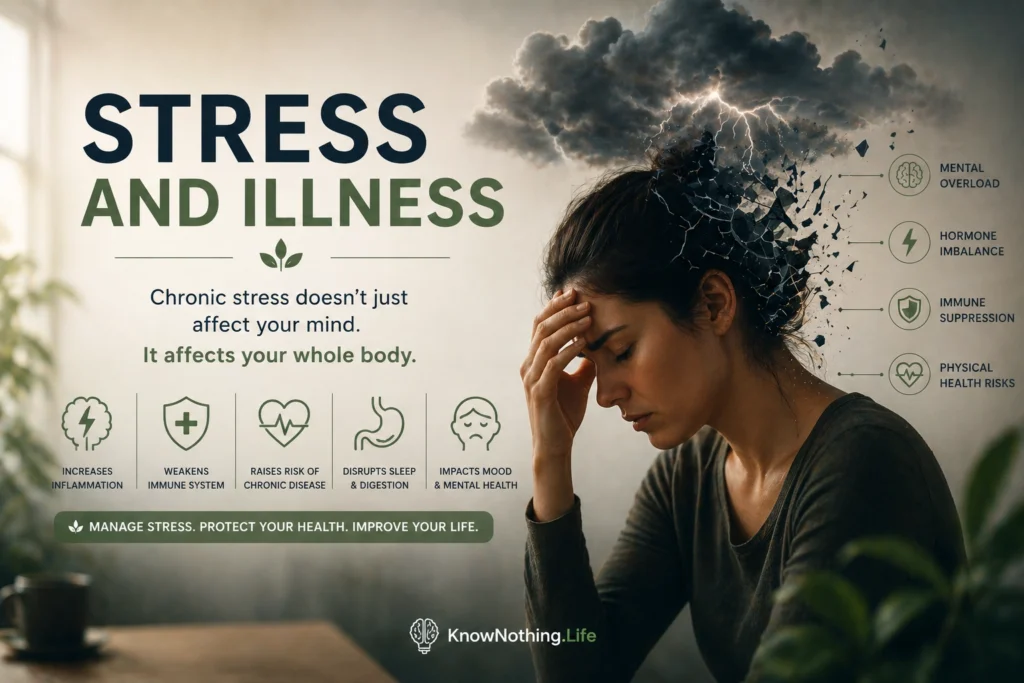
Stress is one of the most pervasive forces shaping human health, influencing both the onset and progression of disease. Defined broadly as the body’s response to perceived challenges or threats, stress is not inherently harmful; in fact, it plays a critical role in survival by mobilizing energy and sharpening attention. However, when stress becomes chronic or overwhelming, it transforms from an adaptive mechanism into a significant risk factor for illness. The study of stress and its health consequences lies at the intersection of psychology, biology, and medicine, making it a central concern within health psychology.
The modern scientific understanding of stress began with Hans Selye, who introduced the concept of the General Adaptation Syndrome (GAS) in the 1930s. In his work The Stress of Life, Selye described stress as “the nonspecific response of the body to any demand,” emphasizing its physiological basis. His model outlined three stages—alarm, resistance, and exhaustion—through which the body responds to prolonged stressors. While Selye focused on biological responses, later researchers expanded the concept to include psychological processes, recognizing that how individuals perceive and interpret stressors plays a crucial role in determining their impact.
The Physiology of Stress
At the biological level, stress triggers a cascade of physiological reactions designed to prepare the body for action. When a threat is perceived, the hypothalamus activates the sympathetic nervous system and the hypothalamic-pituitary-adrenal (HPA) axis. This leads to the release of stress hormones such as adrenaline and cortisol, which increase heart rate, elevate blood pressure, and mobilize energy reserves. These changes constitute the “fight-or-flight” response, a term popularized by physiologist Walter Cannon, who emphasized the role of the autonomic nervous system in maintaining homeostasis.
While the acute stress response is adaptive, chronic activation of these systems can have detrimental effects on the body. Prolonged exposure to cortisol, for example, can impair immune function, increase inflammation, and disrupt metabolic processes. Neuroscientist Bruce McEwen introduced the concept of allostatic load to describe the cumulative physiological burden imposed by chronic stress. As McEwen explained, “Allostasis is the process of achieving stability through change, but the cost of this adaptation can be high,” highlighting how repeated stress responses can gradually erode health over time.
Psychological Appraisal and Coping
The experience of stress is not determined solely by external events, but by how individuals perceive and interpret those events. This insight was central to the work of Richard Lazarus and Susan Folkman, whose transactional model of stress emphasized cognitive appraisal. In their seminal book Stress, Appraisal, and Coping (1984), they argued that stress arises when individuals perceive a situation as exceeding their resources or threatening their well-being. This means that the same event can be experienced as stressful by one person and manageable by another.
Coping strategies play a critical role in mediating the effects of stress on health. Lazarus and Folkman distinguished between problem-focused coping, which involves addressing the source of stress, and emotion-focused coping, which aims to regulate emotional responses. Effective coping can reduce the physiological impact of stress and promote resilience, while maladaptive coping—such as avoidance or substance use—can exacerbate health problems. As Lazarus noted, “Stress is not what happens to us, but how we respond to what happens,” underscoring the importance of perception and agency in the stress process.
Stress and the Immune System
One of the most significant discoveries in health psychology is the impact of stress on the immune system. The field of psychoneuroimmunology has demonstrated that psychological factors can influence immune function through complex interactions between the nervous and endocrine systems. Research pioneered by Robert Ader showed that immune responses could be conditioned, providing early evidence that the immune system is sensitive to psychological states.
Subsequent studies have confirmed that chronic stress suppresses immune activity, making individuals more vulnerable to infections and slowing the healing process. Research by Sheldon Cohen found that individuals under high levels of stress were significantly more likely to develop colds when exposed to a virus, demonstrating a direct link between stress and susceptibility to illness. Stress has also been implicated in the progression of autoimmune diseases and cancer, although these relationships are complex and influenced by multiple factors. These findings illustrate that the immune system is not isolated, but deeply integrated with psychological processes.
Stress-Related Illnesses
Chronic stress has been associated with a wide range of physical and mental health conditions. Cardiovascular disease is among the most well-documented outcomes, with stress contributing to hypertension, atherosclerosis, and increased risk of heart attack and stroke. Research has shown that individuals with high levels of hostility or chronic anxiety are more likely to develop coronary heart disease, highlighting the role of emotional factors in cardiovascular health.
Stress is also linked to gastrointestinal disorders, such as irritable bowel syndrome (IBS) and ulcers, as well as metabolic conditions like obesity and diabetes. The connection between stress and mental health is equally significant, with chronic stress serving as a major risk factor for depression, anxiety disorders, and burnout. As physician and researcher Gabor Maté argues in When the Body Says No, “Chronic stress suppresses the immune system, disorganizes emotional functioning, and undermines the sense of self,” suggesting that illness can be understood, in part, as a response to prolonged psychological strain.
Social and Environmental Stressors
Stress does not occur in a vacuum; it is shaped by social and environmental contexts. Factors such as socioeconomic status, work conditions, discrimination, and social isolation can all contribute to chronic stress. Individuals living in poverty or facing systemic inequality often experience higher levels of stress and, consequently, poorer health outcomes. This relationship is a key focus of research on the social determinants of health, which examines how structural conditions influence well-being.
Social support, on the other hand, can buffer the effects of stress and promote resilience. Studies have consistently shown that individuals with strong social networks experience lower levels of stress and better health outcomes. Psychologist Julianne Holt-Lunstad has demonstrated that social isolation is associated with increased mortality risk, comparable to well-known risk factors such as smoking. These findings highlight the importance of relationships and community in mitigating the harmful effects of stress.
Managing Stress and Promoting Health
Given the profound impact of stress on health, effective stress management is essential for preventing illness and promoting well-being. Psychological interventions such as cognitive-behavioral therapy (CBT), mindfulness-based stress reduction (MBSR), and relaxation techniques have been shown to reduce stress and improve health outcomes. Jon Kabat-Zinn, the founder of MBSR, defines mindfulness as “paying attention in a particular way: on purpose, in the present moment, and nonjudgmentally,” a practice that has been widely adopted in both clinical and everyday settings.
Lifestyle factors also play a crucial role in stress management. Regular physical activity, adequate sleep, and a balanced diet can enhance resilience and reduce the physiological impact of stress. Additionally, developing adaptive coping strategies, fostering social connections, and cultivating a sense of purpose can help individuals navigate stress more effectively. These approaches reflect a holistic understanding of health, in which psychological and behavioral factors are integral to physical well-being.
Future Directions in Stress Research
As research on stress and illness continues to evolve, new perspectives and technologies are expanding our understanding of this complex relationship. Advances in neuroscience and genetics are shedding light on individual differences in stress reactivity, revealing why some people are more vulnerable to stress-related illness than others. The study of epigenetics, in particular, suggests that stress can influence gene expression, potentially affecting health across generations.
Digital health tools, such as wearable devices and mobile apps, are also transforming how stress is monitored and managed. These technologies allow individuals to track physiological indicators of stress in real time, providing opportunities for early intervention. At the same time, there is growing recognition of the need to address systemic sources of stress, such as inequality and environmental instability. As Bruce McEwen observed, “Understanding stress requires looking beyond the individual to the broader context in which they live,” a perspective that will likely guide future research and policy.
Conclusion
The relationship between stress and illness is one of the most important and complex topics in health psychology. While stress is an inevitable part of life, its effects on health depend on a combination of biological, psychological, and social factors. From the physiological mechanisms of the stress response to the role of perception and coping, research has shown that stress can both protect and harm the body.
Understanding this relationship provides valuable insights into how illness develops and how it can be prevented. By addressing stress at multiple levels—individual, social, and systemic—it is possible to reduce its harmful effects and promote resilience. In this sense, the study of stress and illness not only deepens our understanding of health, but also offers practical pathways toward a more balanced and sustainable way of living.