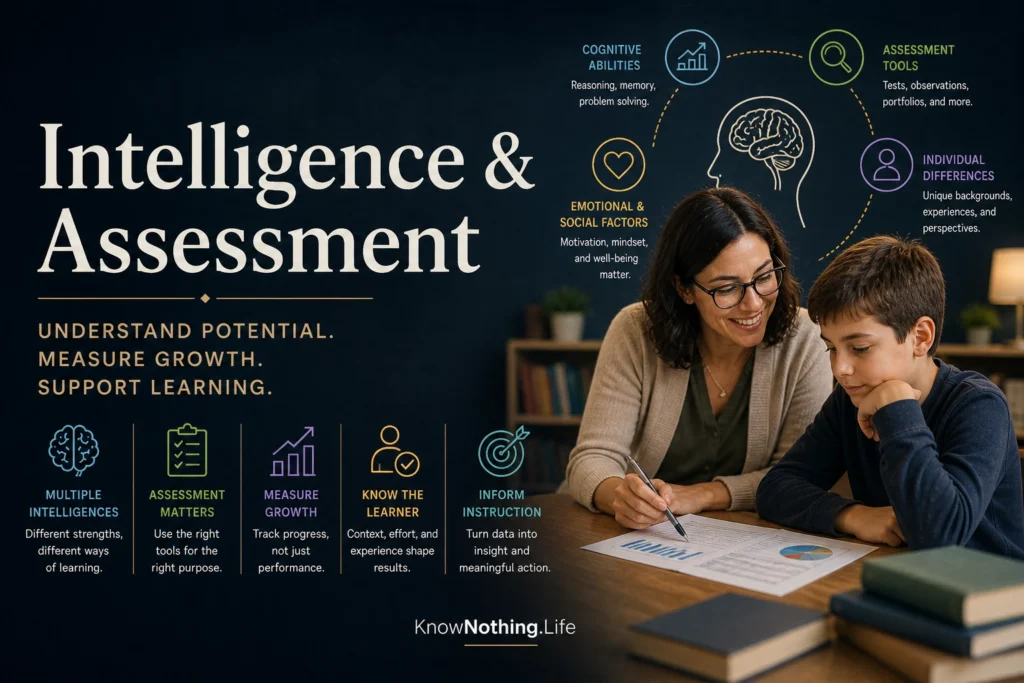
Intelligence and assessment are central concepts in psychology and education, shaping how individuals are understood, evaluated, and supported in their development. Intelligence broadly refers to the capacity to learn, reason, solve problems, and adapt to new situations, while assessment involves the systematic measurement of these abilities. Together, they form the basis for decisions about education, employment, and intervention, making their study both scientifically important and socially consequential. Yet, defining and measuring intelligence has proven to be one of the most complex and debated challenges in psychology.
Early efforts to conceptualize intelligence focused on identifying a single, general ability that could explain differences in performance across tasks. This idea was most prominently advanced by Charles Spearman, who proposed the concept of a general intelligence factor, or “g.” Spearman argued that “all branches of intellectual activity have in common one fundamental function,” suggesting that intelligence could be captured through a unified measure. While influential, this view has been challenged by alternative theories that emphasize the multidimensional nature of intelligence and the limitations of standardized assessment.
Theories of Intelligence
The study of intelligence has given rise to a wide range of theoretical perspectives, each offering a different understanding of human cognitive ability. In contrast to Spearman’s single-factor model, Louis Thurstone proposed a set of primary mental abilities, including verbal comprehension, numerical ability, and spatial reasoning. This approach suggested that intelligence is composed of distinct but related components, rather than a single overarching capacity.
One of the most influential modern theories is the concept of multiple intelligences, developed by Howard Gardner. Gardner argued that traditional measures of intelligence fail to capture the full range of human abilities, proposing instead that individuals possess multiple forms of intelligence, such as linguistic, logical-mathematical, musical, and interpersonal. He wrote, “We should spend less time ranking children and more time helping them identify their natural competencies and gifts.” While this theory has been widely embraced in educational contexts, it has also been debated for its empirical support. Nevertheless, it has played a significant role in expanding the understanding of intelligence beyond narrow academic measures.
Intelligence Testing and Measurement
The development of intelligence testing marked a major milestone in the history of psychology, providing tools for quantifying cognitive abilities. The first widely used intelligence test was created by Alfred Binet and Théodore Simon in the early 20th century. Their goal was not to label or limit children, but to identify those who needed additional support in school. Binet emphasized that intelligence is not fixed, stating, “Intelligence is not a single, fixed, or innate capacity.”
Modern intelligence tests, such as the Wechsler scales developed by David Wechsler, assess a range of cognitive abilities, including verbal comprehension, working memory, and processing speed. These tests produce an intelligence quotient (IQ) score, which is often used as a standardized measure of cognitive ability. While IQ tests have demonstrated reliability and predictive validity, they have also been criticized for cultural bias and their limited scope. As Wechsler himself noted, “Intelligence is the aggregate or global capacity of the individual to act purposefully, to think rationally, and to deal effectively with the environment,” suggesting that no single test can fully capture its complexity.
Cultural and Contextual Considerations
One of the most significant criticisms of traditional intelligence assessment is that it may not adequately account for cultural and contextual differences. Standardized tests are often based on specific cultural norms and assumptions, which can disadvantage individuals from diverse backgrounds. This has led to concerns about fairness and the potential for misinterpretation of results.
Psychologist Robert Sternberg has addressed these issues through his theory of triarchic intelligence, which includes analytical, creative, and practical components. Sternberg argued that “intelligence is not just about adapting to the environment, but also about shaping and selecting environments,” emphasizing the importance of context. His work has highlighted the need for more inclusive and flexible approaches to assessment that recognize diverse forms of intelligence. By considering cultural and environmental factors, psychologists can develop more accurate and equitable measures of cognitive ability.
Assessment in Educational Contexts
In education, assessment plays a critical role in guiding instruction, evaluating progress, and identifying areas for support. Beyond intelligence testing, a wide range of assessment methods are used to measure learning and development, including standardized tests, classroom assessments, and performance-based evaluations. Each method has its strengths and limitations, and effective assessment often involves combining multiple approaches.
Formative assessment, which occurs during the learning process, provides ongoing feedback that can inform teaching and support student growth. Summative assessment, conducted at the end of a learning period, evaluates overall achievement. Educational researcher John Hattie has emphasized the importance of feedback in assessment, stating that “the most powerful single modification that enhances achievement is feedback.” This perspective highlights that assessment is not merely a tool for measurement, but a means of enhancing learning.
Intelligence, Achievement, and Potential
The relationship between intelligence and achievement is complex and influenced by a range of factors, including motivation, environment, and opportunity. While intelligence tests can predict certain aspects of academic performance, they do not determine an individual’s potential or future success. Research has shown that non-cognitive factors, such as perseverance and self-regulation, play a significant role in achievement.
The work of Carol Dweck on mindset has been particularly influential in this area. Dweck’s research suggests that individuals who believe their abilities can be developed through effort—a growth mindset—are more likely to achieve success than those who view intelligence as fixed. She writes, “Why waste time proving over and over how great you are, when you could be getting better?” This perspective challenges traditional notions of intelligence as a static trait, emphasizing the importance of learning and development.
Ethical Considerations in Assessment
The use of intelligence tests and assessments raises important ethical questions, particularly regarding fairness, labeling, and the potential for misuse. Test results can have significant consequences for individuals, influencing educational placement, career opportunities, and self-perception. Ensuring that assessments are used responsibly and interpreted accurately is therefore essential.
Ethical guidelines emphasize the importance of validity, reliability, and fairness in assessment. Psychologists must consider cultural bias, provide appropriate accommodations, and ensure that results are used to support rather than limit individuals. As Stephen Jay Gould argued in The Mismeasure of Man, “The abstraction of intelligence as a single entity… has no validity,” cautioning against oversimplification and misuse. These concerns highlight the need for critical reflection and ongoing evaluation of assessment practices.
Advances in Assessment and Technology
Advances in technology are transforming the field of intelligence and assessment, offering new tools for measuring and understanding cognitive abilities. Computer-based testing, adaptive assessments, and data analytics allow for more personalized and efficient evaluation. These technologies can provide detailed insights into learning processes, enabling more targeted interventions.
Neuroscience is also contributing to the study of intelligence, offering insights into the biological basis of cognitive abilities. Brain imaging techniques are revealing how different regions of the brain are involved in tasks such as problem-solving and memory. While these developments hold promise, they also raise questions about privacy, interpretation, and the limits of measurement. As the field evolves, it will be important to balance innovation with ethical considerations and a nuanced understanding of intelligence.
Future Directions in Intelligence Research
The future of intelligence research is likely to focus on integrating multiple perspectives, combining insights from psychology, neuroscience, and education. There is growing recognition that intelligence is not a single, fixed trait, but a dynamic and multifaceted capacity that develops over time. This has led to increased interest in concepts such as emotional intelligence, practical intelligence, and collective intelligence.
Researchers are also exploring how intelligence interacts with other factors, such as creativity, motivation, and social context. These efforts aim to provide a more holistic understanding of human potential, moving beyond narrow measures to capture the richness of cognitive ability. As the field continues to evolve, it will play a crucial role in shaping how individuals are assessed and supported in their development.
Conclusion
Intelligence and assessment are fundamental to understanding human ability and guiding educational and professional decisions. While early theories emphasized a single, measurable capacity, contemporary perspectives recognize the complexity and diversity of intelligence. Advances in research and technology are expanding the ways in which cognitive abilities are assessed, offering new opportunities for understanding and support.
At the same time, the study of intelligence raises important ethical and practical questions, particularly regarding fairness and the interpretation of results. By adopting a nuanced and inclusive approach, psychologists and educators can use assessment as a tool for empowerment rather than limitation. Ultimately, intelligence is not just about what individuals know, but about their capacity to learn, adapt, and grow in an ever-changing world.