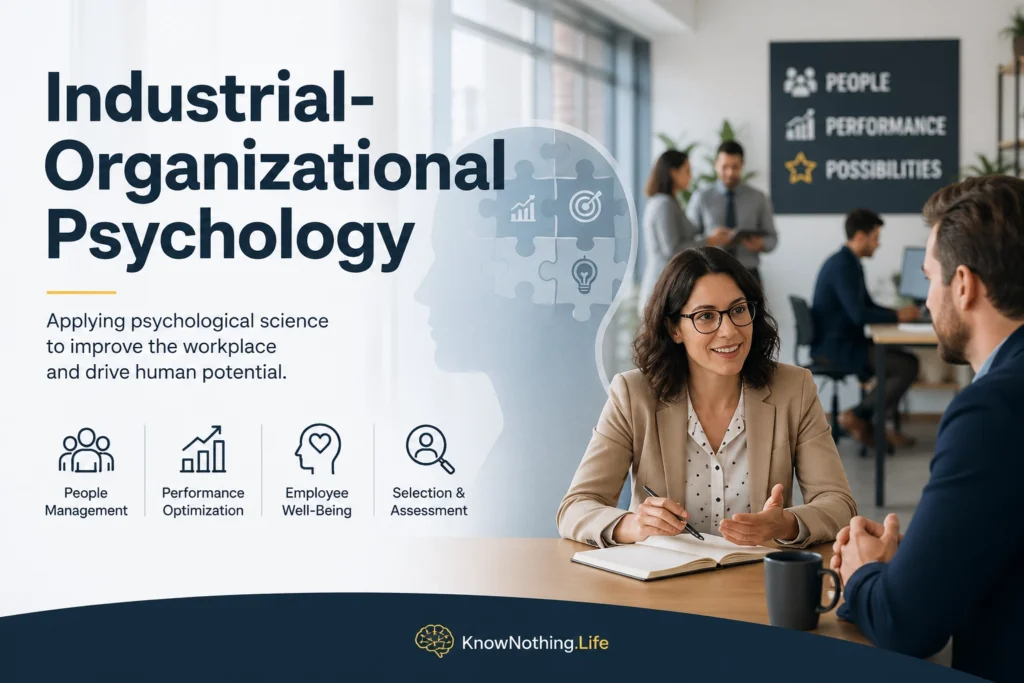
Industrial-Organizational (I-O) Psychology is the scientific study of human behavior in the workplace, focusing on how individuals, groups, and organizational structures interact to influence performance, satisfaction, and well-being. It applies psychological principles to practical challenges in organizations, including hiring, training, leadership, motivation, and workplace culture. As modern work environments become more complex and globalized, I-O psychology plays a critical role in aligning human potential with organizational goals.
The field emerged in the early 20th century alongside industrialization, when organizations began seeking systematic ways to improve efficiency and productivity. Early pioneers recognized that human factors—such as motivation, fatigue, and social dynamics—were just as important as machinery and processes. As psychologist Hugo Münsterberg wrote in Psychology and Industrial Efficiency, “The right man in the right place is the first condition of efficiency,” emphasizing the importance of matching individual capabilities with job demands. This foundational idea continues to guide I-O psychology today.
Historical Foundations and Evolution
The development of I-O psychology has been shaped by both scientific advances and practical needs. During World War I, psychologists were called upon to develop methods for selecting and placing soldiers, leading to the creation of early aptitude tests. These efforts demonstrated the value of psychological assessment in organizational settings and laid the groundwork for modern personnel selection techniques.
A major turning point in the field came with the Hawthorne Studies, conducted at Western Electric in the 1920s and 1930s under the direction of Elton Mayo. These studies revealed that social and psychological factors, such as attention and group dynamics, significantly influenced productivity. Mayo concluded that “the desire to be recognized as part of a group is one of the strongest human motivations,” shifting the focus from purely technical factors to the human side of organizations. This marked the beginning of the human relations movement, which emphasized the importance of employee well-being and social interaction.
Personnel Selection and Assessment
One of the core areas of I-O psychology is personnel selection, which involves identifying individuals who are best suited for specific roles. This process relies on a variety of assessment tools, including cognitive ability tests, personality inventories, and structured interviews. The goal is to predict job performance and ensure a good fit between the individual and the organization.
Research by Frank L. Schmidt and colleagues has shown that cognitive ability tests are among the most reliable predictors of job performance. However, effective selection also considers other factors, such as personality traits and situational judgment. Psychologist Robert P. Tett has emphasized the importance of aligning personality with job requirements, noting that “performance is maximized when personality traits are matched to job demands.” These insights highlight the complexity of selection and the need for evidence-based approaches.
Training and Development
Training and development are essential components of organizational success, enabling employees to acquire new skills and adapt to changing demands. I-O psychologists design and evaluate training programs to ensure they are effective and aligned with organizational goals. This includes assessing learning needs, developing instructional materials, and measuring outcomes.
Theories of learning and motivation play a central role in this process. Edward Thorndike’s law of effect and B. F. Skinner’s principles of reinforcement inform many training practices, emphasizing the importance of feedback and practice. More recent approaches incorporate cognitive and social learning theories, recognizing that learning is influenced by observation, interaction, and reflection. As organizational psychologist Edwin A. Locke has noted, “Goal setting is one of the most effective ways to enhance performance,” highlighting the role of clear objectives in training and development.
Motivation and Job Satisfaction
Understanding what motivates employees is a central concern of I-O psychology, as motivation directly influences performance, engagement, and retention. Early theories, such as Frederick Herzberg’s two-factor theory, distinguished between hygiene factors (such as salary and working conditions) and motivators (such as achievement and recognition). Herzberg argued that “the opposite of job satisfaction is not job dissatisfaction,” suggesting that simply removing negative conditions is not enough to create motivation.
More contemporary theories, such as self-determination theory developed by Edward Deci and Richard Ryan, emphasize the importance of autonomy, competence, and relatedness in fostering intrinsic motivation. Employees who feel empowered, capable, and connected are more likely to be engaged and productive. These insights have led organizations to adopt practices that support employee well-being and meaningful work, recognizing that motivation is not solely driven by external rewards.
Leadership and Organizational Behavior
Leadership is another key area of I-O psychology, focusing on how individuals influence and guide others within organizations. Effective leadership involves not only decision-making and strategic thinking but also the ability to inspire, communicate, and build relationships. Research has identified various leadership styles, including transformational, transactional, and servant leadership, each with different implications for organizational outcomes.
Transformational leadership, characterized by vision, inspiration, and individualized consideration, has been particularly influential. Psychologist Bernard Bass expanded on earlier work by James MacGregor Burns, suggesting that transformational leaders “raise followers to higher levels of motivation and morality.” This approach has been associated with increased job satisfaction, performance, and organizational commitment. Understanding leadership dynamics is essential for fostering effective teams and achieving organizational success.
Organizational Culture and Climate
Organizational culture refers to the shared values, beliefs, and norms that shape behavior within an organization. It influences how employees interact, make decisions, and respond to challenges. Organizational climate, on the other hand, reflects employees’ perceptions of their work environment, including factors such as support, fairness, and communication.
Research by Edgar Schein has been instrumental in understanding culture, which he describes as “a pattern of shared basic assumptions learned by a group.” A strong, positive culture can enhance performance and satisfaction, while a negative culture can lead to conflict and disengagement. I-O psychologists work to assess and shape organizational culture, promoting environments that support collaboration, innovation, and well-being.
Work-Life Balance and Employee Well-Being
As work demands increase, the importance of work-life balance and employee well-being has become more prominent in I-O psychology. Chronic stress, burnout, and job dissatisfaction can have significant consequences for both individuals and organizations, affecting health, productivity, and retention. Addressing these issues requires a holistic approach that considers both organizational practices and individual needs.
Research by Christina Maslach on burnout has identified key dimensions, including emotional exhaustion, depersonalization, and reduced personal accomplishment. Maslach notes that “burnout is a response to chronic emotional and interpersonal stressors on the job,” highlighting the importance of supportive work environments. Organizations are increasingly adopting policies that promote flexibility, well-being, and work-life integration, recognizing that employee health is integral to organizational success.
Future Directions in I-O Psychology
The future of I-O psychology is being shaped by rapid technological and societal changes. The rise of remote work, artificial intelligence, and global collaboration is transforming how organizations operate and how employees engage with their work. These changes present both opportunities and challenges, requiring new approaches to leadership, communication, and performance management.
Data analytics and machine learning are also playing an increasing role in I-O psychology, enabling more precise assessment and decision-making. At the same time, ethical considerations, such as privacy and fairness, are becoming more important as organizations rely on data-driven approaches. As the nature of work continues to evolve, I-O psychology will remain essential in understanding and optimizing the human element of organizations.
Conclusion
Industrial-Organizational Psychology provides a comprehensive framework for understanding behavior in the workplace and applying psychological principles to improve organizational outcomes. From personnel selection and training to leadership and culture, the field addresses a wide range of issues that influence both individual and organizational success.
By integrating scientific research with practical application, I-O psychology helps organizations create environments that are both productive and supportive. As work continues to change, the insights of I-O psychology will be crucial in navigating new challenges and opportunities, ensuring that human potential is effectively harnessed in the modern workplace.