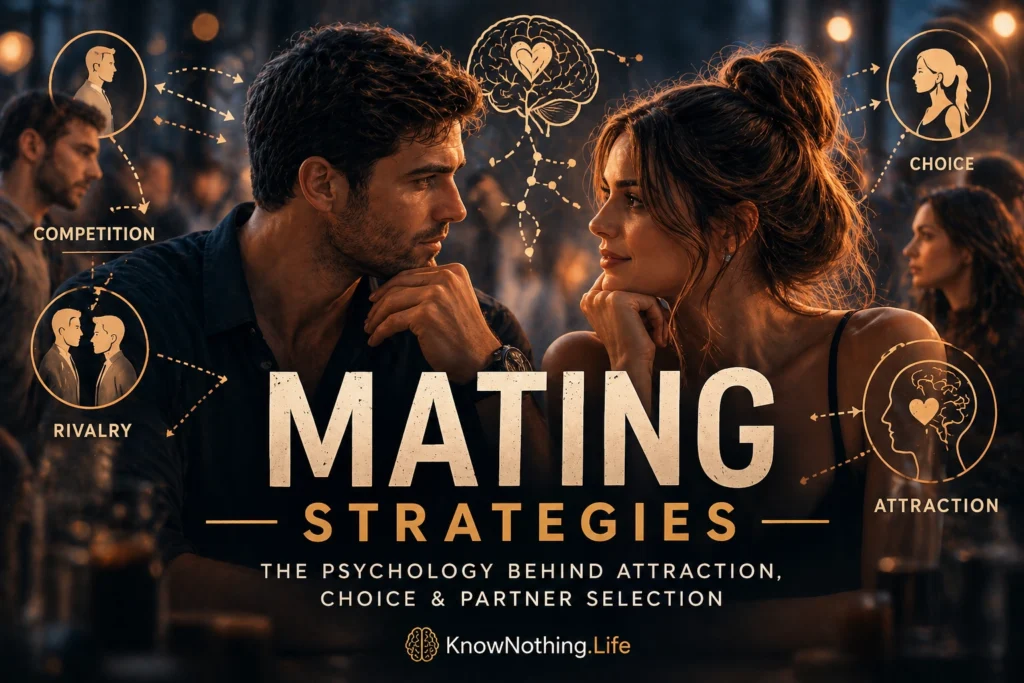
Mating strategies refer to the patterns of behavior, preferences, and decision-making processes individuals use to select partners and reproduce. These strategies are shaped by evolutionary pressures, biological constraints, and social environments, reflecting the fundamental challenge of maximizing reproductive success. In humans, mating strategies are particularly complex, influenced not only by biological imperatives but also by culture, cognition, and personal values. As a result, they encompass a wide range of behaviors, from short-term attraction to long-term pair bonding.
The study of mating strategies is rooted in evolutionary theory, particularly the concept of sexual selection introduced by Charles Darwin. Darwin proposed that traits that enhance mating success can evolve even if they do not directly contribute to survival. He wrote, “The advantage which certain individuals have over others of the same sex and species, in exclusive relation to reproduction,” defining the essence of sexual selection. This framework has been expanded by modern researchers to explore the psychological mechanisms underlying human mating behavior.
Evolutionary Foundations of Mating
Mating strategies are deeply influenced by evolutionary pressures that shaped human reproduction over thousands of generations. One of the most important principles in this context is parental investment theory, developed by Robert Trivers. This theory suggests that the sex that invests more in offspring—typically females in humans—will be more selective in choosing mates, while the less-investing sex will compete more intensely for access to partners.
Trivers argued that “the sex which invests more in offspring will be more discriminating in mate choice,” a principle that has been widely supported by research. This asymmetry in investment leads to different mating strategies for men and women, influencing preferences, behaviors, and competition. While these patterns are not absolute and are shaped by cultural and individual factors, they provide a foundation for understanding differences in mating behavior across contexts.
Mate Preferences and Attraction
Human mate preferences are shaped by both biological and social factors, reflecting the need to identify partners who can contribute to reproductive success and long-term stability. Research by David Buss has identified consistent patterns in mate preferences across cultures. For example, physical attractiveness is often valued as a cue of health and fertility, while traits such as kindness, intelligence, and reliability are associated with long-term partnership success.
Buss’s cross-cultural studies revealed that “women place greater emphasis on a mate’s earning capacity and status, whereas men place greater emphasis on physical attractiveness,” reflecting differences in reproductive challenges. However, these preferences are not fixed; they are influenced by cultural norms, individual experiences, and situational factors. Attraction is also shaped by psychological processes such as similarity, familiarity, and proximity, highlighting the interplay between biology and environment in shaping mate choice.
Short-Term and Long-Term Strategies
One of the central distinctions in the study of mating strategies is between short-term and long-term approaches. Short-term strategies involve seeking immediate reproductive opportunities with minimal commitment, while long-term strategies focus on forming stable, enduring relationships that support offspring and mutual investment.
Evolutionary psychologists argue that humans have the capacity to employ both strategies, depending on context and individual goals. David Buss has noted that “humans have evolved a menu of mating strategies,” allowing flexibility in response to environmental and social conditions. Short-term strategies may be more prevalent in contexts where resources are abundant and parental investment is less critical, while long-term strategies are more common in environments that require cooperation and stability. This flexibility reflects the adaptive nature of human behavior.
Sexual Selection and Competition
Sexual selection not only influences mate choice but also drives competition within and between sexes. Intrasexual competition involves individuals competing with members of the same sex for access to mates, while intersexual selection involves choosing partners based on desirable traits. These processes shape behaviors such as courtship, display, and rivalry.
Research by Geoffrey Miller has explored how traits such as creativity, humor, and intelligence may have evolved as signals of genetic quality. Miller argues that “the mind may have evolved as a courtship device,” suggesting that cognitive abilities can function as indicators of fitness. This perspective highlights the role of psychological traits in mating competition, extending beyond physical characteristics to include behaviors and talents that signal desirability.
Social and Cultural Influences
While evolutionary principles provide a framework for understanding mating strategies, social and cultural factors play a significant role in shaping behavior. Cultural norms, values, and institutions influence how individuals approach relationships, including expectations about marriage, gender roles, and sexual behavior.
Anthropological research by Helen Fisher has emphasized the diversity of human mating systems, noting that “romantic love is a universal human experience, but its expression varies across cultures.” Social factors such as economic conditions, education, and technology also influence mating strategies, creating variations in how individuals select partners and form relationships. This interplay between biology and culture underscores the complexity of human mating behavior.
Attachment and Pair Bonding
Attachment theory provides insight into the emotional and psychological aspects of long-term relationships. Developed by John Bowlby and expanded by Mary Ainsworth, this framework suggests that early experiences with caregivers shape patterns of attachment that influence adult relationships.
Attachment styles—secure, anxious, and avoidant—affect how individuals approach intimacy, trust, and commitment. Secure individuals are more likely to form stable and satisfying relationships, while insecure attachment styles can lead to challenges in maintaining bonds. Bowlby argued that “the propensity to make strong emotional bonds to particular individuals is a basic component of human nature,” highlighting the importance of attachment in mating strategies. Pair bonding, therefore, is not only a reproductive strategy but also a psychological process that supports emotional connection and cooperation.
Modern Mating and Technology
The rise of digital technology has transformed mating strategies, introducing new ways of meeting and evaluating potential partners. Online dating platforms, social media, and mobile applications have expanded the pool of potential mates, allowing individuals to connect across geographic and social boundaries.
However, these technologies also introduce new challenges, such as decision overload, superficial evaluation, and shifting expectations. Research suggests that while technology can facilitate connections, it may also influence how individuals approach relationships, often emphasizing short-term interactions over long-term commitment. Understanding modern mating requires integrating traditional theories with insights into how technology shapes behavior and preferences.
Ethical Considerations and Critiques
The study of mating strategies has not been without controversy, particularly regarding the interpretation of gender differences and the potential for reinforcing stereotypes. Critics argue that evolutionary explanations can oversimplify complex behaviors and overlook the role of culture and individual agency.
Scholars such as Stephen Jay Gould have cautioned against deterministic interpretations, emphasizing that “human behavior is flexible and shaped by a wide range of influences.” Ethical considerations also arise in the application of research findings, particularly in areas such as dating, relationships, and social policy. A balanced approach recognizes both the biological and cultural dimensions of mating behavior, avoiding reductionist explanations.
Future Directions in Mating Research
The study of mating strategies continues to evolve, with new research exploring the role of genetics, neuroscience, and social change. Advances in brain imaging are providing insights into the neural mechanisms underlying attraction and attachment, while cross-cultural studies are expanding understanding of diversity in mating behavior.
There is also growing interest in how changing social conditions, such as increased gender equality and shifting family structures, influence mating strategies. These developments highlight the dynamic nature of human relationships, reflecting the interplay between evolutionary heritage and contemporary context. Future research will likely continue to integrate multiple perspectives, providing a more comprehensive understanding of human mating.
Conclusion
Mating strategies are a fundamental aspect of human behavior, reflecting the complex interplay of biological, psychological, and social factors. From evolutionary principles to modern technological influences, these strategies shape how individuals form relationships and pursue reproduction.
By examining the mechanisms underlying mating behavior, researchers can gain insight into both the diversity and commonality of human relationships. Ultimately, mating strategies illustrate the adaptability of human nature, demonstrating how ancient evolutionary pressures continue to influence behavior in a rapidly changing world.