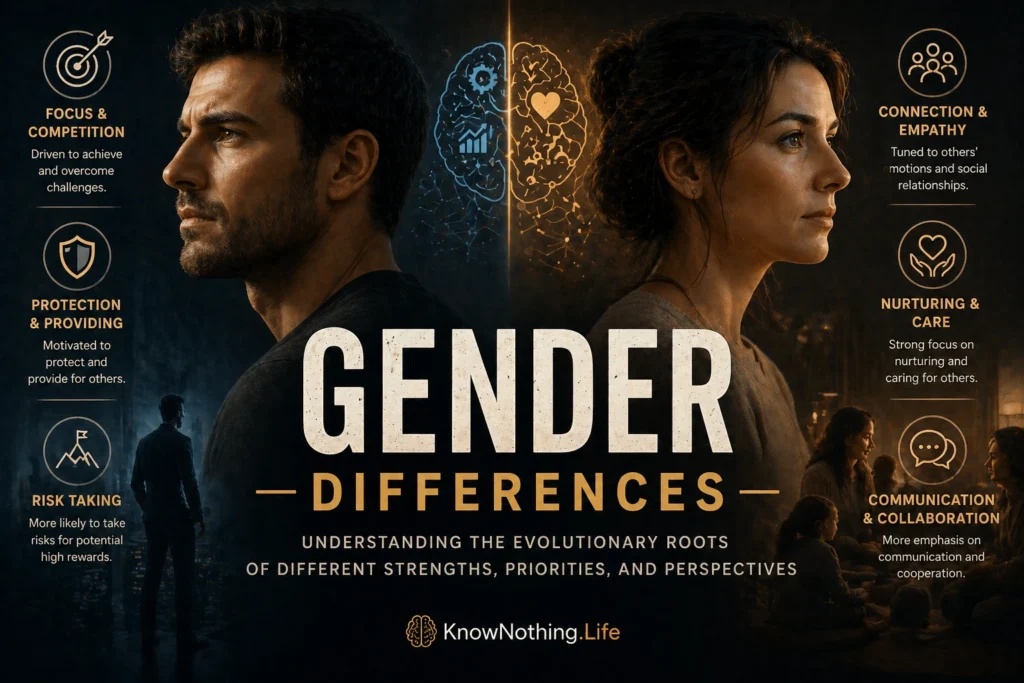
Gender differences refer to the patterns of variation in behavior, cognition, emotion, and social roles typically observed between men and women. These differences have been the subject of extensive research across psychology, biology, sociology, and anthropology, reflecting their complexity and significance. While some differences appear consistent across cultures, others vary widely depending on social, cultural, and historical contexts. Understanding gender differences requires a careful balance between recognizing biological influences and acknowledging the powerful role of socialization and environment.
The study of gender differences has evolved significantly over time. Early approaches often emphasized fixed biological distinctions, while more recent perspectives highlight the interplay between nature and nurture. As psychologist Sandra Bem argued, “The lenses of gender shape our perceptions of reality,” suggesting that societal expectations influence how differences are perceived and interpreted. This perspective underscores the importance of examining both biological and cultural factors in understanding gender-related variation.
Biological Foundations of Gender Differences
Biological explanations of gender differences focus on genetic, hormonal, and neurological factors that may influence behavior and cognition. Differences in sex chromosomes (XX in females, XY in males) and hormonal profiles, particularly levels of testosterone and estrogen, are thought to contribute to variations in physical development and certain behavioral tendencies.
Research by Simon Baron-Cohen has explored the role of prenatal hormones in shaping cognitive styles, proposing that higher levels of testosterone may be associated with systemizing tendencies, while lower levels may be linked to empathizing tendencies. Baron-Cohen suggested that “the female brain is predominantly hard-wired for empathy, while the male brain is predominantly hard-wired for understanding systems.” While this theory has generated significant discussion, it remains subject to debate, particularly regarding the extent to which biological factors determine behavior. Biological perspectives provide important insights but must be considered alongside other influences.
Cognitive and Psychological Differences
Research on cognitive differences between genders has examined areas such as verbal ability, spatial reasoning, and mathematical performance. Some studies have found average differences in specific domains, such as higher verbal fluency in females and stronger spatial abilities in males. However, these differences are typically small and show considerable overlap between individuals.
Psychologist Janet Hyde has proposed the gender similarities hypothesis, which suggests that men and women are similar on most psychological variables. Hyde argued that “males and females are similar on most, but not all, psychological variables,” emphasizing that differences are often exaggerated. This perspective challenges stereotypes and highlights the importance of focusing on individual variation rather than broad generalizations. Cognitive differences, where they exist, are influenced by both biological predispositions and environmental factors such as education and experience.
Socialization and Gender Roles
Socialization plays a central role in shaping gender differences, as individuals learn societal expectations and norms associated with their gender. From early childhood, boys and girls are often encouraged to adopt different behaviors, interests, and roles, reinforcing patterns of difference. These influences are transmitted through family, education, media, and cultural institutions.
The work of Albert Bandura on social learning theory highlights how individuals acquire gendered behaviors through observation and imitation. Bandura noted that “most human behavior is learned observationally through modeling,” suggesting that children learn gender roles by observing others. Additionally, gender schema theory, developed by Sandra Bem, proposes that individuals internalize gender-related information, which then guides their behavior and perceptions. These theories emphasize that gender differences are not only biological but also socially constructed and reinforced.
Emotional and Social Differences
Gender differences in emotional expression and social behavior have been widely studied, with research suggesting that women may be more expressive and attuned to emotional cues, while men may be more likely to suppress emotional expression. These patterns are often attributed to both biological and social factors, including differences in brain function and cultural expectations.
Research by Daniel Goleman on emotional intelligence suggests that women often score higher on measures of empathy and interpersonal skills, while men may excel in certain aspects of self-regulation. However, these differences are influenced by social norms that encourage or discourage emotional expression. As Goleman noted, “In a very real sense we have two minds, one that thinks and one that feels,” highlighting the importance of emotional processes in human behavior. Understanding these differences requires considering both innate tendencies and cultural influences.
Gender Differences in Communication
Communication styles are another area where gender differences have been observed. Research suggests that women may use language to build relationships and express emotions, while men may use it to convey information and assert status. These patterns reflect broader social roles and expectations, rather than inherent differences in ability.
Linguist Deborah Tannen has explored these differences in her work on gender and communication, arguing that “boys and girls grow up in what are essentially different cultures,” leading to distinct communication styles. Tannen’s research highlights how misunderstandings can arise from these differences, particularly in workplace and interpersonal contexts. Recognizing and adapting to diverse communication styles can improve interaction and collaboration.
Gender Differences in Work and Leadership
Gender differences in the workplace have been a major focus of research, particularly in relation to leadership, career advancement, and pay equity. While women have made significant gains in many fields, disparities persist in areas such as leadership representation and compensation. These differences are influenced by a combination of structural barriers, cultural expectations, and individual choices.
Research by Alice Eagly on social role theory suggests that gender differences in behavior arise from the roles that men and women occupy in society. Eagly argued that “gender roles are shared expectations about the behavior of men and women,” which shape opportunities and outcomes. In leadership, women are often associated with transformational styles that emphasize collaboration and support, while men may be more associated with directive approaches. These patterns reflect both individual differences and societal influences.
Cultural and Cross-Cultural Perspectives
Gender differences vary across cultures, reflecting the influence of social norms, values, and institutions. Cross-cultural research has shown that some differences are consistent, while others are highly variable. For example, gender roles tend to be more flexible in societies with greater gender equality, suggesting that social context plays a significant role in shaping behavior.
Research by Geert Hofstede has identified cultural dimensions that influence gender roles, such as masculinity and femininity. These dimensions reflect the extent to which societies emphasize competition, achievement, and assertiveness versus cooperation and care. Understanding cultural variation is essential for interpreting gender differences and avoiding ethnocentric assumptions.
Critiques and Contemporary Debates
The study of gender differences has been subject to ongoing debate, particularly regarding the interpretation of findings and the potential for reinforcing stereotypes. Critics argue that emphasizing differences can obscure similarities and contribute to bias. There is also concern about the misuse of research to justify inequality or limit opportunities.
Scholars such as Cordelia Fine have challenged biological determinism, arguing that “the evidence for hardwired sex differences is often overstated.” Fine emphasizes the role of socialization and context in shaping behavior, advocating for a more nuanced understanding of gender. Contemporary research increasingly focuses on intersectionality, recognizing that gender interacts with other factors such as race, class, and culture.
Future Directions in Gender Research
The future of research on gender differences is likely to focus on integrating biological, psychological, and social perspectives. Advances in neuroscience and genetics are providing new insights into the biological basis of behavior, while social and cultural studies are expanding understanding of diversity and context.
There is also growing emphasis on moving beyond binary conceptions of gender, recognizing the complexity and fluidity of gender identity. This shift reflects broader societal changes and has important implications for research and policy. By embracing a more inclusive and interdisciplinary approach, researchers can develop a deeper understanding of gender and its role in human behavior.
Conclusion
Gender differences are a complex and multifaceted phenomenon, shaped by the interplay of biological, psychological, and social factors. While some differences are consistent, many are influenced by context and vary across individuals and cultures. Understanding these differences requires a balanced approach that recognizes both similarities and diversity.
Ultimately, the study of gender differences is not about categorizing individuals but about understanding the factors that shape human behavior. By adopting a nuanced and evidence-based perspective, researchers and practitioners can contribute to more equitable and inclusive societies.