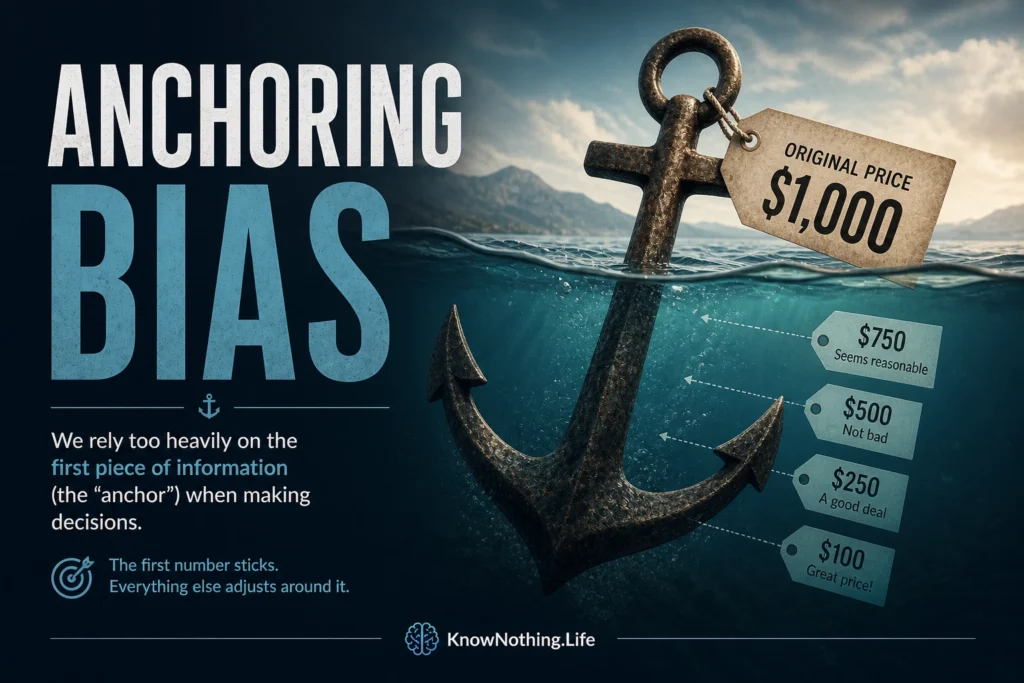
Anchoring bias is one of the most influential and robust cognitive biases affecting human judgment. It refers to the tendency to rely heavily on the first piece of information encountered—the “anchor”—when making decisions, even when that information is irrelevant or arbitrary. Once an anchor is established, subsequent judgments are typically made by adjusting away from it, but these adjustments are often insufficient. As a result, the initial value continues to exert a powerful influence over final estimates and choices.
The phenomenon was systematically studied by Amos Tversky and Daniel Kahneman, whose experiments in the 1970s revealed how even random numbers could shape human judgment. In a classic study, participants spun a wheel rigged to stop at either 10 or 65 and were then asked whether the percentage of African countries in the United Nations was higher or lower than the number shown. Their subsequent estimates were significantly influenced by the arbitrary anchor. Kahneman later reflected in Thinking, Fast and Slow (2011) that “people start from an initial value that is adjusted to yield the final answer,” but that the adjustment process is typically inadequate.
Anchoring bias has far-reaching implications across domains such as economics, law, medicine, and everyday decision-making. It highlights a fundamental limitation in human reasoning: the difficulty of making independent judgments in the presence of initial information. This article explores the cognitive mechanisms underlying anchoring bias, its manifestations in real-world contexts, and strategies for mitigating its effects.
The Cognitive Mechanisms of Anchoring
Anchoring bias is rooted in the interplay between intuitive and analytical processes in human cognition. According to dual-process theory, the fast, automatic system—often referred to as System 1—generates initial impressions and associations, while the slower, more deliberate System 2 is responsible for reasoning and adjustment. Anchors are typically processed by System 1, which quickly integrates the initial value into judgment without critically evaluating its relevance.
One explanation for anchoring is the “insufficient adjustment” hypothesis proposed by Amos Tversky and Daniel Kahneman. When individuals are presented with an anchor, they begin with that value and adjust upward or downward to reach a final estimate. However, these adjustments are often incomplete, leaving the final judgment biased toward the anchor. This process reflects the limitations of System 2, which may not exert enough effort to fully correct the initial impression.
Another explanation involves selective accessibility, a concept developed by Thomas Mussweiler. According to this theory, anchors influence judgment by activating information consistent with the anchor value. For example, if individuals are asked whether a historical figure lived longer than 120 years, they may retrieve information that supports the possibility, even if it is unlikely. This selective activation reinforces the anchor’s influence, shaping subsequent estimates and decisions.
Types of Anchors
Anchors can arise from various sources, including external information, internal knowledge, and contextual cues. External anchors are introduced by outside factors, such as suggested prices, numerical values, or initial offers in negotiations. These anchors are particularly influential because they are often perceived as relevant or authoritative, even when they are arbitrary.
Internal anchors, on the other hand, originate from an individual’s own knowledge or experience. For example, when estimating the cost of a product, individuals may rely on past experiences as a reference point. While internal anchors may seem more reliable, they can still lead to biased judgments if they are not representative of the current context. The distinction between external and internal anchors highlights the pervasive nature of anchoring bias across different types of decision-making.
Contextual anchors also play a role in shaping judgments. The way information is presented can create implicit anchors that influence perception. For instance, the order of options in a survey or the framing of a question can affect responses. These subtle influences demonstrate that anchoring bias is not limited to explicit numerical values but can arise from the broader context in which decisions are made.
Anchoring in Economic and Consumer Behavior
Anchoring bias has significant implications in economic and consumer contexts, where it influences pricing, negotiations, and purchasing decisions. In retail settings, initial price tags often serve as anchors, shaping consumers’ perceptions of value. A product priced at $200 and discounted to $100 may be perceived as a better deal than a product originally priced at $100, even if the final price is the same. This effect illustrates how anchors can distort value judgments.
Negotiations provide another clear example of anchoring bias. The first offer made in a negotiation often sets the tone for the entire discussion, influencing subsequent counteroffers and final agreements. Research has shown that individuals who make the first offer can gain an advantage by establishing a favorable anchor. However, this advantage depends on the plausibility of the anchor; unrealistic anchors may be dismissed or lead to disengagement.
Behavioral economists, including Richard Thaler, have explored how anchoring affects economic decision-making, challenging traditional models of rational choice. Thaler’s work demonstrates that individuals do not always evaluate options based on objective criteria but are influenced by contextual factors such as anchors. This insight has led to the development of behavioral economics, a field that integrates psychological principles into economic theory.
Anchoring in Legal and Medical Contexts
Anchoring bias also has critical implications in high-stakes domains such as law and medicine. In legal settings, anchors can influence sentencing decisions, damage awards, and jury judgments. For example, prosecutors’ sentencing recommendations can serve as anchors, shaping the penalties imposed by judges. Similarly, initial claims in civil cases can affect the size of jury awards, even when they are not supported by evidence.
In medical decision-making, anchoring bias can affect diagnosis and treatment. Physicians may rely on initial impressions or early information when evaluating a patient, leading to diagnostic errors. Once an initial diagnosis is formed, subsequent information may be interpreted in ways that confirm it, making it difficult to consider alternative possibilities. This phenomenon, known as diagnostic anchoring, highlights the importance of critical evaluation and second opinions in healthcare.
The influence of anchoring in these contexts underscores the need for awareness and safeguards. Structured decision-making processes, such as checklists and peer review, can help mitigate the effects of bias by encouraging systematic evaluation of evidence. By recognizing the role of anchoring, professionals can take steps to reduce its impact on critical decisions.
Strategies for Reducing Anchoring Bias
Given its pervasive nature, reducing anchoring bias is a challenging but important goal. One effective strategy is to increase awareness of the bias and its potential influence. While awareness alone may not eliminate anchoring, it can prompt individuals to engage in more deliberate and critical thinking.
Another approach involves considering alternative anchors or generating independent estimates before being exposed to external information. By establishing a baseline judgment, individuals may be less susceptible to external anchors. Additionally, encouraging multiple perspectives and collaborative decision-making can help counteract the influence of a single anchor.
Structured analytical techniques, such as statistical analysis and formal decision frameworks, can also reduce reliance on intuitive judgments. These methods provide objective criteria for evaluation, minimizing the impact of arbitrary anchors. While it may not be possible to eliminate anchoring entirely, these strategies can significantly improve decision-making accuracy.
Conclusion
Anchoring bias reveals a fundamental aspect of human cognition: the tendency to rely on initial information when making judgments. While this tendency can simplify decision-making, it also introduces systematic errors that affect perception and behavior. The work of Amos Tversky, Daniel Kahneman, and Thomas Mussweiler has provided valuable insights into the mechanisms and consequences of anchoring bias.
Understanding anchoring bias is essential for improving decision-making across a wide range of domains. By recognizing the influence of initial information and adopting strategies to mitigate its effects, individuals can make more informed and objective judgments. In a world where information is abundant and often strategically presented, the ability to question anchors is a critical skill.
Ultimately, anchoring bias highlights both the efficiency and the limitations of human cognition. It reminds us that while mental shortcuts are necessary for navigating complexity, they must be balanced with critical thinking and awareness. By doing so, individuals and organizations can better navigate the challenges of decision-making and achieve more accurate outcomes.