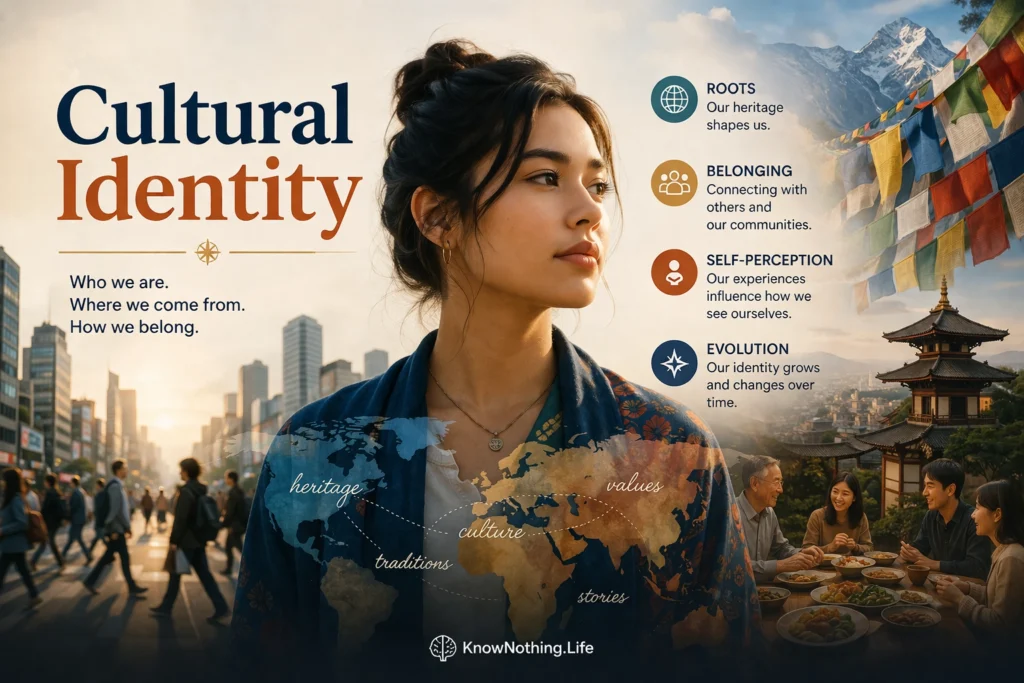
Cultural identity is one of the most fundamental yet complex dimensions of human experience. It refers to the sense of belonging to a particular group defined by shared traditions, language, values, history, and social practices. Unlike purely biological or individual traits, cultural identity is formed through participation in a collective world of meaning. It shapes how individuals understand themselves, interpret others, and navigate the social environments in which they live. From early childhood, people absorb cultural cues that inform what is considered appropriate, desirable, and meaningful, gradually internalizing these patterns into a coherent sense of self.
The study of cultural identity spans psychology, sociology, anthropology, and philosophy. Scholars such as Erik Erikson, Stuart Hall, Clifford Geertz, and Charles Taylor have all contributed to understanding how identity is shaped by culture. Erikson, in Identity: Youth and Crisis, framed identity as a developmental achievement rooted in social context, while Stuart Hall argued that cultural identity is not fixed but continually constructed through history, representation, and power. These perspectives converge on a central insight: cultural identity is not something people simply possess—it is something they actively live, negotiate, and reinterpret over time.
The Formation of Cultural Identity
Cultural identity begins forming early in life through processes of socialization. Family, community, education, religion, and media all play critical roles in transmitting cultural knowledge. Children learn language, norms, rituals, and values not through formal instruction alone, but through everyday interaction—observing how others behave, what they prioritize, and how they interpret the world. These early experiences establish a framework that shapes perception, emotion, and behavior, often in ways that feel natural and unquestioned.
Erik Erikson’s theory of psychosocial development emphasized that identity formation involves integrating personal experiences with social expectations. During adolescence, individuals engage in what Erikson called an “identity crisis,” exploring different roles and values before committing to a coherent sense of self. Cultural context plays a decisive role in this process. The options available, the expectations imposed, and the meanings attached to different identities vary across societies. What it means to be a successful adult, a responsible family member, or an authentic individual depends on the cultural environment in which one is embedded.
Culture, Meaning, and Symbolic Systems
Cultural identity is deeply tied to systems of meaning—shared symbols, narratives, and practices that give structure to human experience. Clifford Geertz described culture as “webs of significance” that people themselves have spun, emphasizing that meaning is not inherent in actions but constructed through interpretation. In The Interpretation of Cultures, Geertz argued that understanding human behavior requires understanding the symbolic systems that make it meaningful. Cultural identity emerges from participation in these systems, which include language, rituals, art, and collective memory.
These symbolic systems do more than communicate meaning; they shape how individuals think and feel. Language, for example, influences how people categorize experience, while rituals reinforce shared values and social bonds. Cultural narratives—stories about history, origin, and collective purpose—provide individuals with a sense of continuity and belonging. Charles Taylor, in Sources of the Self, argued that identity is formed within “horizons of meaning,” frameworks that define what is significant and worthwhile. Without such frameworks, individuals would struggle to orient themselves in the world. Cultural identity thus provides not only a sense of belonging but also a structure for understanding one’s place within a broader moral and social order.
Multiple Identities and Intersectionality
Cultural identity is rarely singular. Individuals typically belong to multiple cultural groups simultaneously, including those defined by ethnicity, nationality, religion, gender, class, and profession. These overlapping identities interact in complex ways, shaping how individuals experience themselves and are perceived by others. The concept of intersectionality, introduced by Kimberlé Crenshaw, highlights how different aspects of identity intersect to create unique experiences of privilege and disadvantage. Cultural identity must therefore be understood as multidimensional rather than fixed or uniform.
Stuart Hall emphasized that cultural identity is not a stable essence but a “positioning”—a process of becoming rather than being. In his essays on identity and diaspora, Hall argued that identities are constantly shaped by historical forces such as migration, colonization, and globalization. For individuals living in multicultural or diasporic contexts, cultural identity often involves navigating multiple frameworks of meaning, sometimes experiencing tension or hybridity. This dynamic process challenges the idea that identity can be reduced to a single category or origin.
Cultural Identity and Social Interaction
Cultural identity plays a crucial role in shaping social interaction. It influences how individuals communicate, interpret behavior, and establish relationships. Shared cultural identity can facilitate understanding and trust, as individuals operate within familiar norms and expectations. Conversely, differences in cultural identity can lead to misunderstanding, particularly when behaviors are interpreted through incompatible frameworks. What one culture considers respectful, another may perceive as distant; what one sees as assertive, another may interpret as aggressive.
Social identity theory, developed by Henri Tajfel and later expanded by John Turner, provides insight into how cultural identity influences group dynamics. According to this theory, individuals derive part of their self-concept from their membership in social groups. This can lead to in-group favoritism and out-group bias, as people seek to maintain a positive social identity. Cultural identity, therefore, is not only a source of belonging but also a factor in social division and conflict. Understanding these dynamics is essential for fostering cooperation and reducing prejudice in diverse societies.
Globalization and Cultural Change
Globalization has profoundly transformed cultural identity by increasing interaction between different societies. Advances in technology, communication, and transportation have made it easier for ideas, values, and practices to circulate across borders. This has led to both convergence and diversification of cultural identities. On one hand, global influences can create shared cultural experiences, such as the spread of popular media, consumer culture, and digital communication. On the other hand, exposure to multiple cultures can lead to the emergence of hybrid identities that combine elements from different traditions.
Anthony Giddens, in Modernity and Self-Identity, argued that globalization has made identity more reflexive—individuals must actively construct their identities in a rapidly changing world. Cultural identity is no longer simply inherited but negotiated, often requiring individuals to balance local traditions with global influences. This process can be empowering, offering greater freedom of choice, but it can also create uncertainty and tension. The challenge is to maintain a sense of continuity and belonging while adapting to new cultural contexts.
Cultural Identity and Power
Cultural identity is not only a matter of personal experience but also of power. Social structures, institutions, and historical forces shape which identities are recognized, valued, or marginalized. Colonialism, for example, imposed dominant cultural frameworks that often suppressed or devalued indigenous identities. Postcolonial theorists have examined how cultural identity is shaped by these histories of domination and resistance, emphasizing the role of power in defining what counts as legitimate culture.
Stuart Hall argued that representation plays a key role in this process. Media, education, and political discourse shape how cultural groups are portrayed and understood, influencing both self-perception and social perception. Cultural identity can therefore be a site of struggle, where individuals and communities seek recognition and challenge stereotypes. Charles Taylor similarly emphasized the importance of recognition, arguing that misrecognition can harm individuals by distorting their sense of self. Cultural identity, in this sense, is not only about belonging but also about being acknowledged and respected within a broader social framework.
Conclusion
Cultural identity is a dynamic, multifaceted construct that shapes how individuals understand themselves and interact with the world. It is formed through socialization, sustained through shared systems of meaning, and continually reshaped by historical and social forces. From early development to global interaction, cultural identity influences cognition, emotion, behavior, and social relationships in profound ways.
At the same time, cultural identity is not fixed or singular. It evolves over time, incorporates multiple dimensions, and responds to changing contexts. The study of cultural identity reveals both the diversity and the interconnectedness of human experience. By understanding how identity is shaped by culture, we gain insight into the ways people navigate difference, construct meaning, and seek belonging. In an increasingly interconnected world, this understanding is essential—not only for academic inquiry but for building more inclusive and empathetic societies.