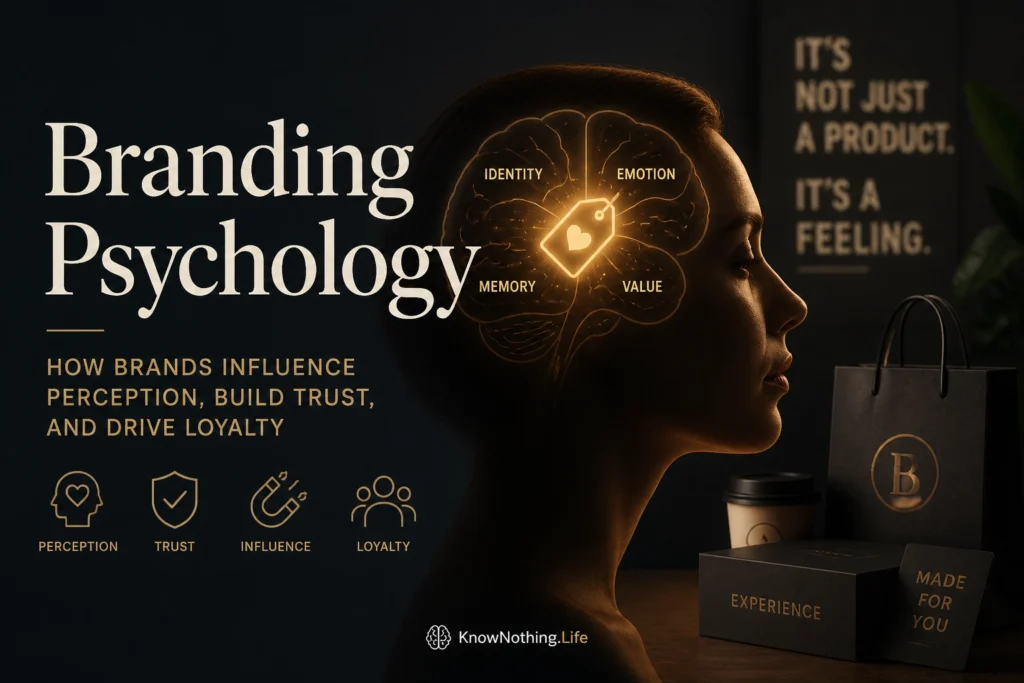
Branding psychology studies how brands become meaningful in the minds of consumers. A brand is not simply a logo, name, slogan, package, or color palette. Those elements matter, but they are only visible signs of a deeper psychological process. A brand is a network of associations that shapes how people recognize, remember, trust, evaluate, and emotionally respond to a product, company, person, or institution. When branding works, consumers do not experience a product as a neutral object. They experience it through expectation, memory, identity, emotion, and cultural meaning.
The study of branding psychology draws from consumer psychology, social psychology, behavioral economics, semiotics, and marketing theory. Philip Kotler’s Marketing Management helped define marketing as the creation and satisfaction of human needs, while Kevin Lane Keller’s work on customer-based brand equity emphasized that brand power exists in “what customers have learned, felt, seen, and heard” about a brand over time. Daniel Kahneman’s Thinking, Fast and Slow explains why intuitive judgments strongly influence consumer perception, and Robert Cialdini’s Influence shows how trust, authority, liking, and social proof shape persuasion. Branding psychology is therefore the study of how symbols become shortcuts, how names become feelings, and how repeated experiences become loyalty.
Brands as Mental Associations
A brand lives primarily in memory. Consumers recognize a brand because repeated exposure has created associations between its name and certain meanings. These associations may involve quality, price, status, safety, rebellion, simplicity, elegance, nostalgia, innovation, or belonging. A coffee brand may become associated with comfort and routine; a technology brand with creativity and progress; a clothing brand with confidence or exclusivity. The product itself matters, but the psychological meaning attached to the product often determines how it is perceived.
David Aaker’s Managing Brand Equity is central to this understanding. Aaker defined brand equity as a set of assets and liabilities linked to a brand’s name and symbols that add to or subtract from the value of a product. These assets include awareness, loyalty, perceived quality, and brand associations. The key insight is that brands create value beyond physical function. Two products may perform similarly, but the one with stronger brand associations can feel safer, more desirable, or more meaningful. Branding psychology explains why consumers often buy not only what a product does, but what the brand makes the product mean.
Attention, Recognition, and Memory
Before a brand can influence choice, it must be noticed and remembered. Attention is the entry point into consumer psychology. William James wrote in The Principles of Psychology that attention is “the taking possession by the mind” of one object among many. In modern markets, where consumers encounter thousands of messages, this insight is crucial. Branding must make something mentally available before it can become preferred. Logos, colors, sounds, packaging, slogans, and distinctive visual systems help brands cut through clutter and become recognizable.
Byron Sharp’s How Brands Grow emphasizes the importance of mental availability—the likelihood that a brand comes to mind in buying situations. From this perspective, branding is not only about deep emotional attachment; it is also about easy recall. A consumer standing in a store or scrolling online is more likely to choose a brand that feels familiar, fluent, and easy to process. Familiarity itself can produce trust because the brain often interprets ease of recognition as evidence of reliability. Branding therefore works partly by reducing cognitive effort. The remembered brand feels like the obvious choice.
Emotion and Brand Meaning
Emotion is central to branding because people rarely form lasting attachments to purely functional claims. A brand that only communicates features may inform consumers, but a brand that evokes feeling becomes memorable. Emotions such as joy, pride, nostalgia, security, aspiration, excitement, and belonging all shape brand preference. Ernest Dichter, one of the early figures in motivational research, argued in The Strategy of Desire that products often carry hidden emotional meanings. Consumers may give practical reasons for choosing a brand while being influenced by deeper emotional motives.
Emotional branding works because brands become connected to personal stories and life moments. A cereal brand may evoke childhood. A car brand may evoke freedom. A sports brand may evoke discipline and achievement. A skincare brand may evoke care, self-respect, or transformation. These emotional meanings do not arise from advertising alone; they develop through repeated experience, social exposure, cultural symbols, and memory. Strong brands become emotional containers. They hold feelings that consumers return to, sometimes without fully realizing why.
Identity, Self-Expression, and Belonging
Brands also help people construct and communicate identity. Consumers use brands to express who they are, who they want to be, and which groups they identify with. Russell Belk’s influential essay “Possessions and the Extended Self” argued that personal possessions can become part of the self. His famous phrase “we are what we have” captures the way objects participate in identity formation. Brands intensify this process by giving possessions symbolic structure. A plain shirt covers the body, but a branded shirt can signal lifestyle, taste, values, wealth, rebellion, or community.
This identity function is especially powerful in categories where products are visible to others, such as fashion, technology, cars, fitness, food, and lifestyle goods. Thorstein Veblen’s The Theory of the Leisure Class introduced the idea of “conspicuous consumption,” where goods are used to display status. In modern branding, status can be traditional luxury, but it can also be ethical awareness, minimalism, creativity, authenticity, or insider knowledge. A consumer may choose a brand not because it is objectively superior, but because it fits the story they want to tell about themselves.
Trust, Credibility, and Brand Consistency
Trust is one of the most valuable psychological assets a brand can build. Consumers face uncertainty whenever they buy. They wonder whether the product will work, whether the company is honest, whether the quality is reliable, and whether the purchase will feel worthwhile afterward. A trusted brand reduces perceived risk. It reassures the consumer before the product is even used. This is why consistency matters so much in branding. When a brand repeatedly delivers on its promise, consumers begin to rely on it as a shortcut for decision-making.
Robert Cialdini’s Influence helps explain why credibility matters. Principles such as authority, social proof, liking, and consistency all influence whether people accept a message. A brand with expert endorsements, strong reviews, clear values, and consistent behavior becomes easier to trust. But trust is fragile. If the brand’s promise and behavior diverge, consumers experience betrayal rather than ordinary disappointment. A low-expectation brand can fail mildly, but a trusted brand that violates its identity can damage the emotional contract it has built with its audience.
Storytelling and Narrative Branding
Humans understand meaning through stories. Branding psychology uses narrative to connect products with purpose, conflict, transformation, and identity. A brand story may describe humble origins, craftsmanship, innovation, rebellion against an industry, commitment to sustainability, or a mission to improve people’s lives. These stories give consumers a reason to care beyond price and features. They make the brand feel human, intentional, and memorable.
Jerome Bruner, in Actual Minds, Possible Worlds, distinguished between logical-scientific thinking and narrative thinking, arguing that stories are one of the primary ways people organize experience. Branding uses this narrative tendency by making a product part of a larger meaning structure. A running shoe is not only foam and fabric; it can become part of a story about discipline. A notebook is not only paper; it can become part of a story about creativity. A food brand is not only taste; it can become part of a story about family, nature, or tradition. The stronger the story, the easier it is for consumers to remember and repeat.
Social Proof, Culture, and Brand Communities
Brands gain power when they become social. People often look to others when deciding what is valuable, safe, fashionable, or trustworthy. Cialdini described social proof as the tendency to treat others’ behavior as evidence, especially under uncertainty. Reviews, testimonials, influencers, popularity rankings, word of mouth, and visible adoption all strengthen brand credibility. A brand used by people we admire or identify with becomes more appealing because it carries social validation.
Some brands go further and create communities. Brand communities form when consumers feel connected not only to the company but to other users. Albert Muniz and Thomas O’Guinn’s work on brand community showed that strong brands can foster shared rituals, traditions, and a sense of belonging. In these cases, consumers are not merely buyers; they become participants. They defend the brand, recommend it, interpret its meaning, and sometimes treat it as part of their social identity. This is one reason loyal customers can become more persuasive than advertising. They make the brand socially real.
Perceived Value and the Psychology of Price
Branding changes how consumers perceive value. A strong brand can make a product seem higher quality, more reliable, more fashionable, or more effective, even before the consumer directly evaluates it. This does not mean branding is always deceptive. Sometimes the brand reflects real quality and consistent performance. But branding does influence expectation, and expectation shapes experience. A meal may taste better in a respected restaurant. A product may feel more premium in elegant packaging. A service may feel more professional when its branding is clear and confident.
Kahneman and Tversky’s research on judgment helps explain this effect. Consumers use mental shortcuts when evaluating value, especially when they lack complete information. Brand reputation becomes a heuristic. Price also becomes a signal. A higher price may suggest exclusivity or quality, while a discount may create urgency or perceived savings. The psychology of branding and pricing are therefore inseparable. Brands do not merely tell consumers what something costs; they shape what the cost seems to mean.
Brand Loyalty and Habit
Brand loyalty develops when positive experience, trust, identity, and habit reinforce one another. Some loyalty is emotional: consumers genuinely prefer a brand and feel attached to it. Some loyalty is practical: the brand is convenient, familiar, and good enough. Some loyalty is habitual: the consumer repeats the purchase without reconsidering alternatives. Charles Duhigg’s The Power of Habit describes habit as a loop of cue, routine, and reward. In branding, the cue might be a need, a store aisle, a notification, or a daily routine; the routine is the purchase; the reward is satisfaction, ease, pleasure, or reassurance.
The strongest brands become default choices. Consumers do not re-evaluate them every time because the brand has already earned a place in memory and routine. This is valuable because repeated choice reduces marketing friction. However, loyalty must be maintained. A brand that stops delivering value, loses cultural relevance, or violates trust can be replaced. Branding psychology shows that loyalty is not a permanent possession. It is an ongoing relationship between expectation and experience.
Ethics and Manipulation in Branding
Because branding shapes perception and desire, it carries ethical responsibility. Branding can help consumers make sense of choices, identify quality, and connect with products that fit their needs. But it can also manipulate insecurity, exaggerate benefits, hide weaknesses, or manufacture artificial status. When brands use psychological insight to exploit fear, shame, urgency, or social comparison, persuasion becomes manipulation. This is especially concerning in categories related to health, finance, body image, children, and identity.
Ethical branding aligns promise with reality. It respects consumers by making meaning without deception. It builds trust through transparency, consistency, and genuine value rather than confusion or pressure. Branding psychology is most useful when it helps both businesses and consumers understand how influence works. For businesses, it encourages responsibility. For consumers, it encourages awareness. A person who understands branding can still enjoy brands, but with clearer insight into how symbols, emotions, and social meanings shape preference.
Conclusion
Branding psychology reveals that brands are not merely business tools; they are psychological structures. They organize memory, emotion, trust, identity, social influence, and perceived value. A successful brand does more than identify a product. It makes the product easier to recognize, easier to trust, easier to desire, and easier to incorporate into personal and cultural meaning.
In modern consumer culture, branding has become one of the main ways people encounter products, companies, and even themselves. It turns objects into symbols and choices into expressions of identity. Understanding branding psychology allows us to see why some brands endure, why others fade, and why consumers often feel strong attachments to things that seem ordinary on the surface. At its best, branding clarifies value and creates meaningful connection. At its worst, it manipulates perception. The task of branding psychology is to understand both possibilities with honesty, depth, and care.