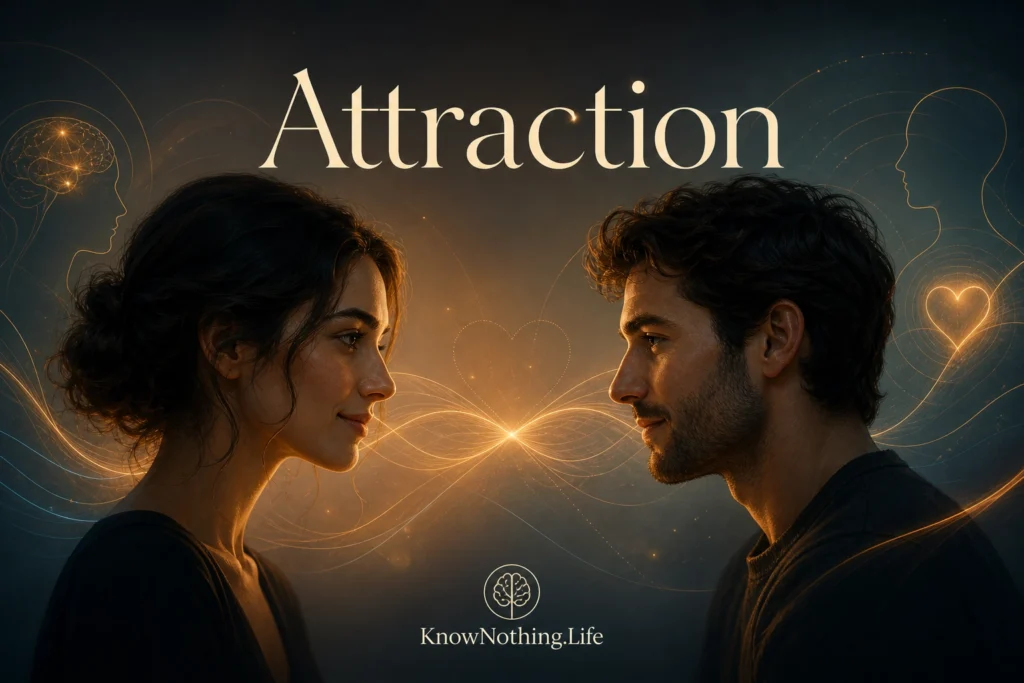
Attraction is one of the most powerful forces in human social life. It draws people toward friends, romantic partners, mentors, communities, ideas, and identities. At the simplest level, attraction can mean liking another person or feeling pulled toward them physically, emotionally, intellectually, or socially. Yet attraction is never only one thing. It can involve beauty, familiarity, similarity, chemistry, status, kindness, mystery, emotional safety, shared values, and unconscious associations. A person may be attracted to someone because of how they look, but also because of how they listen, how they make life feel, or how they reflect a possible version of the self.
Psychologists study attraction as part of interpersonal psychology, social psychology, evolutionary psychology, attachment theory, and relationship science. Classic research on interpersonal attraction examines how proximity, similarity, reinforcement, reciprocity, and physical appeal influence liking. Later theories of love, such as Robert Sternberg’s triangular theory, explain how attraction can develop into different forms of love through intimacy, passion, and commitment. Sternberg describes love as involving three major components: intimacy, passion, and decision or commitment, with different combinations producing different relationship patterns. Attraction is therefore not merely the beginning of romance. It is a broad psychological process through which people evaluate, approach, desire, bond with, and sometimes idealize others.
Physical Attraction and First Impressions
Physical attraction is often the most immediate form of attraction because appearance is quickly perceived. Facial symmetry, grooming, body language, style, movement, voice, posture, and facial expression can all shape first impressions. People often make rapid judgments before they know much about another person’s character or values. This does not mean attraction is shallow in a simple moral sense; it means that human perception is fast, embodied, and responsive to visible cues. The face and body communicate health, emotion, confidence, openness, and social identity before conversation begins.
Still, physical attraction is not fixed or purely biological. Culture shapes standards of beauty, and personal experience shapes what feels appealing or familiar. Someone may become more physically attractive to us after we associate them with kindness, humor, intelligence, or emotional safety. Likewise, someone visually striking may become less attractive if they seem cruel, arrogant, or unsafe. Attraction is therefore interpretive. The body may provide the first signal, but meaning determines how that signal develops.
Proximity, Familiarity, and Repeated Exposure
One of the most reliable findings in attraction research is the importance of proximity. People are more likely to form relationships with those they encounter regularly: classmates, coworkers, neighbors, friends of friends, or members of the same community. Proximity matters because it creates opportunities for interaction. A person cannot become attracted to someone they never meet, and repeated contact allows familiarity, comfort, and shared routine to develop. Many relationships begin not with dramatic passion, but with ordinary repeated presence.
The mere exposure effect helps explain why familiarity can increase liking. Repeated exposure often makes a person, place, song, face, or style feel easier to process, and ease can be mistaken for warmth or trust. This is why attraction can grow slowly. Someone who seemed neutral at first may become appealing after repeated conversations, shared tasks, or small moments of kindness. Familiarity does not guarantee attraction, especially if the repeated experiences are negative, but it creates the psychological conditions in which attraction can become possible.
Similarity and Shared Values
Similarity is another major factor in attraction. People are often drawn to those who share their values, interests, background, humor, beliefs, goals, or lifestyle. Similarity reduces uncertainty because it makes the other person easier to understand. It also provides validation. When someone shares our view of the world, we may feel more confident that our preferences and beliefs make sense. Similarity can support smoother communication, fewer conflicts, and a stronger sense of “we.”
However, similarity does not mean two people must be identical. Difference can create curiosity, growth, and excitement. The key distinction is between complementary difference and incompatible difference. A calm person may appreciate an energetic partner; a practical person may admire a creative one. But deep differences in ethics, life goals, emotional availability, or respect can make attraction unstable. Research reviews of interpersonal attraction have long treated similarity as a major area of study, while also noting that attraction depends on multiple variables rather than personality similarity alone.
Reciprocity and Being Chosen
People are often attracted to those who appear attracted to them. This principle is called reciprocity of liking. Being liked is rewarding. It makes people feel valued, seen, and safe enough to approach. When another person shows interest, warmth, attention, or admiration, attraction may increase because the relationship begins to feel possible. Uncertainty can create excitement, but complete uncertainty often produces anxiety. Mutual interest gives attraction a place to land.
Reciprocity also explains why rejection can be so painful. Attraction is not only desire for another person; it is also hope for mutual recognition. When that hope is refused, the person may feel not only disappointed but diminished. This is one reason unrequited attraction can be emotionally intense. It activates longing, comparison, fantasy, shame, and the desire to be chosen. Healthy attraction requires the ability to desire without entitlement. Another person’s interest cannot be forced, and mutuality is what separates connection from pursuit.
Reinforcement and Emotional Association
Attraction is strongly shaped by reinforcement. People tend to like those who make them feel good, safe, understood, admired, amused, or alive. A person associated with positive feelings becomes more attractive because the brain links them with reward. This does not mean attraction is calculated. Often the association is subtle: someone’s presence lowers anxiety, makes conversation flow, or brings out a more confident self. Over time, the person becomes emotionally rewarding.
Early reinforcement-affect models of attraction emphasized that positive affect can increase liking and that people may become attracted to others associated with rewarding experiences. This helps explain why context matters. People may feel attraction more strongly in exciting, beautiful, or emotionally charged settings because the feeling of the situation becomes attached to the person present. A shared adventure, difficult challenge, or moment of vulnerability can intensify attraction because the emotional state becomes part of the interpersonal memory.
Attachment and Romantic Attraction
Attachment theory helps explain why people are attracted not only to beauty or similarity, but to certain emotional patterns. John Bowlby’s attachment theory showed that early relationships shape expectations about safety, closeness, and dependence. In adulthood, those expectations can influence romantic attraction. Some people feel drawn to partners who are emotionally available and consistent. Others may feel intense attraction toward unavailable, unpredictable, or rejecting partners because those patterns feel familiar, even if painful.
This does not mean people are doomed to repeat early attachment wounds. It means that attraction can be shaped by old emotional learning. An anxiously attached person may confuse uncertainty with chemistry because inconsistency activates longing. An avoidantly attached person may feel attracted when distance is preserved but threatened when intimacy deepens. A securely attached person is more likely to experience attraction as both desire and safety. Attraction becomes healthier when people learn to distinguish genuine connection from nervous-system activation.
Passion, Love, and Long-Term Bonding
Attraction may begin with interest, desire, or chemistry, but it can develop into love when deeper elements are added. Robert Sternberg’s triangular theory is useful because it separates love into intimacy, passion, and commitment. Passion includes physical attraction, romance, and sexual desire; intimacy includes closeness, trust, and emotional sharing; commitment includes the decision to maintain the relationship. Sternberg’s model shows why attraction alone is not the same as lasting love. Passion may begin a relationship, but intimacy and commitment help sustain it.
Elaine Hatfield’s distinction between passionate and companionate love also clarifies attraction’s development. Passionate love is intense, emotionally charged, and often urgent, while companionate love is more stable, affectionate, trusting, and enduring. Hatfield’s work on passionate love and intimacy helped establish that romantic bonds change over time rather than remaining in the same emotional state forever. Long-term attraction often depends on whether partners can renew curiosity, maintain respect, create shared meaning, and remain emotionally responsive after the first intensity softens.
Culture and Attraction
Attraction is shaped by culture because cultures teach people what is desirable, appropriate, beautiful, masculine, feminine, romantic, respectable, or marriageable. In some societies, attraction is expected to lead romantic choice; in others, family compatibility, social status, religion, caste, class, or community expectations may weigh heavily. Even when people feel attraction as personal and private, their desires are often shaped by cultural stories about love, beauty, gender, success, and partnership.
Culture also affects how attraction is expressed. Some people communicate interest directly through words, touch, and explicit invitation. Others rely on indirect signals, restraint, family involvement, or slow relational development. Misunderstandings can occur when one person interprets another’s style through the wrong cultural frame. What looks like confidence in one setting may seem aggressive in another; what looks like modesty in one culture may be misread as lack of interest elsewhere. Attraction is universal in the broad sense that humans form preferences and bonds, but its expression is culturally patterned.
The Role of Mystery and Idealization
Attraction often contains imagination. In early attraction, people fill gaps in knowledge with hope, fantasy, and projection. A brief conversation, glance, or shared interest can become the basis for an imagined future. This imaginative quality is not always bad; it gives attraction energy and possibility. But idealization becomes risky when the imagined person replaces the real one. The attracted person may fall in love with a projection rather than a human being.
Psychoanalytic and psychodynamic perspectives emphasize that attraction can involve unconscious wishes, unmet needs, and old relational patterns. People may be drawn to someone who represents rescue, admiration, rebellion, security, or repair. Sometimes attraction reveals what a person values; other times it reveals what remains unresolved. Maturity in attraction requires curiosity about the real person. The question is not only “How do they make me feel?” but “Who are they, and can I know them truthfully?”
Digital Attraction and Modern Dating
Digital environments have changed attraction by transforming how people encounter, evaluate, and pursue one another. Dating apps, social media, messaging, video calls, and online communities allow people to meet beyond local proximity. They also encourage quick judgment based on photos, profiles, status signals, and curated identity. Attraction becomes partly algorithmic: shaped by swipes, matches, filters, prompts, and platform design.
Digital attraction can expand possibility, but it can also produce choice overload, comparison, disposability, and anxiety. When people are presented as endless options, it becomes easier to evaluate them like products rather than persons. At the same time, online communication can allow emotional intimacy to develop before physical meeting, especially when people share deeply through text or voice. Modern attraction is therefore paradoxical: it can be more immediate and more distant, more abundant and more fragile, more expressive and more curated.
Healthy Attraction
Healthy attraction is not simply intense attraction. Intensity can come from chemistry, anxiety, novelty, fear, fantasy, or instability. Healthy attraction includes desire, but also respect, consent, emotional safety, curiosity, and mutuality. It allows both people to remain fully human rather than turning one into an object, rescuer, prize, or solution. It does not require perfection, but it does require the ability to see clearly.
A mature psychology of attraction recognizes that desire should be listened to but not blindly obeyed. Attraction provides information: about preference, longing, values, wounds, needs, and possibility. But it must be interpreted. The most meaningful forms of attraction are those that deepen through knowledge rather than dissolve under it. They grow when admiration meets reality, when chemistry meets kindness, and when desire becomes connection.
Conclusion
Attraction is a complex psychological process involving perception, biology, familiarity, similarity, reciprocity, reinforcement, attachment, culture, and imagination. It can be physical, emotional, intellectual, romantic, sexual, social, or spiritual. It may begin quickly through appearance or chemistry, but it develops through interaction, meaning, and mutual recognition. Attraction is not merely something that happens to people. It is something shaped by memory, environment, culture, and the human need to be seen.
Understanding attraction helps explain why people are drawn to some individuals and not others, why desire can feel powerful, why familiar patterns repeat, and why love requires more than chemistry. Attraction opens the door, but what happens afterward depends on communication, character, timing, emotional availability, and shared reality. At its best, attraction is not only a pull toward another person. It is an invitation into deeper recognition: of the other, of oneself, and of the kind of connection that can make life more fully human.