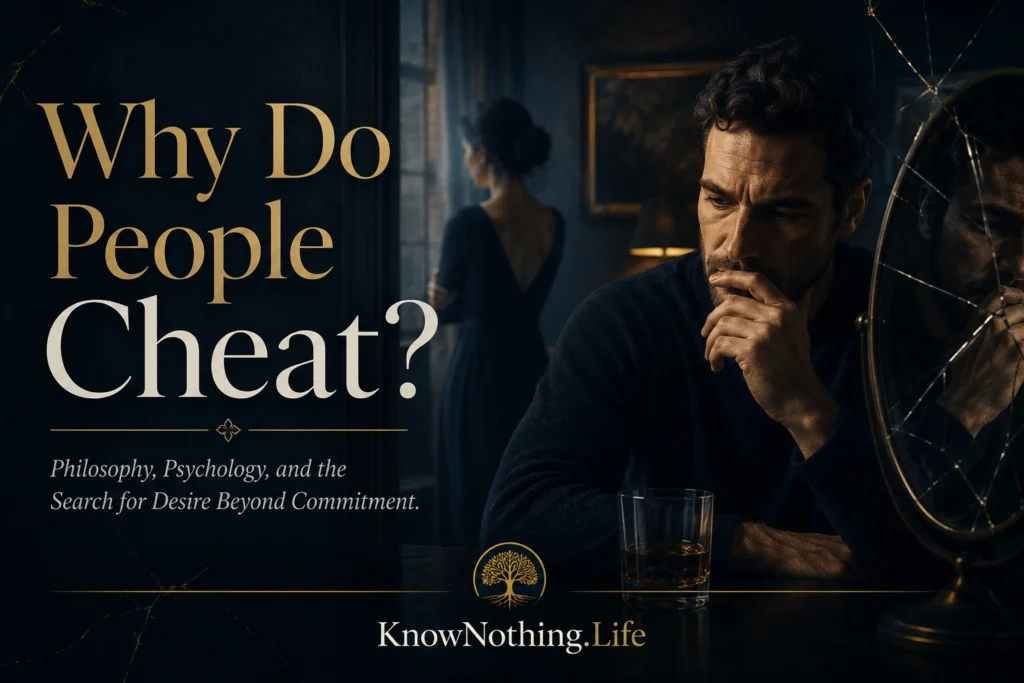
Cheating is one of the most painful forms of betrayal because it breaks more than a rule. It breaks the shared reality of a relationship. A partner who discovers infidelity often feels that the past has been rewritten: conversations, excuses, absences, affection, and promises suddenly mean something different. The injury is not only sexual or romantic. It is psychological. Cheating attacks trust, identity, memory, and the belief that one’s intimate life was being lived on honest ground.
People cheat for many reasons, and no single explanation fits every case. Some cheat because they feel neglected, lonely, resentful, bored, unseen, sexually frustrated, or emotionally starved. Others cheat because they crave novelty, validation, escape, power, revenge, or the feeling of being desirable again. Some affairs emerge from long-standing dissatisfaction; others happen in relationships that seem stable from the outside. Cheating may reveal a broken relationship, a divided self, a weak boundary, a hunger for aliveness, or a refusal to face consequences honestly. Understanding why people cheat does not excuse betrayal. It helps explain the psychological forces that make betrayal possible.
The Moral Meaning of Cheating
Philosophically, cheating is wrong because it violates a promise while secretly preserving the benefits of that promise. The cheater wants the security, loyalty, reputation, or emotional labor of the committed relationship while privately stepping outside its agreed boundaries. This creates an imbalance of knowledge and freedom. One partner is making choices based on reality; the other is making choices inside a false world. That is why betrayal often feels like theft. The betrayed person has been deprived of informed consent over their own life.
Immanuel Kant’s ethics are useful here. Kant argued that using people merely as means rather than as ends violates their dignity. Cheating does exactly that when a partner is kept in the dark so the cheater can maintain comfort, image, or access to both relationships. A consequentialist philosopher would focus more on harm: deception, emotional trauma, family disruption, disease risk, loss of trust, and the collapse of future security. Aristotle’s virtue ethics would ask what cheating does to character. A person who practices secrecy, rationalization, and double living may become less capable of courage, honesty, and self-command.
The Psychology of Desire and Novelty
One major reason people cheat is desire for novelty. Long-term relationships provide familiarity, safety, and emotional attachment, but desire often feeds on mystery, distance, uncertainty, and the feeling of being newly seen. Esther Perel, in Mating in Captivity and The State of Affairs, argues that modern couples often expect one relationship to provide what entire communities once supplied: security, passion, friendship, eroticism, identity, comfort, adventure, and meaning. She writes that “the victim of the affair is not always the marriage; it can also be the image we have of ourselves.” That insight matters because some people cheat not simply to find another person, but to find another version of themselves.
The affair can become a stage on which the person feels young, powerful, admired, free, or alive. This does not make the betrayal acceptable, but it explains why affairs can become emotionally intoxicating. They are often less about the affair partner as a full person and more about the psychological state created by secrecy, attention, risk, fantasy, and escape from ordinary responsibility. The cheater may say, “I felt like myself again,” when what they mean is, “I felt freed from the self I had become.”
Relationship Dissatisfaction and Emotional Neglect
Many people cheat because they feel emotionally or sexually deprived inside the relationship. They may feel ignored, criticized, controlled, undesirable, or lonely. Over time, resentment can grow into permission: “My needs have been neglected, so I deserve this.” This is one of the most common psychological pathways into infidelity. The person does not necessarily begin with the intention to betray. They begin with complaint, disappointment, fantasy, and small boundary crossings that gradually become larger.
Shirley Glass, author of Not “Just Friends”, emphasized that many affairs begin through emotional intimacy rather than immediate sexual intent. A private friendship becomes a confidant relationship. The person shares frustrations, receives sympathy, hides the intensity from their partner, and slowly builds a wall around the secret connection. Glass argued that healthy relationships need “walls and windows”: walls that protect the couple from outside intrusion, and windows of honesty between partners. Cheating often reverses this structure. The affair partner gets the window; the committed partner gets the wall.
Insecurity, Validation, and the Need to Feel Chosen
Cheating is often driven by insecurity. Some people seek affairs because they need proof that they are still attractive, powerful, wanted, or important. This motive is especially common when aging, rejection, failure, parenthood, career disappointment, or routine has weakened self-esteem. The affair becomes a mirror that reflects back desirability. The person may not want to leave their partner; they want to escape the shame of feeling ordinary, invisible, or unwanted.
This connects cheating to narcissistic injury, though not every cheater is narcissistic. A person who cannot regulate shame may seek external validation instead of facing internal emptiness. They may confuse being desired with being healed. But validation gained through betrayal is unstable. It requires secrecy, performance, and continued attention. Once the fantasy becomes real life, the same insecurities often return. The affair does not cure the wound; it distracts from it.
Attachment, Fear, and Self-Sabotage
Attachment theory also helps explain cheating. People with avoidant attachment may feel trapped by closeness and use affairs to create distance or preserve a sense of independence. People with anxious attachment may cheat out of fear, anger, protest, or the desperate need to feel wanted by someone when the primary relationship feels uncertain. In both cases, cheating becomes a dysfunctional attempt to regulate attachment distress.
Some people cheat when intimacy becomes too emotionally exposing. A stable relationship may require vulnerability, accountability, and being truly known. For someone who fears dependence or rejection, an affair can provide intensity without full responsibility. It offers closeness with an escape hatch. This is one reason cheating can be self-sabotaging: the person may destroy the very bond they fear losing because sustaining honest intimacy feels more frightening than secrecy.
Opportunity, Impulsivity, and Weak Boundaries
Not all cheating begins with deep unhappiness. Sometimes opportunity, impulsivity, alcohol, travel, workplace closeness, digital privacy, or poor boundaries create conditions where betrayal becomes easier. A person may not set out to have an affair, but they repeatedly choose situations that make one more likely. They flirt privately, hide messages, complain about their partner to someone attractive, or tell themselves nothing has happened yet. By the time the boundary is crossed, the emotional groundwork has already been laid.
Behavioral psychology would say that cheating can be shaped by reward. Attention feels good. Secrecy creates excitement. Risk intensifies desire. If the person gets away with small betrayals, the behavior may escalate. Social psychology also matters. People are more likely to cheat in environments where cheating is normalized, hidden, encouraged, or treated as a sign of status. A person’s values may be strong in theory but weaker in a context that rewards temptation and minimizes accountability.
What University Research Shows
Research supports the idea that infidelity has multiple motives. A study by Dylan Selterman, Justin Garcia, and Irene Tsapelas, published in The Journal of Sex Research, identified several common motivations for infidelity, including anger, sexual desire, lack of love, low commitment, esteem, situation, neglect, and variety. This research is important because it moves beyond the simple claim that people cheat only because something is wrong with the relationship. Sometimes the relationship is troubled; sometimes the person is seeking novelty, validation, revenge, or opportunity.
Evolutionary psychologists David Buss and Todd Shackelford studied susceptibility to infidelity in early marriage and connected infidelity risk to factors such as relationship dissatisfaction, sexual dissatisfaction, and mate-value concerns. Their work does not reduce cheating to biology, but it shows that jealousy, mate guarding, sexual desire, emotional dissatisfaction, and reproductive psychology have long been part of the human story. Cheating is morally judged by culture, but the temptations behind it are tied to ancient motives: desire, status, competition, attachment, and opportunity.
The Effects of Cheating
Cheating can produce intense psychological harm. The betrayed partner may experience shock, intrusive thoughts, anxiety, rage, humiliation, grief, self-doubt, and symptoms similar to trauma. They may question not only the partner but themselves: “Was I foolish? Was anything real? How did I not see it?” Betrayal is destabilizing because intimate trust is a basic emotional shelter. When the shelter becomes unsafe, the nervous system remains alert.
The cheater may also suffer, though differently. Guilt, shame, compartmentalization, fear of exposure, and identity conflict can become psychologically corrosive. A double life demands constant management. Lies must be remembered, emotions divided, and reality edited. Some cheaters become numb to this split; others collapse under it. Healing requires more than ending the affair. It requires truth, accountability, remorse, boundaries, and a willingness to understand the motive without hiding behind it.
Final Thoughts on Why People Cheat
People cheat because human beings are capable of desire without discipline, pain without honesty, and longing without courage. They cheat to feel alive, escape shame, punish a partner, avoid loneliness, seek novelty, prove desirability, regulate fear, or avoid confronting the truth of a relationship. Philosophy shows why cheating is morally serious: it violates trust, consent, dignity, and character. Psychology shows why it happens anyway: people are divided between values and impulses, love and resentment, security and desire, honesty and self-protection.
The most important point is that cheating is a choice, even when the motives are complex. Understanding the motive does not erase responsibility. A person can feel lonely and still choose honesty. They can feel tempted and still choose boundaries. They can feel unhappy and still choose a direct conversation, therapy, separation, or integrity. Cheating is often an attempt to solve an inner conflict by making someone else unknowingly pay the price. The healthier path is harder but cleaner: tell the truth before betrayal becomes the language of pain.