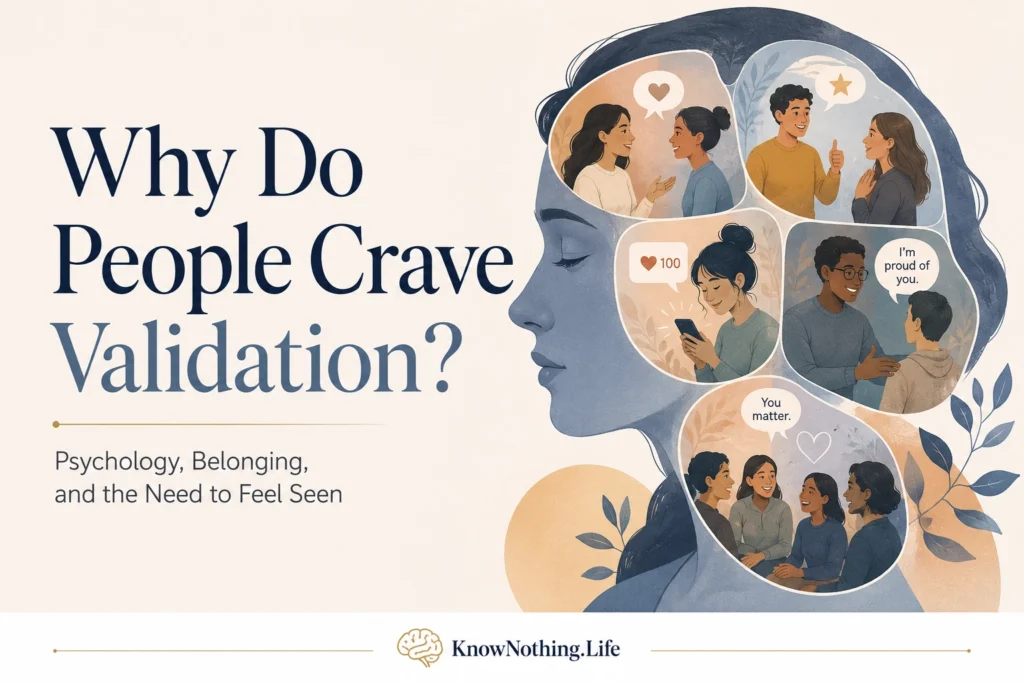
Validation is the experience of having one’s feelings, identity, actions, or worth recognized as meaningful by another person. It can be as simple as someone saying, “That makes sense,” “I understand why you feel that way,” or “You did well.” Human beings crave validation because they are not isolated minds sealed inside private worlds. From infancy, people learn who they are partly through how others respond to them. A baby cries and learns whether the world answers. A child shows a drawing and waits for delight. A teenager searches faces for approval or rejection. An adult posts, performs, confesses, argues, achieves, dresses, jokes, or explains partly because some part of the self still asks: “Do you see me? Do I matter?”
The craving for validation becomes unhealthy when external recognition becomes the main evidence of inner worth. Everyone needs some validation, but not everyone becomes dependent on it. Healthy validation confirms reality without replacing it. Unhealthy validation becomes emotional oxygen: praise, likes, admiration, reassurance, romantic attention, status, or agreement must keep arriving or the person begins to feel empty, ashamed, invisible, or unreal. The central problem is not wanting to be recognized. The problem is losing the ability to recognize oneself without constant confirmation from outside.
The Philosophy of Recognition
Philosophically, validation belongs to the larger question of recognition. G. W. F. Hegel made recognition central to self-consciousness in Phenomenology of Spirit. His famous struggle for recognition suggests that the self does not become fully itself alone. We become conscious of ourselves through relation to other conscious beings. To be ignored, degraded, or misrecognized is not merely unpleasant; it wounds the way a person exists socially. The human self is not just private inwardness. It is formed in the space between self-perception and the eyes of others.
Charles Taylor makes a similar point in “The Politics of Recognition,” where he writes that recognition is “a vital human need.” The word vital matters. Validation is not only vanity. People need others to confirm that their pain is real, their dignity matters, their identity is not absurd, and their presence counts. The danger, however, is that recognition can become captivity. If a person needs the world to validate every feeling, choice, appearance, belief, and achievement, then the self becomes dependent on an unstable audience. Philosophy asks for balance: we need recognition from others, but we also need enough inner grounding to survive its absence.
Validation and the Need to Belong
Psychology strongly supports the idea that validation is tied to belonging. Roy Baumeister and Mark Leary’s influential 1995 paper, “The Need to Belong,” argued that human beings have a fundamental motivation to form and maintain strong, stable interpersonal relationships. Their review concluded that belonging affects emotional patterns and cognitive processes, and that people readily form attachments and resist their dissolution. In other words, validation matters because social connection matters. Being accepted by others is not a decorative preference; it has deep roots in survival, development, and emotional regulation.
This helps explain why rejection feels so powerful. Validation tells the nervous system, “You are included.” Invalidating responses can signal the opposite: “You are alone, wrong, excessive, unwanted, or unsafe.” Naomi Eisenberger and Matthew Lieberman’s UCLA research on social exclusion found that social rejection activates brain regions associated with distress, including the anterior cingulate cortex, and that exclusion-related activity correlated with self-reported distress. Their work helped explain why people speak of rejection as painful: social pain and physical pain overlap in meaningful ways.
Childhood, Attachment, and Mirroring
The craving for validation often begins in early relationships. Children need caregivers not only to feed and protect them, but to mirror their inner states. When a child is frightened, the caregiver’s calm recognition teaches, “Your fear makes sense, and it can be managed.” When a child is proud, the caregiver’s delight teaches, “Your effort matters.” When a child is sad, comfort teaches, “Your pain is not too much.” Over time, these repeated experiences become internal structure. The child gradually learns to validate themselves because someone first validated them reliably.
When mirroring is inconsistent, conditional, dismissive, or frightening, the person may grow up hungry for external confirmation. They may doubt their emotions unless someone else agrees. They may feel valuable only when praised, attractive only when desired, competent only when admired, or lovable only when reassured. Psychoanalyst Heinz Kohut, founder of self psychology, argued that the developing self needs empathic mirroring and idealizable relationships. Without enough stable mirroring, the self may remain fragile, constantly searching for reflection from others to feel whole.
Self-Esteem and the Social Mirror
Mark Leary’s sociometer theory offers another powerful explanation. According to this view, self-esteem functions partly like an internal gauge of social acceptance. When people feel valued and included, self-esteem rises; when they feel rejected or excluded, it falls. This means the craving for validation is not random weakness. It is connected to an ancient social monitoring system. People care what others think because, historically, belonging to the group mattered for survival.
But the sociometer can become overactive. Some people constantly scan for approval, disapproval, silence, tone changes, delayed replies, facial expressions, and social comparison. A neutral response may feel like rejection. A small criticism may feel like collapse. A lack of praise may feel like failure. The person is not merely seeking compliments; they are trying to regulate social threat. Validation becomes a way to calm the fear that they are losing value in the eyes of others.
Contingent Self-Worth
Jennifer Crocker’s research on contingencies of self-worth helps explain why validation can become addictive. Crocker and colleagues found that college students often base self-esteem on specific domains such as academics, appearance, approval from others, competition, family support, virtue, or religious love. In one major study, the Contingencies of Self-Worth Scale measured seven sources of self-esteem among 1,418 college students, including approval from others, appearance, academics, and competition.
When self-worth is contingent, a person’s emotional stability depends on performance in the chosen domain. If worth depends on appearance, aging or comparison becomes threatening. If worth depends on achievement, mistakes become identity crises. If worth depends on approval, disagreement feels dangerous. This is why validation feels so urgent for some people. They are not simply enjoying praise. They are trying to keep the foundation of the self from shaking.
Social Media and Measurable Worth
Social media intensifies validation-seeking because it turns recognition into visible numbers. Likes, comments, shares, followers, views, and reactions create a public scoreboard of attention. The human longing to be seen is old, but modern platforms make it immediate, measurable, and endless. A person can now check, minute by minute, whether the world is responding. Silence becomes data. Popularity becomes quantified. Approval becomes addictive because it arrives unpredictably, like a reward machine.
This does not mean social media is inherently harmful. It can provide community, creativity, expression, and support. But it can also train people to experience themselves from the outside. Instead of asking, “Was this meaningful?” the person asks, “Did it perform?” Instead of feeling an emotion privately, they may feel pressure to package it for response. The danger is not only vanity. It is alienation from inner life. The self becomes a product looking for market confirmation.
The Difference Between Validation and Approval
Validation and approval are not the same. Validation means acknowledging that an experience is real, understandable, or worthy of consideration. Approval means agreeing with, praising, or endorsing it. A therapist can validate someone’s anger without approving destructive behavior. A friend can validate pain without agreeing with every interpretation. This distinction matters because many people crave approval when what they truly need is validation.
Marsha Linehan, the founder of dialectical behavior therapy, made validation central to her work with emotional dysregulation. DBT teaches that people can accept the reality of a feeling while still changing the behavior that follows it. In that sense, validation is not indulgence. It is contact with reality. When someone says, “Your pain makes sense,” the nervous system often becomes less defensive. Only then can responsibility become possible. People change more easily when they do not have to fight to prove that their feelings exist.
The Cost of Constant Validation-Seeking
Constant validation-seeking can damage relationships because it asks others to repeatedly stabilize the self. Reassurance may help briefly, but if the underlying insecurity remains, the person needs more reassurance soon after. This can create exhaustion for partners, friends, parents, and coworkers. The seeker may interpret fatigue as rejection, which increases the need for validation, creating a painful cycle.
It also weakens self-trust. If every decision requires approval, the person never develops confidence in their own judgment. If every feeling requires agreement, the person never learns emotional independence. If every achievement requires applause, satisfaction becomes impossible in private. A mature self still enjoys recognition, but it does not collapse without it. Inner validation is the ability to say, “This mattered,” even when no audience claps.
Final Thoughts on Why People Crave Validation
People crave validation because they are social, vulnerable, meaning-making beings whose identities develop in relationship. Philosophy shows that recognition is central to human selfhood. Psychology shows that validation is tied to belonging, attachment, self-esteem, emotion regulation, and social pain. The need to be seen is not shameful. It is human.
The danger begins when validation becomes the substitute for self-worth rather than the support of it. A person who cannot feel real without external confirmation becomes trapped in performance, comparison, reassurance-seeking, and fear of invisibility. The healthier path is not to reject validation, but to balance it. We need others to see us, but we also need to see ourselves clearly. We need praise sometimes, but we also need principles. We need belonging, but not at the cost of becoming strangers to our own inner life. Validation is most powerful when it reminds us of our worth, not when it becomes the only place our worth exists.