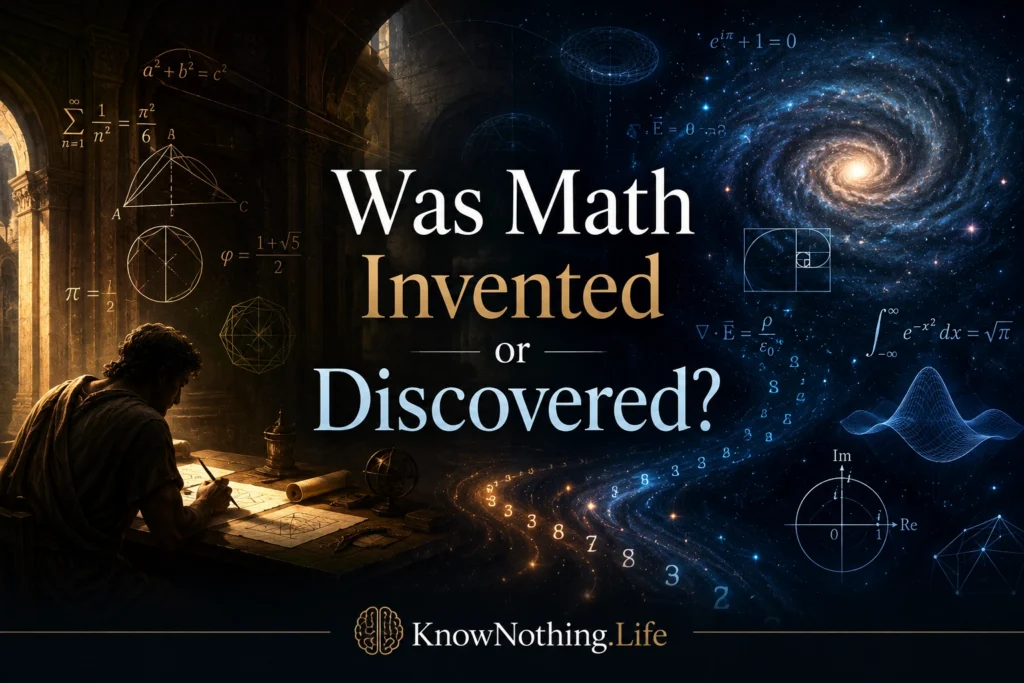
The question “Was math invented or discovered?” is one of the oldest and most fascinating problems in philosophy. At first, the answer may seem obvious. Human beings invented mathematical symbols, formulas, diagrams, textbooks, calculators, and notation systems. No triangle ever wrote down the Pythagorean theorem. No prime number carved itself into stone. Mathematics, as we study it in classrooms and publish it in journals, clearly involves human language, creativity, culture, and imagination.
Yet math also feels discovered. Two plus two equals four whether anyone likes it or not. The ratio of a circle’s circumference to its diameter existed before the Greek letter π was chosen to represent it. Prime numbers appear to have properties that no mathematician can change by vote, fashion, or opinion. When mathematicians prove a theorem, they often speak as if they have uncovered something that was already true. This is why mathematics sits in a strange place between invention and discovery. It is created by human minds, yet it often seems to reveal a structure deeper than human choice.
The Case for Discovery
The strongest argument for discovery is that mathematical truths appear objective. Once the rules are established, the conclusions are not optional. The angles of a Euclidean triangle add up to 180 degrees. There are infinitely many prime numbers. The square root of two is irrational. These truths do not depend on personal taste or historical era. A civilization may discover them earlier or later, describe them differently, or ignore them entirely, but the truths themselves seem to remain.
This view is often associated with Platonism, named after Plato. Plato believed that the world we see is changing, imperfect, and temporary, while true knowledge concerns eternal forms. Mathematical objects, in this view, are not physical things but abstract realities. A perfect circle does not exist in nature, because every drawn circle has flaws. But the concept of a perfect circle seems real to the mind. The Platonist therefore argues that mathematicians discover timeless truths in an abstract realm. They do not invent numbers any more than astronomers invent planets.
The Case for Invention
The strongest argument for invention is that mathematics depends on human-made systems. We invented numerals, algebraic notation, coordinate geometry, calculus symbols, set theory language, and computer algorithms. The number “7” is not the same as seven objects. The symbol is a cultural tool. Ancient Babylonians, Egyptians, Greeks, Indians, Chinese scholars, Islamic mathematicians, and modern Europeans all used different mathematical methods and notations. This history shows that mathematics is not simply handed to humanity fully formed. It develops through human creativity.
Even mathematical systems themselves may be invented. Euclidean geometry was long treated as the geometry of space itself. Then mathematicians such as Nikolai Lobachevsky, János Bolyai, and Bernhard Riemann developed non-Euclidean geometries in which the familiar rules changed. In some geometries, the angles of a triangle do not add up to 180 degrees. These systems are internally consistent, useful, and mathematically rich. Their existence suggests that mathematicians do not merely discover one fixed structure. They also invent frameworks and explore what follows from them.
The Power of Unreasonable Effectiveness
One of the deepest reasons this debate continues is that mathematics works so well in the physical world. Physicist Eugene Wigner famously described “the unreasonable effectiveness of mathematics” in the natural sciences. Equations can predict the motion of planets, the behavior of light, the structure of atoms, the growth of populations, and the curvature of spacetime. Mathematics developed in pure thought sometimes later becomes essential for describing reality. Riemannian geometry, once abstract, became central to Einstein’s general theory of relativity.
This effectiveness supports the discovery side. If math were only a human invention, why would it describe the universe with such precision? Why should equations created in the mind match the behavior of stars, particles, and black holes? The Platonist answer is that mathematics works because reality itself has mathematical structure. The universe is not merely being forced into human categories; it is revealing patterns that mathematics is uniquely suited to express.
Human Minds and Mathematical Tools
The invention side answers differently. Mathematics works because humans developed it in response to the world. Counting emerged from practical needs: herds, trade, calendars, land, architecture, astronomy, inheritance, taxation, and measurement. Geometry began with land surveying and construction. Arithmetic grew from exchange and recordkeeping. Probability developed partly through gambling and risk. Calculus emerged from problems involving motion, change, and accumulation. Humans invented mathematical tools because they helped us navigate a patterned world.
From this view, mathematics is like a map. A map is invented, but it is not arbitrary. It is useful because it corresponds to real terrain. Different maps can represent the same land for different purposes: road maps, weather maps, subway maps, elevation maps. Likewise, different mathematical systems can model different features of reality. The symbols are invented, the methods are refined, but the world constrains what works. Bad mathematics fails when applied to real problems. Good mathematics survives because it captures structure.
Formalism: Math as a Game of Rules
Another major view is formalism, associated with thinkers such as David Hilbert. Formalists argue that mathematics is a system of symbols manipulated according to rules. In this sense, mathematics resembles a game like chess. The pieces and rules are invented, but once the rules exist, certain moves are valid and others are not. Mathematicians do not need to believe that numbers exist in a mysterious abstract realm. They can treat mathematics as a formal structure.
Formalism explains why different mathematical systems can exist. Euclidean geometry, non-Euclidean geometry, classical logic, intuitionistic logic, set theory, and alternative axiomatic systems can all be studied as rule-governed structures. But formalism has a weakness: it can make mathematics seem too empty. Mathematicians often feel they are doing more than moving symbols. They experience proof as insight. They discover surprising relationships, hidden patterns, and unexpected necessities. A purely formal account may describe the surface of mathematics while missing its intellectual depth.
Intuitionism and the Role of the Mind
Intuitionism, associated with L. E. J. Brouwer, argues that mathematics is constructed by the mind. Mathematical truth is not something floating independently in an abstract universe; it is built through mental acts. From this view, a mathematical object exists only when it can be constructed or demonstrated. Intuitionists are often skeptical of certain kinds of proof that assert existence without showing how to construct the thing claimed.
This view emphasizes the human role in mathematics. Mathematical knowledge does not arrive from nowhere. It depends on intuition, imagination, and constructive reasoning. A child learning numbers is not merely looking at an invisible world of numbers; the child is building concepts. A mathematician working on a proof is not only receiving truth; they are actively forming pathways of thought. Intuitionism makes mathematics deeply human, but it still preserves rigor. It does not say mathematics is whatever we want. It says mathematical truth is grounded in disciplined construction.
History Shows Both Forces
The history of mathematics strongly suggests that invention and discovery are intertwined. Zero, for example, had to be invented as a symbol and concept within a place-value system, with major developments in Indian mathematics. But once zero entered mathematics, it revealed truths and methods that seemed waiting to be uncovered. Algebraic notation was invented, but algebra exposed relationships that were not matters of preference. Calculus was invented independently by Isaac Newton and Gottfried Wilhelm Leibniz, using different notation, but both were responding to real problems of motion and change.
This pattern repeats across mathematics. Humans invent a language, and then the language reveals a world. We invent coordinate systems, and suddenly geometry and algebra become linked. We invent imaginary numbers, and they later become indispensable in electrical engineering, quantum mechanics, and signal processing. We invent set theory, and it opens deep questions about infinity. The invention creates a doorway; the discovery begins once we walk through it.
Final Thoughts
So, was math invented or discovered? The best answer is that mathematical language is invented, but mathematical truth is discovered within the structures that language allows us to see. Humans invent symbols, definitions, axioms, diagrams, methods, and systems. But once those systems are established, their consequences are not under human control. No mathematician can decide that there are only finitely many prime numbers. No committee can make a false proof true. Mathematical creativity opens possibilities, but mathematical necessity pushes back.
Math is therefore both a human creation and a revelation of structure. It is invented in the way music, language, maps, and tools are invented. It is discovered in the way patterns, relationships, and consequences are discovered. The mystery is that the human mind, a product of nature, can create abstract systems that reach beyond immediate experience and describe reality with astonishing precision. Mathematics may be the place where invention and discovery meet: the mind builds the ladder, then climbs it and finds that the view was there all along.