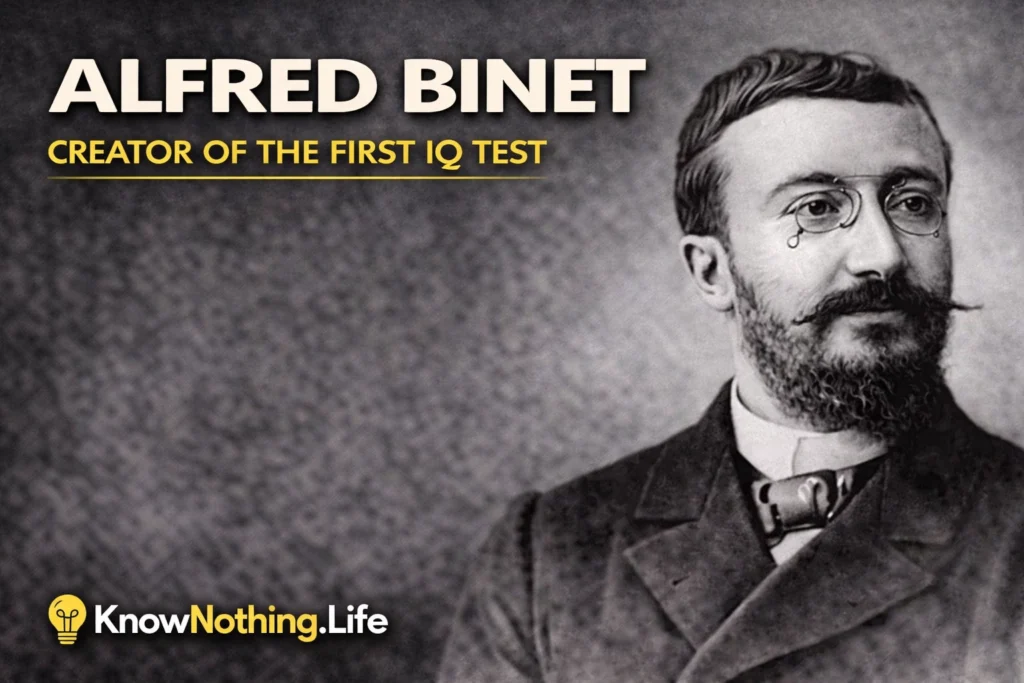
Few psychologists have shaped modern education, testing, and child psychology as deeply as Alfred Binet. Best known for creating the first practical intelligence test with Théodore Simon, Binet helped launch the modern era of psychological assessment. Yet his legacy is often misunderstood. He did not create intelligence testing to permanently label children, rank human worth, or reduce the mind to a single number. His original goal was far more practical and humane: to identify children who needed educational support so they could receive help rather than be dismissed as incapable.
Binet’s work stands at the crossroads of experimental psychology, education, child development, and psychometrics. His intelligence scale became the foundation for later IQ testing, including the Stanford-Binet Intelligence Scale in the United States, but Binet himself warned against treating intelligence as fixed or fully measurable. He believed the mind was complex, adaptable, and shaped by attention, judgment, effort, and instruction. This tension between Binet’s original purpose and the later uses of intelligence testing makes him one of the most important and debated figures in the history of psychology.
Early Life and Intellectual Formation
Alfred Binet was born in 1857 in Nice, France, and came to psychology through a path that was anything but direct. He first studied law and received his legal degree, but his interests soon shifted toward medicine, biology, philosophy, and the emerging scientific study of the mind. Unlike many academic psychologists of his era, Binet was largely self-directed, reading widely and developing his interests outside a conventional university career path. This independence helped shape the breadth of his later work.
Binet became fascinated by questions of perception, memory, attention, personality, and reasoning. His early work brought him into contact with Jean-Martin Charcot at the Salpêtrière Hospital in Paris, where hypnosis and hysteria were major subjects of investigation. Binet initially supported some of Charcot’s claims, but later recognized that several conclusions had been shaped by suggestion and expectation. That experience was important because it taught him caution. He became increasingly committed to observation, experiment, and the careful testing of assumptions rather than accepting fashionable theories too quickly.
Experimental Psychology in France
In the 1890s, Binet became associated with the psychological laboratory at the Sorbonne, where he helped establish experimental psychology in France as a serious scientific discipline. He later directed the laboratory and became one of the leading figures in French psychology. He also founded L’Année Psychologique, the first French journal devoted specifically to psychology, giving the field an important institutional foundation.
Binet’s research interests were unusually wide. He studied memory, suggestibility, personality, reasoning, children’s thinking, visual perception, and mental fatigue. He used pictures, puzzles, questions, objects, writing samples, and observational methods, showing a practical creativity that separated him from more abstract theorists. His psychology was not limited to adult laboratory subjects. He wanted to understand real minds in development, especially children learning under ordinary educational conditions.
Studies of Children and Individual Differences
Binet’s interest in children was deeply influenced by his observations of his two daughters, Madeleine and Alice. Through them, he studied attention, imagination, personality, and reasoning as living processes rather than fixed traits. He noticed that children differed not only in how much they knew, but in how they approached problems. Some were more verbal, some more visual, some more reflective, and some more impulsive. These observations helped him move toward a richer view of intelligence.
He became especially interested in individual differences, but he did not see differences as destiny. For Binet, intelligence involved practical judgment, adaptation, attention, and problem-solving. He famously described intelligence as involving “good sense, practical sense, initiative,” and “the faculty of adapting oneself.” This definition reveals how different his view was from later crude interpretations of IQ. Intelligence was not merely memory or school knowledge. It was the flexible use of the mind in meeting life’s demands.
The Binet-Simon Intelligence Scale
Binet’s most famous achievement began when the French government sought a method for identifying schoolchildren who needed special educational assistance. Working with physician Théodore Simon, Binet developed the first Binet-Simon scale in 1905, with later revisions in 1908 and 1911. The scale used tasks of increasing difficulty to estimate a child’s level of intellectual development. These tasks included memory, vocabulary, comprehension, attention, and problem-solving.
The brilliance of the Binet-Simon scale was its practical focus. It was not designed to measure innate worth. It was meant to identify children whose learning needs were not being met by ordinary schooling. Binet wanted assessment to serve education. The test was a diagnostic tool, not a final judgment. This distinction is essential because later versions of intelligence testing were often used in ways Binet himself would likely have resisted.
Mental Age and the Meaning of Intelligence
One of Binet’s major contributions was the idea of mental age. Instead of asking whether a child was simply “smart” or “not smart,” Binet compared a child’s performance to the typical performance of children at different ages. If a seven-year-old performed similarly to the average nine-year-old, the child could be said to have a mental age above chronological age. If performance resembled that of a younger child, the child might need additional support.
This concept later became central to IQ testing, especially after the scale was adapted by Lewis Terman at Stanford University. Yet Binet was cautious about the meaning of such scores. He warned, “The scale, properly speaking, does not permit the measure of intelligence.” By this, he meant that intelligence was too complex to be treated as a simple linear quantity. A score could be useful, but it should never be mistaken for the whole person.
Major Works and Scientific Contributions
Binet’s major works extended far beyond intelligence testing. La Psychologie du raisonnement explored reasoning and experimental approaches to thought. L’Étude expérimentale de l’intelligence examined intelligence through observation and experiment, especially in children. The Mind and the Brain, translated from L’Âme et le Corps, explored the relationship between mental and physical phenomena and showed Binet’s interest in deeper philosophical questions about consciousness.
He also wrote on suggestibility, personality, fatigue, perception, and education. This broad range matters because Binet was not merely a “test maker.” He was a psychologist of mental life in the fullest sense. His work helped establish psychology as an experimental science while keeping it connected to education, development, and practical human problems. He wanted psychology to be useful, but not simplistic.
Warnings Against Misuse
Binet’s greatest historical irony is that intelligence testing later became associated with fixed ranking, hereditarian claims, and exclusionary policies, especially in the United States. Binet had warned against exactly this kind of misuse. He rejected the idea that intelligence was an unchangeable quantity. He objected to what he called “brutal pessimism,” the belief that a child’s intellectual level could not be improved.
He believed education, practice, method, and encouragement could improve mental functioning. In one of his most important statements, he argued that with “practice, enthusiasm, and especially with method,” people could increase attention, memory, and judgment. This quote captures the humane center of his psychology. Testing should identify need, not limit possibility. Measurement should open doors, not close them.
Criticism and Later Debate
Modern psychologists have criticized intelligence testing for cultural bias, overreliance on numerical scores, and narrow definitions of ability. Some of these criticisms apply more directly to later IQ testing movements than to Binet’s original project. Still, Binet’s work began a tradition that would become powerful enough to shape schools, immigration policy, military classification, and employment systems.
The debate over Binet’s legacy remains important because it reveals the double edge of psychological measurement. A test can help identify children who need support, but it can also be misused to sort, stigmatize, or exclude. Binet understood this danger more clearly than many who followed him. His caution remains one of the most ethically important parts of his legacy.
Legacy and Lasting Influence
Alfred Binet died in Paris in 1911 while still revising his intelligence scale. Though his life ended relatively early, his influence became enormous. The Binet-Simon scale inspired the Stanford-Binet and helped establish intelligence testing as a major field in psychology. His work influenced educational assessment, developmental psychology, special education, and psychometrics.
Yet Binet’s true legacy is not simply the invention of a test. It is the idea that children’s minds can be studied scientifically in order to help them learn. He believed intelligence was complex, developmental, and improvable. He saw assessment as a tool for understanding, not a weapon for judgment. That vision remains deeply relevant in modern debates about testing, ability, and educational opportunity.
Final Thoughts
To study Alfred Binet is to study both the promise and danger of psychological measurement. He gave the world one of the most influential tools in educational history, but he also warned against misunderstanding that tool. His work reminds us that numbers can clarify, but they can also deceive when treated as final truths.
Binet’s greatest insight was that intelligence should never be separated from development, education, and human possibility. He wanted struggling children to be seen more clearly so they could be helped more effectively. In that sense, his legacy is not the cold ranking of minds, but the compassionate use of science to understand how minds grow.