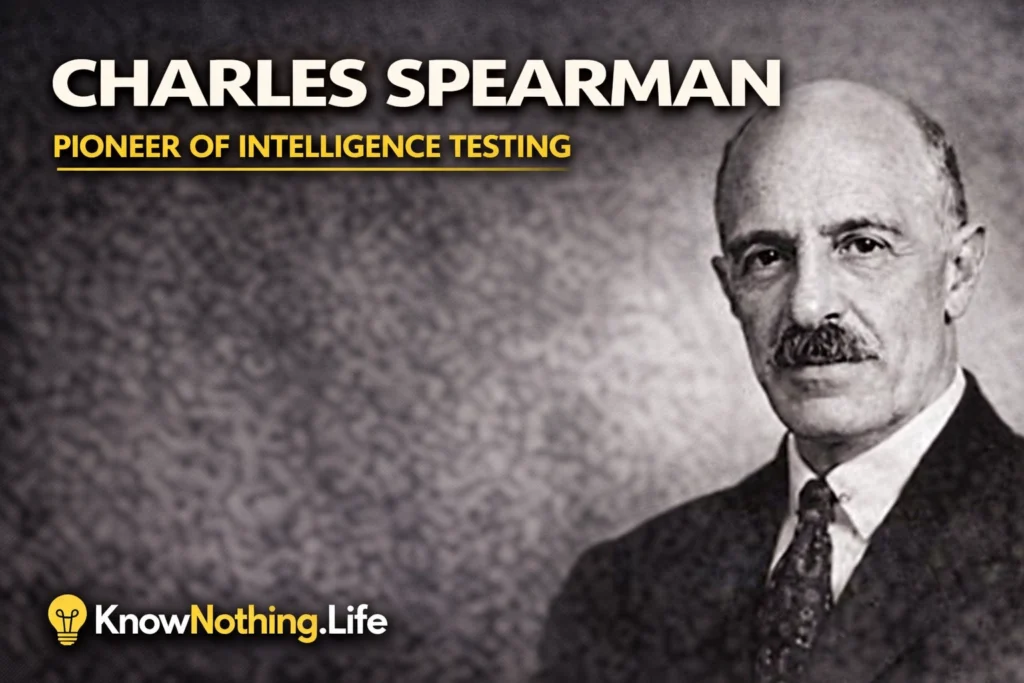
Few psychologists have shaped the science of intelligence as deeply as Charles Spearman. Best known for developing the theory of general intelligence, or the “g factor,” Spearman transformed psychology by applying statistics to one of its most difficult questions: why do people who perform well on one mental task often perform well on others? His answer was controversial, influential, and enduring. Beneath different intellectual skills, he argued, there appears to be a common mental factor that contributes to performance across many kinds of cognitive tasks.
Spearman’s work helped create modern psychometrics, factor analysis, and intelligence testing. He did not merely speculate about intelligence as philosophers had done for centuries. He tried to measure patterns in performance, analyze correlations, and infer the hidden structure of ability from data. His ideas influenced educational testing, occupational assessment, cognitive psychology, and debates about intelligence that continue today. Even critics of the g factor still work within a field partly shaped by the questions Spearman made unavoidable.
Early Life and Intellectual Formation
Charles Edward Spearman was born on September 10, 1863, in London, England. Unlike many psychologists who entered the field directly through university study, Spearman first spent many years in the British Army. His military career lasted from the 1880s into the late 1890s, but his intellectual interests gradually moved toward philosophy, psychology, and the scientific study of the mind. He came to believe that progress in philosophy required a stronger foundation in psychology, and that psychology itself needed more rigorous methods.
After leaving military service, Spearman studied in Germany with Wilhelm Wundt at the University of Leipzig, one of the great centers of early experimental psychology. Wundt’s laboratory represented a new model for studying the mind scientifically rather than only philosophically. Spearman absorbed this experimental spirit but added something distinctive: a fascination with mathematical relations among mental abilities. He wanted psychology not only to observe behavior but to uncover structure through statistical analysis.
The Problem of Intelligence
By the late nineteenth and early twentieth centuries, psychologists were increasingly interested in individual differences. Francis Galton had pioneered statistical approaches to human variation, while Alfred Binet was developing practical intelligence tests for identifying children who needed educational help. Yet the basic nature of intelligence remained unclear. Was intelligence one thing, many things, or merely a convenient word for unrelated abilities?
Spearman entered this debate with a statistical question. If school performance, sensory discrimination, memory, reasoning, and other abilities were truly separate, then high performance in one area should not necessarily predict high performance in another. But Spearman observed that cognitive abilities tended to correlate positively. People who did well on one kind of mental task often tended to do well on others. This pattern later became known as the positive manifold.
The positive manifold became the foundation of Spearman’s theory. He believed it pointed to a common factor operating across intellectual tasks. This did not mean all abilities were identical. A person might still be better at verbal reasoning than spatial tasks, or stronger in mathematics than language. But Spearman believed that underneath these differences was a general source of intellectual efficiency.
“General Intelligence,” Objectively Determined and Measured
Spearman’s most famous paper, published in 1904, was titled “‘General Intelligence,’ Objectively Determined and Measured.” The title itself captured his ambition. He placed “general intelligence” in quotation marks because the term was already vague and often used carelessly. Spearman wanted to move beyond loose description toward scientific measurement. He argued that intelligence should be studied through objective relations among test performances rather than through impressionistic judgment.
In this paper, Spearman introduced the basic logic that would become factor analysis. By examining correlations among different measures, he attempted to identify what they shared and what made each one unique. His conclusion was that performance on any mental test reflects two components: a general factor common to all intellectual tasks and a specific factor unique to that particular task.
This became known as Spearman’s two-factor theory. The general factor was labeled g, while task-specific abilities were labeled s. A person solving an arithmetic problem, for example, would draw upon general intelligence as well as specific numerical knowledge or skill. A person solving a vocabulary task would draw upon general intelligence as well as specific verbal knowledge. The elegance of this model made it one of the most influential theories in the history of intelligence research.
The Meaning of g
Spearman’s g factor became both famous and controversial because it seemed to suggest that intelligence has a central underlying core. He did not view g as identical to every form of talent, knowledge, or achievement. Rather, g was a statistical and psychological factor inferred from the way different cognitive tasks correlate. In The Abilities of Man, published in 1927, he gave his fullest account of the theory and described g as something like “mental energy.”
That phrase became one of the most quoted descriptions associated with his theory. By “mental energy,” Spearman did not mean intelligence was a simple physical substance that could be seen directly. He meant there appeared to be a general source of cognitive power influencing performance across tasks. He also distinguished between general intelligence and specific abilities, recognizing that individuals possess particular strengths that cannot be reduced entirely to g.
One of Spearman’s important ideas involved the “eduction of relations and correlates.” By this he meant the ability to perceive relationships, infer connections, and draw out meaning from complex material. This view made his theory more than a statistical claim. Spearman believed intelligence involved the mind’s capacity to discover structure, not merely memorize facts.
Major Works and Scientific Contributions
Spearman’s major works helped define psychometrics as a scientific field. His 1904 paper “‘General Intelligence,’ Objectively Determined and Measured” introduced the theory that made him famous. His later book The Nature of “Intelligence” and the Principles of Cognition developed his psychological interpretation of intelligence in greater depth. His most important and widely cited book, The Abilities of Man: Their Nature and Measurement, presented the mature version of his views on g, specific abilities, and the measurement of mental performance.
Spearman also wrote Psychology Down the Ages, a historical survey of psychological thought, and later contributed to Human Ability with L. W. Jones. Beyond intelligence theory, he made important statistical contributions, including Spearman’s rank correlation coefficient, a method still widely used for measuring association between ranked variables. This statistical legacy extends far beyond psychology into education, medicine, social science, and data analysis.
His importance lies not only in the conclusions he reached but in the methods he introduced. Spearman showed that psychological theories could be built from patterns in data. He helped move psychology toward mathematical modeling, measurement, and statistical inference. In that sense, he was not merely a theorist of intelligence. He was one of the architects of quantitative psychology.
Influence on Intelligence Testing
Spearman’s theory strongly influenced the development of intelligence testing throughout the twentieth century. If a general factor underlies many different tasks, then broad intelligence tests could be designed to estimate that factor. Later IQ tests often included diverse subtests—vocabulary, reasoning, memory, pattern recognition, arithmetic, and spatial tasks—partly because Spearman’s work suggested that different tasks can reveal a common cognitive dimension.
His ideas influenced later psychologists such as Raymond Cattell, who distinguished between fluid and crystallized intelligence, and John Carroll, whose three-stratum theory placed general intelligence at the top of a hierarchy of broad and narrow abilities. Even when later theories became more complex, many preserved Spearman’s basic insight that cognitive abilities are positively related.
At the same time, Spearman’s theory created lasting debate. If intelligence tests measure g, what exactly is g? Is it a real psychological capacity, a statistical abstraction, a biological property, or simply a pattern produced by schooling and culture? These questions remain central to intelligence research. Spearman did not end the debate over intelligence. He gave it its modern form.
Criticism and Debate
Spearman’s work faced criticism from the beginning. One of his most important critics was L. L. Thurstone, who argued that intelligence should be understood as multiple primary mental abilities rather than one dominant general factor. Thurstone identified abilities such as verbal comprehension, number ability, spatial visualization, memory, perceptual speed, and reasoning. Later theorists, including J. P. Guilford and Howard Gardner, also challenged unitary views of intelligence by proposing more pluralistic models.
Critics have also argued that intelligence tests may reflect educational opportunity, cultural familiarity, motivation, socioeconomic conditions, and test-taking experience. These criticisms are important because they show that the measurement of intelligence is never purely technical. It always carries ethical and social consequences. Spearman’s g factor may describe a real statistical pattern, but how that pattern should be interpreted remains contested.
Modern research often takes a more balanced view. Many psychologists accept that a general factor appears reliably in cognitive test data, while also recognizing that human intelligence includes specialized abilities, creativity, practical judgment, emotional understanding, cultural knowledge, and other dimensions not fully captured by g. Spearman’s theory remains powerful, but not complete.
Legacy and Lasting Influence
Charles Spearman died on September 17, 1945, but his influence remains deeply embedded in psychology. Every modern discussion of intelligence, IQ testing, cognitive ability, educational assessment, and psychometrics must in some way respond to his work. Whether researchers defend g, modify it, or reject it, they are still engaging with the intellectual problem Spearman clarified.
His legacy also lives in statistical methods. Spearman helped demonstrate that hidden psychological constructs could be inferred from patterns of correlation. This idea became central not only to intelligence research but to personality psychology, educational measurement, clinical assessment, and the social sciences more broadly. The modern use of latent variables owes much to the kind of thinking Spearman helped pioneer.
Perhaps his most lasting contribution was methodological courage. He attempted to bring mathematical precision to a subject that had long been dominated by vague language. Intelligence was difficult to define, but Spearman insisted difficulty was not an excuse for avoiding measurement. He believed psychology needed both theory and data if it hoped to become a mature science.
Final Thoughts
To study Charles Spearman is to study one of psychology’s most influential attempts to measure the hidden structure of the mind. His theory of g remains one of the most debated ideas in psychological science because it touches questions that are scientific, educational, philosophical, and ethical all at once. What is intelligence? Can it be measured? Is it one ability, many abilities, or both? What should society do with such measurements?
Spearman did not provide final answers to all these questions, but he gave psychology a framework that continues to shape them. His work reminds us that human ability is both measurable and mysterious, patterned and complex. In searching for the general factor of intelligence, Spearman changed not only how psychologists study ability, but how modern society thinks about the mind itself.