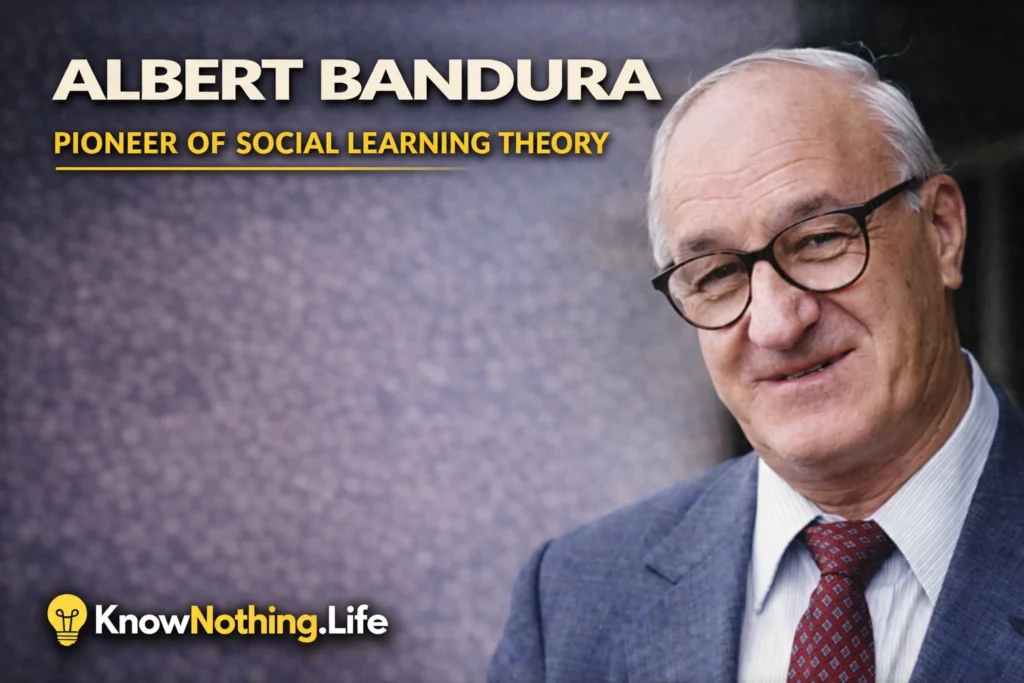
Albert Bandura was born on December 4, 1925, in Mundare, Alberta, Canada, a small farming community shaped by immigration, hard work, and limited formal educational opportunity. He was the youngest of six children, and his early life did not resemble the privileged path often associated with major academic figures. His parents had little formal schooling, but they encouraged independence, curiosity, and self-reliance. Those early conditions mattered because Bandura would later build one of psychology’s most influential theories around human agency: the idea that people are not merely shaped by the world, but also help shape the world they live in.
Bandura studied psychology at the University of British Columbia, graduating in 1949, then earned his master’s degree in 1951 and Ph.D. in clinical psychology in 1952 from the University of Iowa. He joined Stanford University’s psychology department in 1953 and remained associated with Stanford for nearly the rest of his career. At a time when behaviorism still dominated much of American psychology, Bandura helped redirect the field toward cognition, observation, self-regulation, and social influence. His career became a bridge between older learning theory and modern cognitive psychology, showing that human behavior cannot be explained by reward and punishment alone.
The Bobo Doll Experiments and Observational Learning
Bandura became famous through the Bobo doll experiments, a series of studies beginning in 1961 that examined how children learn aggressive behavior by watching adults. In these experiments, children observed an adult acting aggressively toward an inflatable doll. Later, when placed in a similar setting, many of the children imitated the aggressive actions they had seen. The importance of the research was not merely that children copied adults. It showed that learning can occur without direct reinforcement. A child does not always need to be rewarded for a behavior in order to acquire it; sometimes watching is enough.
This finding challenged the behaviorist assumption that learning depends primarily on direct conditioning. Bandura argued that much human behavior is learned socially, through models, symbols, expectations, and imitation. In Social Learning Theory, published in 1977, he wrote that “most human behavior is learned observationally through modeling.” That sentence became one of the clearest summaries of his contribution. People learn from parents, teachers, peers, celebrities, fictional characters, political leaders, and media figures. The social world is not just a background for behavior; it is a living classroom.
Social Learning Theory and Social Cognitive Theory
Bandura’s Social Learning Theory became one of the defining psychological works of the twentieth century. It explained how people acquire behaviors by observing others, but it also emphasized attention, memory, motivation, and expected consequences. A person must notice a model, retain what was observed, be able to reproduce the behavior, and have some reason to perform it. This made Bandura’s theory more sophisticated than simple imitation. Human beings do not copy everything they see. They interpret, select, rehearse, judge, and decide.
Bandura later expanded social learning theory into social cognitive theory, especially in Social Foundations of Thought and Action: A Social Cognitive Theory, published in 1986. This broader theory introduced reciprocal determinism, the idea that behavior, personal factors, and environment influence one another continuously. People are shaped by their surroundings, but they also choose environments, change situations, influence others, and regulate themselves. Bandura expressed this agentic view in the line, “People are producers as well as products of social systems.” That idea became central to education, therapy, health psychology, media studies, and organizational behavior.
Self-Efficacy and Human Agency
Bandura’s most influential concept may be self-efficacy, the belief that one can organize and carry out actions needed to manage situations and achieve goals. Self-efficacy is not the same as vague self-esteem or general confidence. It is specific, practical, and tied to action. A student may feel efficacious in math but not public speaking. An athlete may believe in their ability to train but doubt their ability to compete under pressure. A patient may understand medical advice yet lack confidence in their ability to change daily habits. Bandura showed that these beliefs strongly influence what people attempt, how long they persist, and how they respond to failure.
In Self-Efficacy: The Exercise of Control, published in 1997, Bandura developed this idea into a major theory of motivation and change. People with strong self-efficacy are more likely to approach difficult tasks as challenges rather than threats. They recover more quickly from setbacks because failure is interpreted as information, not identity. Bandura’s work helped explain why two people with similar abilities may perform very differently depending on what they believe they can do. His theory also gave psychology a practical language for growth: mastery experiences, social modeling, encouragement, and emotional regulation can all strengthen a person’s sense of agency.
Moral Disengagement and the Psychology of Harm
Bandura’s later work turned toward moral agency and the disturbing question of how ordinary people justify harmful behavior. In Moral Disengagement: How People Do Harm and Live with Themselves, published in 2015, he examined the psychological mechanisms that allow people to violate their own moral standards without feeling fully responsible. People may rename harmful conduct with cleaner language, shift blame to authorities, diffuse responsibility across a group, minimize consequences, or dehumanize victims. His famous line, “Where everyone is responsible, no one is really responsible,” captures the danger of collective evasion.
This work extended Bandura’s lifelong concern with agency. If people can regulate their actions, they can also selectively turn moral self-regulation off. Moral disengagement helped explain cruelty, corruption, institutional abuse, war, terrorism, corporate wrongdoing, and everyday unethical behavior. Bandura’s point was not that people are naturally evil. It was that social systems can make harmful conduct feel acceptable, necessary, distant, or anonymous. By studying those mechanisms, psychology could better understand how decent people become participants in destructive systems.
Major Works, Honors, and Lasting Legacy
Bandura’s major works include Adolescent Aggression, Social Learning and Personality Development with Richard Walters, Principles of Behavior Modification, Social Learning Theory, Social Foundations of Thought and Action, Self-Efficacy: The Exercise of Control, and Moral Disengagement. Across those works, his core argument remained consistent: people learn, act, and change within social systems, but they are not passive products of those systems. They observe, interpret, anticipate, regulate, imitate, resist, and create. His psychology gave scientific depth to the ordinary truth that people become themselves in relation to other people.
Bandura received many major honors, including the American Psychological Association’s Outstanding Lifetime Contribution to Psychology Award, the National Medal of Science, and numerous honorary degrees. He died on July 26, 2021, at the age of ninety-five. By then, his influence had spread far beyond psychology departments. His theories shaped education, parenting, therapy, public health, media research, leadership, social change campaigns, and moral psychology. Albert Bandura’s enduring legacy is the science of human agency. He showed that people are formed by example, strengthened by belief, guided by self-regulation, and morally responsible for the worlds they help create.