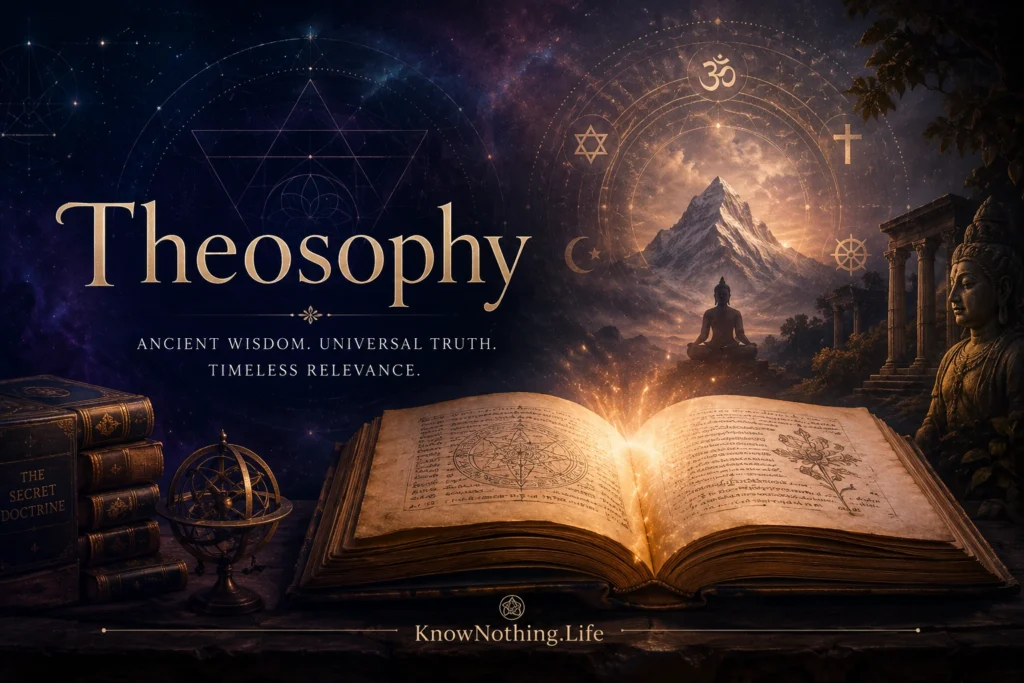
Theosophy is a modern esoteric movement built around the idea that all religions, philosophies, and sciences point toward a deeper spiritual wisdom underlying existence. The word itself comes from Greek roots meaning “divine wisdom,” and although the term appeared before the nineteenth century, it became globally influential through the Theosophical Society, founded in New York in 1875 by Helena Petrovna Blavatsky, Henry Steel Olcott, William Quan Judge, and others. From the beginning, Theosophy presented itself not simply as a religion, but as a synthesis of religion, philosophy, science, mysticism, and occult investigation.
At its heart, Theosophy claims that reality is far more layered than ordinary material experience suggests. Human beings are not merely physical organisms; they are spiritual beings evolving through many lives. Nature is not dead matter; it is alive with intelligence, law, and hidden order. Religions are not isolated systems of belief; they are partial expressions of a universal wisdom tradition. Theosophy became one of the most important bridges between Western occultism and Eastern religious ideas, helping introduce concepts such as karma, reincarnation, subtle bodies, chakras, and spiritual evolution to modern Western audiences.
Helena Blavatsky and the Birth of Modern Theosophy
The central figure in modern Theosophy is Helena Petrovna Blavatsky, often referred to as H. P. Blavatsky or simply HPB. Her first major work, Isis Unveiled (1877), attacked what she saw as the narrowness of both materialist science and dogmatic religion. The book argued that ancient traditions preserved fragments of a deeper wisdom lost or ignored by modern civilization. Blavatsky drew from Hermeticism, Neoplatonism, Hinduism, Buddhism, Kabbalah, Gnosticism, spiritualism, and occult philosophy, creating a sweeping system that claimed to reveal the hidden structure behind world religions.
Her most influential work, The Secret Doctrine (1888), became the foundational text of Theosophical thought. Subtitled The Synthesis of Science, Religion, and Philosophy, it presented a vast cosmology involving cycles of creation, root races, spiritual evolution, hidden masters, and the unfolding of consciousness through cosmic time. Blavatsky argued that humanity was part of a larger evolutionary drama, not merely biological but spiritual. In The Key to Theosophy (1889), she offered a more accessible explanation of Theosophical teachings, while The Voice of the Silence (1889) presented a mystical path of compassion, discipline, and inner awakening.
The Three Objects of the Theosophical Society
The Theosophical Society was organized around three major aims. The first was to form a nucleus of universal brotherhood without distinction of race, creed, sex, caste, or color. This goal was radical for its time because nineteenth-century religious, racial, colonial, and class divisions were intense. Theosophy argued that all human beings shared a spiritual origin and destiny. Whatever criticisms one may make of the movement, its emphasis on universal brotherhood became one of its most enduring ideals.
The second object was to encourage the comparative study of religion, philosophy, and science. Theosophy sought patterns across traditions rather than exclusive truth claims. It compared Christianity, Buddhism, Hinduism, Zoroastrianism, Platonism, Kabbalah, and other systems in search of a common wisdom. The third object was to investigate unexplained laws of nature and the latent powers in humanity. This opened the door to occultism, clairvoyance, astral planes, psychic phenomena, and hidden spiritual faculties. Theosophy therefore combined ethical universalism with metaphysical speculation and occult experimentation.
Core Beliefs: Karma, Reincarnation, and Spiritual Evolution
Theosophy teaches that the universe is governed by spiritual law. Karma, in this framework, is not merely punishment or reward but the moral law of cause and effect. Every thought, action, and intention contributes to the evolution of the soul. Reincarnation gives the soul repeated opportunities to learn, grow, balance past actions, and move toward higher consciousness. This understanding of karma and rebirth drew heavily from Indian religious traditions, though Theosophy adapted these ideas into its own esoteric system.
Spiritual evolution is one of Theosophy’s defining themes. Darwin’s theory of biological evolution had transformed nineteenth-century thought, and Theosophy extended evolution into the spiritual realm. Human beings were not only evolving physically, but also mentally, morally, and spiritually. Annie Besant, one of the movement’s most important later leaders, developed these ideas in works such as The Ancient Wisdom (1897) and Esoteric Christianity (1901). Besant presented Theosophy as a structured path of inner development, linking occult cosmology with ethics, service, and spiritual discipline.
Hidden Masters and Occult Knowledge
One of the most controversial Theosophical claims concerns the existence of hidden spiritual adepts, often called the Masters or Mahatmas. Blavatsky claimed that advanced beings such as Koot Hoomi and Morya guided the Theosophical movement and preserved ancient wisdom. A. P. Sinnett’s The Occult World (1881) and Esoteric Buddhism (1883) helped popularize these ideas, presenting Theosophy as a system of teachings transmitted from enlightened masters in the East.
To believers, the Masters represented humanity’s future: beings who had advanced beyond ordinary consciousness and worked for the spiritual evolution of the world. To critics, the Masters were unverifiable and became part of the controversy surrounding Blavatsky’s claims of occult phenomena. The debate over the Masters remains central to Theosophy’s reputation. For followers, they symbolize a hidden hierarchy of wisdom. For skeptics, they illustrate the movement’s tendency to make grand claims beyond historical or scientific proof.
Theosophy and Eastern Religion
Theosophy played a major role in introducing Western audiences to Hindu and Buddhist ideas, though not always in ways scholars today would consider accurate. Blavatsky and Olcott moved to India in 1879, and the Society established its international headquarters at Adyar, near Madras, in 1882. Henry Steel Olcott became especially important in the Buddhist revival in Sri Lanka. His Buddhist Catechism (1881) helped present Buddhism in a modern, organized, educational form and contributed to Buddhist reform movements under colonial rule.
At the same time, Theosophy has been criticized for appropriating and reinterpreting Asian traditions through a Western occult lens. Theosophists often claimed to reveal the hidden meaning behind Eastern religions, sometimes overriding the voices of actual practitioners. This creates a complicated legacy. Theosophy helped make Hinduism and Buddhism more visible in the West and supported anti-colonial spiritual renewal in some contexts. But it also reshaped those traditions according to esoteric assumptions, sometimes blending scholarship, imagination, and myth in ways that remain controversial.
Annie Besant, Leadbeater, and Later Developments
After Blavatsky’s death in 1891, Theosophy continued to evolve. Annie Besant became one of its most powerful figures, combining spiritual teaching with political activism, education, women’s rights, and Indian nationalism. Her writings, including The Ancient Wisdom and Thought Power, made Theosophical ideas more systematic and accessible. Besant’s public presence helped turn Theosophy into a major international movement.
Charles Webster Leadbeater also shaped later Theosophy through works such as The Astral Plane (1895), Man Visible and Invisible (1902), and The Chakras (1927). Leadbeater expanded the movement’s teachings on subtle bodies, clairvoyance, spiritual planes, and occult anatomy. His writings strongly influenced later New Age spirituality, especially ideas about auras, chakras, astral travel, and spiritual energy. Yet Leadbeater was also controversial, and his role in the movement created tensions that affected Theosophy’s credibility and internal politics.
Rudolf Steiner, Krishnamurti, and Theosophy’s Splits
Theosophy generated several important breakaway movements. Rudolf Steiner, originally a leader in the German section of the Theosophical Society, eventually separated and founded Anthroposophy in 1913. Steiner’s Theosophy: An Introduction to the Supersensible Knowledge of the World and the Destination of Man (1904) shows his early connection to Theosophical ideas, though he later developed a more Christ-centered esoteric system. His later work influenced Waldorf education, biodynamic agriculture, architecture, and spiritual science.
Another major turning point involved Jiddu Krishnamurti. Besant and Leadbeater promoted the young Krishnamurti as a potential “World Teacher,” and the Order of the Star in the East was formed around that expectation. In 1929, Krishnamurti dissolved the order and rejected the role assigned to him, declaring that truth is “a pathless land.” His break with organized Theosophy became one of the most dramatic moments in modern spiritual history. Krishnamurti went on to teach radical self-inquiry, freedom from authority, and direct perception outside institutions and dogma.
Influence on Art, Spirituality, and Modern Culture
Theosophy had a profound influence on modern spirituality, art, literature, and occultism. It helped shape the New Age movement long before the term existed. Its language of karma, reincarnation, universal wisdom, spiritual planes, hidden masters, subtle bodies, and evolving consciousness became part of modern alternative spirituality. Writers such as Alice Bailey, though later associated with her own esoteric system, inherited much from Theosophical concepts.
Theosophy also influenced modern art. Wassily Kandinsky, in Concerning the Spiritual in Art (1911), drew from esoteric and spiritual ideas circulating in Theosophical culture. Piet Mondrian was influenced by Theosophical thought in his search for spiritual order through abstraction. Theosophy’s idea that visible reality conceals deeper patterns appealed to artists seeking to move beyond representation into symbolism, geometry, color, and spiritual form.
Criticism and Historical Problems
Theosophy has always attracted criticism. Scholars and skeptics have challenged its historical claims, occult phenomena, racial theories, and use of Eastern traditions. Blavatsky’s claims about hidden masters and psychic powers were controversial in her own lifetime. Some of the movement’s teachings about “root races,” though framed as spiritual evolution rather than modern biological racism, are deeply troubling today and have been widely criticized.
Theosophy also mixed genuine comparative curiosity with speculative leaps. It often treated mythology, religion, science, and clairvoyant revelation as if they could be blended into one grand system. This gave the movement imaginative power, but also made it vulnerable to error. A balanced view must recognize both sides: Theosophy helped broaden Western spiritual imagination, but it also made claims that cannot be historically or scientifically verified.
Final Thoughts
Theosophy is best understood as a modern esoteric movement that tried to answer one enormous question: is there a hidden wisdom behind all religion, nature, and human life? Its answer was yes. Through Blavatsky’s Isis Unveiled and The Secret Doctrine, Besant’s The Ancient Wisdom, Olcott’s Buddhist work, Sinnett’s Esoteric Buddhism, Leadbeater’s occult writings, Steiner’s early Theosophical work, and Krishnamurti’s eventual rejection of spiritual authority, Theosophy became a major force in the history of modern spirituality.
Its legacy is mixed but undeniable. It promoted universal brotherhood, comparative religion, spiritual evolution, and the possibility that humanity is more than material existence. It also produced controversy, speculation, and teachings that require serious criticism. Theosophy’s enduring significance lies not in proving all its claims true, but in showing how powerfully modern people have searched for unity between science, religion, philosophy, and mystical experience. It remains one of the most influential attempts to construct a universal spiritual worldview for the modern age.