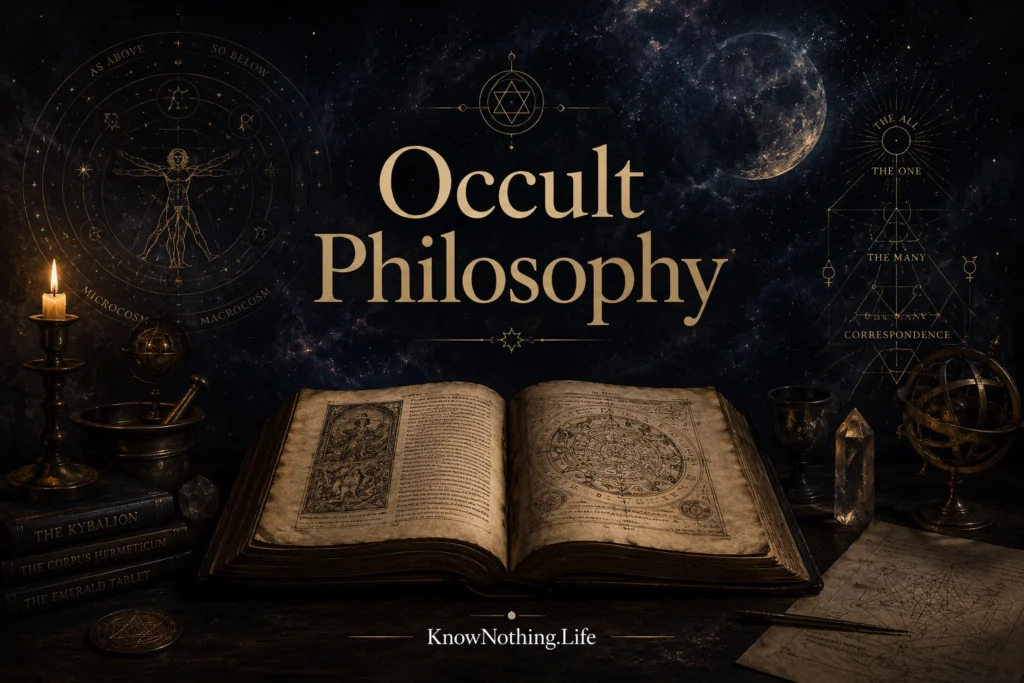
Occult philosophy is the study of hidden forces, symbolic correspondences, spiritual laws, and unseen dimensions of reality. The word “occult” comes from the Latin occultus, meaning hidden, concealed, or secret. In its older sense, occult knowledge did not simply mean dark magic or superstition. It referred to knowledge of things believed to be hidden beneath ordinary appearances: invisible causes, spiritual hierarchies, planetary influences, sacred numbers, divine names, symbolic patterns, and the mysterious relationship between mind, nature, and the cosmos.
To understand occult philosophy properly, it must be separated from modern clichés. Popular culture often treats the occult as horror, witchcraft, demons, secret cults, or forbidden rituals. Historically, however, occult philosophy was often practiced by scholars, theologians, physicians, astrologers, alchemists, natural philosophers, and mystics who believed the universe was alive with meaning. They did not see nature as dead matter governed only by mechanical laws. They saw it as a layered, symbolic, spiritually charged order in which visible things reflected invisible realities.
The Meaning of Occult Philosophy
Occult philosophy asks whether reality contains hidden structures that can be understood through symbolism, analogy, spiritual discipline, and esoteric interpretation. It assumes that the world has depth: what appears on the surface may be only the outer skin of a deeper order. A stone, plant, star, number, sound, color, or word may be more than itself. It may carry a symbolic or energetic relationship to other parts of the cosmos. This is the principle often summarized by the phrase “as above, so below,” associated with Hermetic thought.
In this worldview, the universe is interconnected. The human body mirrors the cosmos. The planets correspond to metals, organs, virtues, colors, and temperaments. Sacred names participate in divine power. Numbers express spiritual principles. Rituals are not merely performances; they are symbolic acts meant to align the human soul with larger realities. Whether one accepts these claims or not, occult philosophy is best understood as a theory of correspondences. It seeks meaning through patterns that connect the visible and invisible worlds.
Hermeticism and Ancient Wisdom
One of the most important roots of occult philosophy is Hermeticism, a spiritual and philosophical tradition associated with Hermes Trismegistus, a legendary figure blending the Greek god Hermes and the Egyptian god Thoth. Texts such as the Corpus Hermeticum presented a universe shaped by divine mind, spiritual ascent, cosmic sympathy, and hidden wisdom. Renaissance thinkers believed these writings preserved ancient Egyptian or primordial theology, though modern scholarship dates them to the early centuries of the Common Era.
Hermeticism taught that the human being is a microcosm of the macrocosm. To know oneself deeply was also to know the structure of reality. This idea influenced later magic, alchemy, astrology, and mystical philosophy. The Hermetic imagination did not sharply separate religion, philosophy, and science. It treated knowledge as transformation. The purpose of wisdom was not only to describe the world but to elevate the soul.
Neoplatonism and the Chain of Being
Neoplatonism also shaped occult philosophy profoundly. Plotinus, the great third-century philosopher, taught that all reality flows from “the One,” a transcendent source beyond ordinary being. From the One emanate intellect, soul, and the material world. Later Neoplatonists such as Iamblichus emphasized theurgy, sacred ritual intended to unite the soul with divine powers. This gave philosophical dignity to certain forms of ritual and symbolic practice.
The Neoplatonic universe was hierarchical and alive. Everything existed within a great chain of being, from the divine source to angels, planetary intelligences, souls, animals, plants, minerals, and matter. Occult philosophy inherited this layered cosmos. It imagined the world as a ladder of correspondences, where lower things reflected higher things. Magic, in this framework, was not necessarily rebellion against religion. For many Renaissance thinkers, it was a disciplined attempt to understand and work within divine order.
Kabbalah and Sacred Language
Jewish Kabbalah also became central to Western occult philosophy, especially after Christian scholars encountered and reinterpreted it during the Renaissance. Kabbalah explores the hidden dimensions of scripture, divine names, creation, and the ten sefirot, or emanations through which divine reality is expressed. Works such as the Sefer Yetzirah and the Zohar shaped Jewish mystical thought, while Christian Kabbalists such as Giovanni Pico della Mirandola and Johannes Reuchlin adapted Kabbalistic ideas into Christian esotericism.
For occult philosophers, Kabbalah suggested that language itself could be sacred. Letters, names, numbers, and words were not arbitrary signs; they could reveal divine structure. This idea deeply influenced ceremonial magic, angelology, numerology, and mystical interpretation. The belief that names have power appears in many traditions, but in Western occult philosophy it became especially tied to Hebrew letters, divine names, and symbolic systems of creation.
Agrippa and the Great Synthesis
The most famous Renaissance work on occult philosophy is Heinrich Cornelius Agrippa’s Three Books of Occult Philosophy, first published in the sixteenth century. Agrippa attempted to organize magic into a grand intellectual system. His three books corresponded broadly to natural magic, celestial magic, and ceremonial or divine magic. Natural magic dealt with hidden properties in plants, stones, animals, and physical substances. Celestial magic concerned stars, planets, astrology, and cosmic influence. Ceremonial magic dealt with divine names, spirits, angels, and religious ritual.
Agrippa’s work is important because it shows occult philosophy at its most systematic. He drew from Hermeticism, Neoplatonism, Kabbalah, astrology, alchemy, Christianity, and classical philosophy. For Agrippa, the true magician was not merely a sorcerer but a learned philosopher-priest who understood nature, mathematics, theology, and spiritual discipline. Magic was framed as knowledge of the hidden bonds connecting the cosmos. This synthesis made Agrippa one of the most influential occult thinkers in Western history.
Alchemy and Inner Transformation
Alchemy is often remembered as the attempt to turn base metals into gold, but occult philosophy interpreted alchemy more deeply. The transformation of lead into gold could also symbolize the purification of the soul. Matter and spirit were not separate worlds but interwoven levels of one reality. The alchemist’s laboratory was therefore both physical and symbolic: furnaces, vessels, acids, metals, and colors represented stages of transformation.
Paracelsus, the sixteenth-century physician and alchemical thinker, helped connect medicine, astrology, chemistry, and occult philosophy. He believed that nature contained hidden signatures indicating the healing properties of plants and minerals. This “doctrine of signatures” reflected a central occult assumption: visible forms reveal invisible purposes. Although modern science rejects many alchemical theories, alchemy contributed to the history of chemistry, medicine, symbolism, and depth psychology. Carl Jung later interpreted alchemy as a symbolic expression of psychological transformation, especially in works such as Psychology and Alchemy.
Astrology and Cosmic Correspondence
Astrology was historically one of the major branches of occult philosophy. Ancient and medieval thinkers often believed that celestial bodies influenced earthly events, human temperaments, health, politics, and fate. The planets were not simply rocks or lights in the sky; they were symbolic powers. Mars corresponded to conflict, iron, heat, aggression, and courage. Venus corresponded to love, beauty, attraction, and harmony. Saturn represented limitation, melancholy, time, and discipline.
Modern astronomy separated itself from astrology, and astrology is not accepted as a science by the scientific community. Yet historically, astrology played a major role in medicine, politics, agriculture, and philosophy. Its significance in occult thought lies in its model of cosmic relationship. It assumes that human life is embedded in a larger celestial order. Even when rejected scientifically, astrology remains culturally influential because it offers symbolic language for personality, timing, fate, and self-understanding.
Magic as Philosophy, Not Mere Spellcraft
In occult philosophy, magic is not merely spellcasting. It is the theory that hidden relationships can be understood and activated through knowledge, symbol, imagination, ritual, and will. Renaissance thinkers sometimes distinguished between natural magic, which studied hidden properties of nature, and demonic or illicit magic, which was condemned as dangerous or corrupt. This distinction mattered because many learned magicians wanted to defend their work as philosophical and religious, not diabolical.
Marsilio Ficino, in works such as Three Books on Life, explored music, spirit, planets, and imagination as part of a cosmic medicine of the soul. Pico della Mirandola defended certain forms of magic and Kabbalah as paths toward divine knowledge. For these thinkers, the magician was not a stage performer but a mediator between worlds: someone who understood how symbols, nature, soul, and cosmos reflected one another.
Modern Occult Revival
Occult philosophy did not disappear with the rise of modern science. It transformed. In the nineteenth century, figures such as Éliphas Lévi revived ceremonial magic, tarot symbolism, and esoteric interpretation. His works, including Dogme et Rituel de la Haute Magie, shaped the modern image of the magician and influenced later occult orders. The Hermetic Order of the Golden Dawn, founded in the late nineteenth century, blended Kabbalah, tarot, astrology, alchemy, Enochian magic, and ritual symbolism into a powerful modern esoteric system.
Aleister Crowley, one of the most controversial occultists of the twentieth century, emerged from this milieu and developed Thelema, expressed in works such as The Book of the Law and Magick in Theory and Practice. Meanwhile, Theosophy, founded by Helena Blavatsky and others, blended occult philosophy with Eastern religion, spiritual evolution, and esoteric cosmology. These movements helped shape modern alternative spirituality, New Age thought, ritual magic, tarot culture, and contemporary esotericism.
Criticism and the Scientific Challenge
Occult philosophy has always faced criticism. Religious critics condemned it as dangerous, prideful, or spiritually illicit. Scientific critics rejected its claims as untestable, symbolic, or unsupported by empirical evidence. Many occult systems rely on analogy and correspondence rather than experiment and measurement. To modern science, the claim that planets, metals, colors, letters, and emotions are linked through hidden forces requires evidence that occult philosophy often does not provide.
Yet dismissing occult philosophy entirely can also miss its historical importance. It influenced early modern science, medicine, art, literature, psychology, and religious imagination. Many early scientists lived in a world where natural philosophy, alchemy, astrology, theology, and magic overlapped. Occult philosophy belongs to the history of humanity’s attempt to understand invisible order before the modern division between science, religion, psychology, and art became firm.
Final Thoughts
Occult philosophy is the study of hidden order. It asks whether nature is symbolic, whether the universe is spiritually structured, whether mind and cosmos mirror one another, and whether ancient traditions preserve forms of wisdom forgotten by ordinary consciousness. Its major sources include Hermeticism, Neoplatonism, Kabbalah, alchemy, astrology, Renaissance magic, and modern esotericism. Its major figures include Hermes Trismegistus, Plotinus, Iamblichus, Marsilio Ficino, Pico della Mirandola, Johannes Reuchlin, Heinrich Cornelius Agrippa, Paracelsus, Éliphas Lévi, Helena Blavatsky, and Aleister Crowley.
Whether one sees occult philosophy as wisdom, symbolism, speculation, or error, it remains one of the most influential currents in Western intellectual history. It gave people a way to imagine the universe as meaningful rather than mechanical, interconnected rather than fragmented, alive rather than dead. Its claims should be examined critically, but its questions remain powerful. What lies beneath appearances? Is reality only what the senses reveal? Are symbols merely human inventions, or do they point toward deeper patterns? Occult philosophy begins where ordinary explanation ends: with the suspicion that the visible world may not be the whole world.