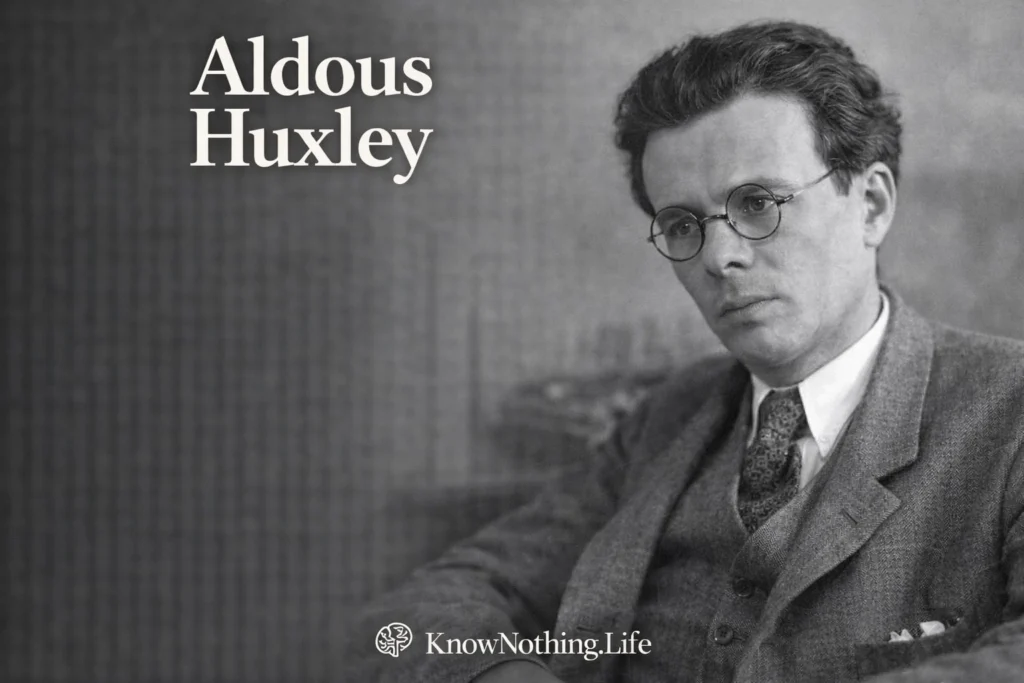
Aldous Leonard Huxley was born on July 26, 1894, in Godalming, Surrey, England, into one of Britain’s most distinguished intellectual families. His grandfather, Thomas Henry Huxley, was the famous defender of Darwin’s theory of evolution, while his great-uncle Matthew Arnold was a major poet and cultural critic. His father, Leonard Huxley, was a writer and editor, and his brother Julian Huxley became a noted biologist. From childhood, Aldous inherited a world where literature, science, religion, and public argument were not separate pursuits, but parts of a single intellectual life.
Huxley’s youth was marked by brilliance and suffering. He studied at Eton, where he intended to pursue medicine or science, but a severe eye illness in adolescence left him nearly blind for a time and permanently weakened his vision. This changed the direction of his life. Unable to follow a conventional scientific career, he turned toward literature, studying at Balliol College, Oxford. The experience of damaged sight never left him. It sharpened his fascination with perception, consciousness, and the fragile difference between what people see and what they think they see.
The Satirist of Modern Civilization
Huxley first became known as a novelist and social satirist. His early works, including Crome Yellow, Antic Hay, Those Barren Leaves, and Point Counter Point, dissected the cleverness, boredom, vanity, and spiritual emptiness of the educated classes between the world wars. He wrote with wit, irony, and intellectual range, filling his fiction with artists, scientists, aristocrats, cynics, mystics, and talkers who often understood too much and felt too little. His early fiction made him one of the sharpest observers of modern disillusionment.
Yet Huxley was more than a comic novelist of manners. Even in his satire, he was asking whether intelligence alone can save human beings from confusion, cruelty, and triviality. His characters often possess brilliant minds but unstable souls. They can analyze culture, art, politics, and desire, yet fail to live wisely. This tension became central to Huxley’s career. He distrusted stupidity, but he also distrusted intellect when it becomes detached from compassion, discipline, and spiritual seriousness. His famous line from Texts and Pretexts—“Experience is not what happens to a man; it is what a man does with what happens to him”—captures that lifelong concern with transformation rather than mere cleverness.
Brave New World and the Nightmare of Happiness
Huxley’s most famous book, Brave New World, was published in 1932 and became one of the defining dystopian novels of the twentieth century. Unlike George Orwell’s later Nineteen Eighty-Four, which imagined domination through surveillance, fear, and punishment, Huxley imagined a society controlled through pleasure, conditioning, distraction, drugs, consumption, and engineered satisfaction. The citizens of the World State are not tortured into obedience. They are trained to love their own servitude. They are kept comfortable enough that freedom begins to feel unnecessary.
The novel’s power lies in its disturbing insight that tyranny does not always arrive with boots and prisons. Sometimes it arrives as entertainment, convenience, promiscuity without intimacy, happiness without truth, and stability without soul. Huxley understood that modern power could operate not only by forbidding pain, but by removing the conditions for depth. In Brave New World, the character Helmholtz says, “Words can be like X-rays if you use them properly.” That line could describe Huxley’s own art. He used fiction to pierce through the surface of progress and ask what kind of human being a technological civilization was producing.
Essays, Pacifism, and Moral Inquiry
During the 1930s and 1940s, Huxley increasingly turned toward essays, politics, pacifism, religion, and moral philosophy. Works such as Ends and Means, The Olive Tree, Grey Eminence, Science, Liberty and Peace, and The Perennial Philosophy show a writer searching for more than satire. The collapse of Europe, the rise of totalitarianism, and the threat of war pushed Huxley toward urgent questions: Can civilization survive without spiritual discipline? Can science serve liberty rather than domination? Can human beings become less violent without becoming naïve?
Huxley’s pacifism was controversial, especially during the age of fascism, but it was part of a larger moral project. He wanted to understand how inner disorder becomes public catastrophe. He became interested in mysticism, Vedanta, meditation, nonviolence, and the possibility of transforming consciousness. His religious interests were not narrow sectarian beliefs. In The Perennial Philosophy, he explored the idea that many spiritual traditions point toward a common core of wisdom: humility, self-knowledge, compassion, and direct awareness of reality beyond ego. Whether one accepts his conclusions or not, this period reveals Huxley’s seriousness. He was no longer only mocking modern emptiness; he was looking for a cure.
Perception, Psychedelics, and the Doors of the Mind
In 1954, Huxley published The Doors of Perception, a short but influential account of his experience with mescaline. The title came from William Blake’s line about cleansing the “doors of perception,” and Huxley used the experience to reflect on consciousness, art, religion, and the brain’s filtering function. He did not treat psychedelics simply as entertainment. He saw them as possible tools for examining perception, though he also recognized that vision without discipline could become another form of escape.
The book helped make Huxley an important figure in later discussions of psychedelics, mysticism, and altered states of consciousness. In Heaven and Hell, he continued these reflections, connecting visionary experience to art, color, light, ritual, and spiritual symbolism. His famous sentence from Music at Night—“After silence, that which comes nearest to expressing the inexpressible is music”—reveals the same concern in another form. Huxley repeatedly returned to the limits of language. The deepest experiences, whether aesthetic, mystical, or emotional, often exceed ordinary explanation. Literature could point toward them, but never fully contain them.
Later Works and Island
Huxley moved to California in the late 1930s, where he became part of a circle that included writers, filmmakers, spiritual teachers, and intellectuals. His later works reflect the mixed atmosphere of Southern California: technology, mysticism, science, health, spectacle, and experiment. He wrote screenplays, essays, lectures, novels, and philosophical reflections, continuing to range across subjects with unusual freedom. Few twentieth-century writers moved so easily between biology, art, politics, religion, psychology, drugs, education, and literature.
His final novel, Island, published in 1962, can be read as the counterpart to Brave New World. Where Brave New World imagines a society that uses science to control and diminish human beings, Island imagines a society that tries to use knowledge, education, sexuality, medicine, and spirituality to cultivate awareness and compassion. It is not as famous as Brave New World, but it shows the positive side of Huxley’s vision. He did not merely warn against dehumanization. He asked what a more humane civilization might require.
Death, Legacy, and Lasting Importance
Aldous Huxley died on November 22, 1963, in Los Angeles, the same day John F. Kennedy was assassinated and C. S. Lewis died. His death was overshadowed in public memory, but his influence only grew. Brave New World became a permanent reference point in debates about technology, biotechnology, consumerism, surveillance, entertainment, drugs, education, and social control. Huxley’s name now appears whenever people worry that comfort may become more dangerous than pain, or that distraction may become more effective than censorship.
Huxley’s lasting importance lies in the range of his warning. He saw that modern civilization could fail not only through brutality, but through softness, speed, noise, pleasure, and loss of inwardness. He understood that intelligence without wisdom can become sterile, that science without ethics can become domination, and that freedom without self-knowledge can dissolve into appetite. Aldous Huxley remains essential because he asked one of the central questions of modern life: What happens when human beings gain enormous power over the world, but not enough understanding of themselves?