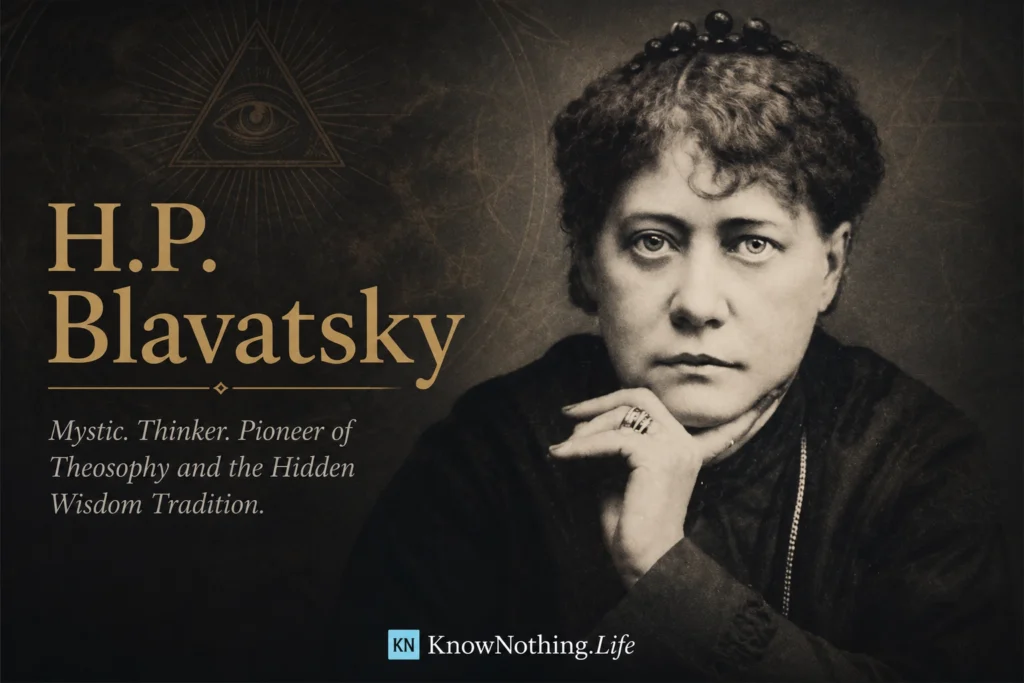
Helena Petrovna Blavatsky, often known as H.P. Blavatsky or Madame Blavatsky, was born in the Russian Empire in 1831 and became one of the most influential occult writers of the nineteenth century. She was born Helena von Hahn into an aristocratic family connected to military service, literature, and European culture. Her mother, Helena Andreyevna de Fadeyev, was a novelist, and Blavatsky grew up in a household where imagination, folklore, religion, and intellectual curiosity surrounded her from childhood. Accounts of her early life often emphasize her unusual temperament: rebellious, theatrical, fearless, and fascinated by the hidden side of things.
As a young woman, she married Nikifor Blavatsky, a much older Russian official, but quickly separated from him and began the wandering life that became part of her legend. She later claimed to have traveled through Europe, the Middle East, India, Tibet, and the Americas in search of esoteric knowledge, although parts of these travels remain difficult to verify. That uncertainty is central to her biography. Blavatsky lived partly in documented history and partly in self-created myth. She was not merely a writer of occult ideas; she made her own life into a kind of occult narrative.
Spiritualism, America, and the Birth of a Movement
Blavatsky arrived in the United States in 1873, entering a culture already fascinated by séances, mediums, spirit communication, and religious experimentation. Nineteenth-century Spiritualism had created a public appetite for invisible worlds, but Blavatsky eventually separated herself from ordinary Spiritualist explanations. She did not want to reduce mysterious phenomena to conversations with the dead. She argued instead for a wider esoteric tradition, one rooted in ancient wisdom, hidden teachers, spiritual evolution, and the unity of religion, philosophy, and science.
In New York in 1875, Blavatsky helped found the Theosophical Society with Henry Steel Olcott, William Quan Judge, and others. The society’s aims were ambitious: to promote universal brotherhood, study comparative religion and philosophy, investigate the hidden laws of nature, and explore latent powers within human beings. Its motto, later widely associated with the movement, was “There is no Religion higher than Truth.” That phrase captured the spirit of Blavatsky’s public mission. She rejected sectarian certainty and claimed to seek a deeper wisdom beneath the surface of world religions.
Isis Unveiled and the Attack on Materialism
Blavatsky’s first major book, Isis Unveiled, appeared in 1877 in two large volumes. Its subtitle, A Master-Key to the Mysteries of Ancient and Modern Science and Theology, announced its scale. The work attacked what Blavatsky saw as the dogmatism of both modern science and organized religion. She believed that materialistic science had narrowed reality too severely, while institutional religion had buried spiritual truth beneath creeds, priesthoods, and superstition. The book tried to recover older traditions of magic, Platonism, Hermeticism, Kabbalah, Hindu thought, Buddhism, and occult philosophy.
Isis Unveiled was not a careful academic book in the modern sense. It was sprawling, combative, learned, uneven, and filled with quotations, comparisons, and polemics. Yet its impact was enormous among readers dissatisfied with conventional religion and skeptical of purely materialist explanations of the mind and universe. Blavatsky presented herself as a restorer of ancient knowledge rather than an inventor of a new religion. Her claim was that beneath religious conflict there exists an older wisdom tradition, preserved by adepts and hidden schools, waiting to be understood again.
India, Adyar, and Controversy
In 1878, Blavatsky became an American citizen, and soon afterward she and Olcott left for India. The move transformed Theosophy from a New York occult society into an international spiritual movement. In India, Blavatsky found a setting where her emphasis on Eastern religion, karma, reincarnation, hidden masters, and ancient wisdom could develop more fully. The Theosophical Society eventually established its headquarters at Adyar, near Madras, making India central to the movement’s identity and global expansion.
Yet Blavatsky’s career was never free from controversy. She claimed contact with hidden adepts or “mahatmas,” especially figures known as Koot Hoomi and Morya, whom she regarded as spiritual teachers guiding her work. Supporters saw her as a messenger of higher wisdom; critics accused her of fraud, theatrical manipulation, and fabricated phenomena. The Society for Psychical Research investigation in the 1880s damaged her reputation, although defenders later challenged aspects of that judgment. Any serious account of Blavatsky must admit both sides: she inspired intense devotion and intense suspicion, and her life cannot be reduced cleanly to either sainthood or deception.
The Secret Doctrine and Esoteric Cosmology
Blavatsky’s most important work, The Secret Doctrine, was published in 1888. Its full title, The Secret Doctrine: The Synthesis of Science, Religion, and Philosophy, summarized her grand ambition. The two volumes, Cosmogenesis and Anthropogenesis, presented an immense esoteric system describing cosmic evolution, cycles of manifestation, root races, spiritual hierarchies, ancient symbols, and the hidden unity behind world mythologies. The book was dense, difficult, and often obscure, but it became the foundational text of modern Theosophy.
At the heart of The Secret Doctrine is the idea that the universe is not a dead machine but a living, evolving reality. Matter and spirit are not absolute opposites but different aspects of a deeper unity. Blavatsky wrote, “Matter is the vehicle for the manifestation of soul,” a phrase that reveals her effort to move beyond crude materialism and crude spiritualism alike. She wanted readers to see visible existence as part of a larger metaphysical process. Whether accepted as revelation, mythology, speculation, or literary esotericism, The Secret Doctrine became one of the most influential occult books of the modern age.
The Key to Theosophy and The Voice of the Silence
In 1889, Blavatsky published The Key to Theosophy, a more accessible explanation of Theosophical ideas in question-and-answer form. It introduced readers to concepts such as karma, reincarnation, spiritual evolution, brotherhood, and the distinction between Theosophy and dogmatic religion. The book was important because it translated the vast, difficult world of The Secret Doctrine into a more direct public teaching. It showed Blavatsky not only as an occult theorist, but as a movement-builder trying to answer objections and define a practical path.
That same year, she published The Voice of the Silence, a short mystical work based, according to Blavatsky, on Eastern spiritual teachings. Its tone is very different from the argument and polemic of Isis Unveiled. It is poetic, ethical, and inward. One of its most memorable teachings is, “Compassion is no attribute. It is the Law of laws.” This line reveals the moral center of Blavatsky’s mature spirituality. Whatever the controversies around her claims, she repeatedly insisted that occult knowledge without altruism was spiritually dangerous. Wisdom, in her view, had to lead toward service.
Influence on Western Esotericism and Modern Spirituality
Blavatsky’s influence extended far beyond the Theosophical Society itself. Theosophy shaped later occult movements, comparative religion, modern esotericism, New Age spirituality, alternative religious movements, and Western interest in Hindu and Buddhist ideas. It influenced artists, writers, reformers, and seekers who were looking for spiritual meaning outside conventional churches. Figures connected directly or indirectly to Theosophical ideas appeared in modern art, literature, education, nationalism, and spiritual experimentation across Europe, India, and America.
Her legacy is complicated by problematic elements in her thought, including speculative racial theories and claims about human evolution that modern readers rightly treat with caution. Yet her broader historical importance remains undeniable. Blavatsky helped popularize ideas that later became common in alternative spirituality: karma, reincarnation, universal wisdom, spiritual evolution, hidden masters, comparative mysticism, and the critique of both religious dogmatism and scientific reductionism. She gave Western occultism a global vocabulary.
Death and Lasting Legacy
H.P. Blavatsky died in London on May 8, 1891. Her followers later commemorated the date as White Lotus Day. By the time of her death, she had created a movement, written massive works of esoteric philosophy, attracted disciples across continents, and provoked critics who saw her as one of the great religious frauds of the century. That contradiction remains part of her power. Blavatsky is not easy to categorize. She was a mystic, polemicist, synthesizer, traveler, occultist, editor, teacher, and mythmaker.
Her lasting importance lies in the scale of her ambition. She tried to create a spiritual worldview large enough to include science, religion, mythology, psychology, and metaphysics. She challenged Western readers to look beyond inherited religious boundaries and take Asian traditions seriously, even though her interpretations were often filtered through esoteric and Victorian assumptions. H.P. Blavatsky remains essential because she helped invent the modern language of occult spirituality. To understand Theosophy, modern esotericism, and much of alternative spirituality, one must reckon with the strange, controversial, and powerful figure of Madame Blavatsky.