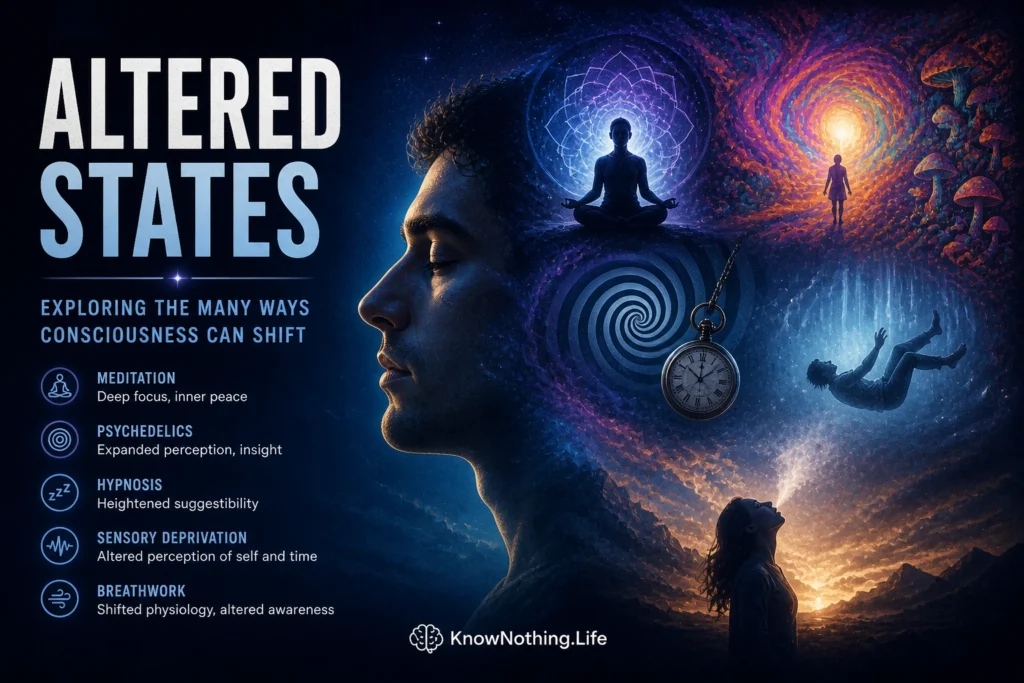
Altered states of consciousness refer to conditions in which an individual’s perception, cognition, emotion, or sense of self differs significantly from ordinary waking awareness. These states can arise naturally, as in sleep and dreaming, or be induced through meditation, sensory deprivation, extreme environments, or psychoactive substances. Far from being anomalies, altered states are a fundamental aspect of human experience, revealing the flexibility and complexity of the mind.
The study of altered states has deep historical roots, spanning religious traditions, philosophical inquiry, and modern scientific research. In the 19th century, William James recognized the importance of these states in The Varieties of Religious Experience, noting that “our normal waking consciousness… is but one special type of consciousness, whilst all about it… there lie potential forms of consciousness entirely different.” This insight captures the central idea that consciousness is not fixed but exists along a spectrum of possible states.
In contemporary psychology and neuroscience, altered states are studied as windows into the mechanisms of consciousness. By examining how perception and cognition change under different conditions, researchers gain insight into how the brain constructs reality. Whether through the introspective stillness of meditation or the vivid distortions of psychedelic experience, altered states challenge assumptions about what it means to be aware and offer a deeper understanding of the human mind.
Defining Altered States of Consciousness
An altered state of consciousness is typically defined as a qualitative shift in mental functioning, distinct from baseline waking awareness. This shift may involve changes in attention, perception, time awareness, emotional intensity, or sense of identity. Importantly, altered states are not inherently pathological; many are natural and even beneficial, playing roles in rest, creativity, and psychological well-being.
Psychologist Charles Tart, a pioneer in the scientific study of consciousness, emphasized that altered states should be understood in terms of changes in the structure of experience rather than deviations from a “normal” standard. In his work Altered States of Consciousness, Tart argued that each state has its own logic and coherence, shaped by patterns of attention and cognition. This perspective shifts the focus from abnormality to diversity, recognizing that different states may serve different functions.
From a neuroscientific perspective, altered states correspond to changes in brain activity and connectivity. Advances in imaging techniques have revealed that different states involve distinct patterns of neural activation, particularly in networks associated with attention, self-referential processing, and sensory integration. These findings suggest that altered states are not random disruptions but organized variations in how the brain processes information.
Natural Altered States
Some of the most common altered states occur naturally as part of daily life. Sleep, for example, involves multiple stages of altered consciousness, ranging from light sleep to deep slow-wave states and REM dreaming. Each stage is associated with specific patterns of brain activity and subjective experience, demonstrating that consciousness can shift dramatically even within a single night.
Dreaming represents a particularly vivid natural altered state. During REM sleep, the brain generates immersive experiences that can feel indistinguishable from waking reality. As Allan Hobson has noted, dreaming reflects the brain’s capacity to create “a virtual reality model of the world” in the absence of external input. This highlights the constructive nature of perception, showing that the mind actively generates experience rather than passively receiving it.
Another natural altered state is the experience of “flow,” described by Mihaly Csikszentmihalyi. In this state, individuals become fully immersed in an activity, losing track of time and self-consciousness. Flow represents a form of optimal experience, in which attention is highly focused and performance is enhanced. Unlike more extreme altered states, flow occurs within the context of everyday activities, illustrating how shifts in consciousness can enhance rather than disrupt functioning.
Meditation and Contemplative States
Meditation and related contemplative practices provide a structured means of entering altered states of consciousness. Rooted in traditions such as Buddhism and Hinduism, these practices aim to cultivate awareness, reduce mental distraction, and transform the relationship between the self and experience. In recent decades, meditation has been extensively studied in psychology and neuroscience, revealing its effects on both brain function and subjective experience.
During meditation, individuals often report changes in attention, perception, and self-awareness. Some forms of meditation emphasize focused attention, directing awareness toward a single object such as the breath. Others promote open monitoring, allowing thoughts and sensations to arise without attachment. These practices can lead to states characterized by clarity, calmness, and a diminished sense of ego.
Research has shown that long-term meditation can alter brain structure and function, particularly in regions associated with attention and emotional regulation. Studies involving experienced meditators, including those examined by Richard Davidson, have demonstrated increased activity in areas linked to positive emotion and well-being. These findings suggest that altered states induced by meditation are not merely transient experiences but can have lasting effects on mental health and cognition.
Psychoactive Substances and Induced States
Psychoactive substances represent another pathway to altered states of consciousness. Substances such as psychedelics, stimulants, and depressants can profoundly affect perception, emotion, and cognition by altering brain chemistry. While these states can vary widely in their effects, they often involve heightened sensory experiences, changes in time perception, and shifts in the sense of self.
In the mid-20th century, researchers such as Timothy Leary explored the potential of psychedelic substances to expand consciousness and facilitate psychological insight. Although early research was controversial and often halted due to legal restrictions, recent studies have renewed interest in the therapeutic potential of these substances, particularly in the treatment of depression and anxiety.
From a neuroscientific perspective, psychedelics appear to disrupt normal patterns of brain connectivity, leading to a more flexible and less constrained mode of processing. This has been described as a “loosening” of the brain’s predictive models, allowing for novel associations and experiences. While these states can be insightful, they also carry risks, highlighting the importance of context, preparation, and integration in their use.
Sensory and Environmental Influences
Altered states can also be induced through changes in sensory input or environmental conditions. Sensory deprivation, for example, reduces external stimulation, leading to heightened internal awareness and, in some cases, hallucinations. Conversely, sensory overload or extreme environments—such as high altitudes or deep-sea diving—can also produce altered states by challenging the brain’s capacity to process information.
Isolation and monotony can similarly affect consciousness. Extended periods without social interaction or environmental variation may lead to changes in perception, cognition, and emotional state. These effects have been studied in contexts such as space travel and polar expeditions, where individuals are exposed to unusual conditions for prolonged periods.
These examples illustrate that altered states are not limited to specific practices or substances but can arise from a wide range of conditions. They highlight the sensitivity of consciousness to both internal and external influences, emphasizing its dynamic and adaptive nature.
Altered States and the Nature of Consciousness
The study of altered states provides valuable insights into the nature of consciousness itself. By examining how experience changes under different conditions, researchers can identify the mechanisms that underlie perception, attention, and self-awareness. Altered states reveal that consciousness is not a fixed entity but a process that can be modulated in multiple ways.
Philosophically, altered states challenge assumptions about reality and identity. If the mind can generate radically different experiences under different conditions, what does this imply about the stability of the self? Thomas Metzinger has argued that the sense of self is a constructed model rather than a fixed entity, and altered states often make this construction more apparent. Experiences of ego dissolution, for example, can temporarily dissolve the boundary between self and world.
From a scientific perspective, altered states offer a natural laboratory for studying consciousness. They allow researchers to observe how changes in brain activity correspond to changes in experience, providing clues about the neural basis of awareness. While many questions remain unanswered, the study of altered states continues to expand our understanding of the mind and its possibilities.
Conclusion
Altered states of consciousness reveal the remarkable flexibility of the human mind. From natural states such as sleep and flow to induced experiences through meditation, substances, and environmental conditions, these states demonstrate that consciousness is not static but dynamic and multifaceted. Each altered state provides a unique perspective on how the brain constructs reality and how experience can be transformed.
The work of thinkers such as William James and Charles Tart has helped to establish altered states as a legitimate area of scientific and philosophical inquiry. Their insights continue to influence contemporary research, which seeks to understand not only how these states arise but what they reveal about the nature of consciousness itself.
Ultimately, the study of altered states invites a broader reflection on human potential. By exploring the full range of possible experiences, we gain a deeper appreciation of the mind’s capacity for change, adaptation, and insight. Altered states are not merely deviations from the norm; they are integral to the richness of human experience, offering pathways to understanding both the limits and the possibilities of consciousness.