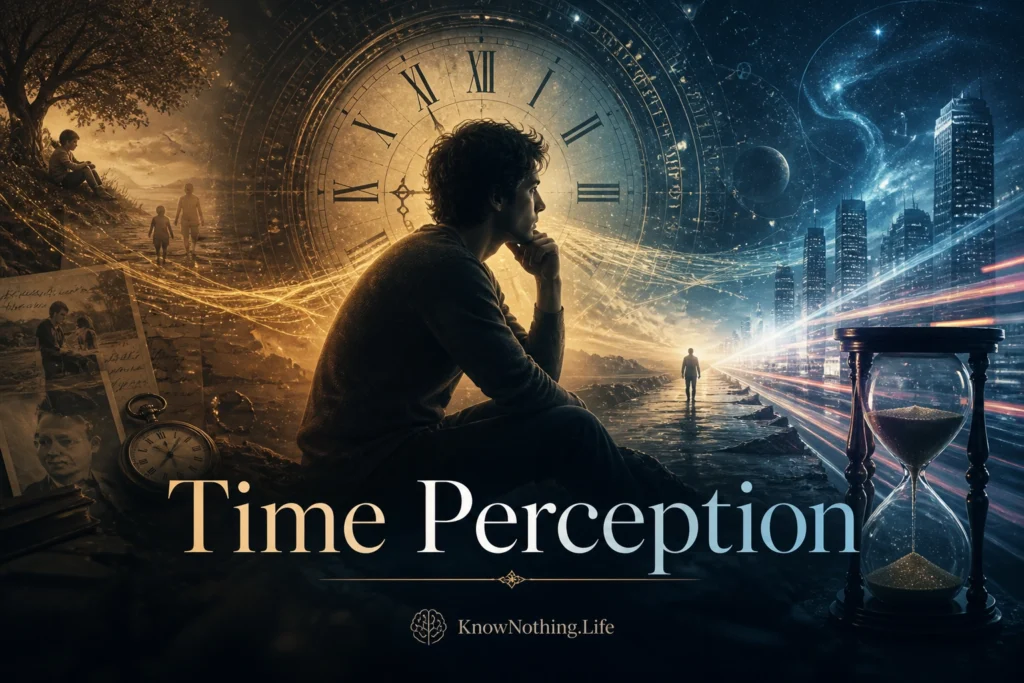
Time perception is the study of how human beings experience duration, sequence, rhythm, waiting, memory, anticipation, and change. Clock time appears objective: seconds, minutes, hours, calendars, and historical dates seem to divide reality into measurable units. Yet lived time is far stranger. A painful minute can feel longer than a pleasant hour; childhood summers can seem vast in memory while adult years pass quickly; danger can make events appear slowed down; boredom stretches time, while absorption makes it disappear. Time perception asks why the same measured interval can feel brief, endless, fragmented, or meaningful depending on attention, emotion, age, bodily state, memory, and expectation.
The topic has always belonged to both philosophy and psychology. Augustine, in Confessions, famously wrote, “What then is time? If no one asks me, I know; if I wish to explain it to one who asks, I know not.” His insight remains one of the clearest starting points for the field: time feels familiar until we try to define it. Henri Bergson later distinguished clock time from lived duration, arguing in Time and Free Will that real inner time is qualitative, flowing, and indivisible, not a row of identical units. William James, in The Principles of Psychology, described the “specious present,” the short span of immediate experience in which consciousness holds the just-past and the about-to-arrive together. These thinkers prepared the way for modern research: time is not merely counted by clocks; it is constructed by the mind.
The Difference Between Clock Time and Lived Time
Clock time is public, standardized, and mathematical. It allows societies to coordinate work, travel, science, law, medicine, and communication. A train schedule, a court deadline, a lab experiment, and a school day all depend on shared measurements. But psychological time is private and elastic. It expands and contracts according to mental state. Five minutes waiting for medical test results can feel longer than five minutes laughing with friends. The clock records the same duration, but consciousness does not. Time perception therefore reveals a basic truth about human experience: we do not simply live in time; we interpret it.
Bergson criticized the habit of treating time as if it were space. In his view, we often imagine time as a line divided into units, but inner life is more like a melody, where earlier notes linger inside later ones. A song is not experienced as separate instants arranged side by side; it unfolds as continuity. Edmund Husserl also explored this structure in his lectures on internal time-consciousness, arguing that consciousness includes retention of the just-past and protention of the anticipated future. When we hear a sentence, a musical phrase, or a spoken name, we do not hear isolated fragments. The mind binds them into temporal form.
Attention and the Feeling of Duration
Attention is one of the strongest forces shaping time perception. When people monitor time closely, duration often feels longer. Waiting in a silent room, staring at a clock, or expecting an important message can make minutes drag because attention repeatedly returns to the passage of time itself. By contrast, when attention is absorbed in an interesting task, time often seems to vanish. This is why creative work, deep reading, gaming, skilled performance, and intense conversation can produce the feeling that hours passed unnoticed. The mind did not stop processing time; rather, attention was directed toward activity instead of duration.
William James observed that consciousness is selective, not a passive mirror of reality. In The Principles of Psychology, he wrote that “my experience is what I agree to attend to.” Applied to time perception, this means that experienced duration depends partly on what the mind selects as important. If the object of attention is time itself, duration becomes prominent. If the object is action, meaning, danger, beauty, or problem-solving, time may recede into the background. Modern attention-based models of timing build on this insight by suggesting that subjective duration increases when more cognitive resources are allocated to temporal monitoring.
Emotion, Arousal, and the Stretching of Time
Emotion can dramatically alter time perception. Fear, anxiety, anger, joy, sadness, and anticipation all change the way duration feels. During frightening events, people often report that time seemed to slow down. A car accident, a fall, a confrontation, or a moment of danger may appear unusually detailed in memory. One explanation is that high arousal increases the rate at which the brain samples or encodes information, producing a richer memory that is later interpreted as having lasted longer. Another possibility is that danger intensifies attention, making the present moment feel unusually expanded.
Anxiety is especially important because it turns the future into a source of threat. The anxious person does not merely experience the present; they repeatedly project forward into possible outcomes. This can make waiting unbearable. Søren Kierkegaard, in The Concept of Anxiety, described anxiety as the dizziness of possibility, and that phrase captures how future-oriented fear can distort time. Depressed states often alter time differently: the future may feel closed, the present heavy, and the past unusually dominant. Psychologist Kurt Lewin’s field theory emphasized that behavior is shaped by a person’s psychological life space, including their relation to past, present, and future. Emotional time is never neutral; it is saturated with hope, dread, regret, or expectation.
Memory and the Retrospective Experience of Time
Time perception changes depending on whether people are judging duration while it is happening or remembering it afterward. A boring event may feel long while it is occurring, but short in memory because little happened. A busy vacation may feel fast while lived, but long in retrospect because it contains many distinct memories. This difference between prospective and retrospective time helps explain why adult life can seem to accelerate. Routine days pass with few memorable markers, so weeks and months compress in memory. Novel experiences, by contrast, create richer encoding and make a period seem longer when remembered.
This relationship between memory and time was central to Augustine’s reflections. He argued that the past and future exist for us as present acts of memory and expectation. The past is not physically present, yet it lives in recollection; the future is not yet real, yet it exists in anticipation. Psychological time is therefore deeply bound to memory. Marcel Proust’s In Search of Lost Time gives literary form to this idea: a taste, smell, or sensation can suddenly reopen an entire period of life. Time is not only measured forward; it can return through memory with emotional force.
The Brain and Internal Timing
Modern neuroscience studies time perception through brain systems involved in attention, movement, prediction, memory, and reward. There does not appear to be one simple “clock” in the brain that controls all timing. Instead, timing emerges from networks involving areas such as the basal ganglia, cerebellum, prefrontal cortex, supplementary motor areas, and dopaminergic systems. The basal ganglia are often associated with interval timing and action selection, while the cerebellum is important for precise motor timing. The prefrontal cortex contributes to working memory and attention, both of which influence duration judgments.
Neuroscientist Warren Meck and others developed influential models of scalar timing, suggesting that organisms estimate duration through internal timing mechanisms that can vary with arousal and dopamine. Dopamine is especially significant because it affects reward, motivation, movement, and the perceived pace of events. Stimulant drugs, Parkinson’s disease, attention disorders, and mood states can all influence timing. Antonio Damasio’s broader work on embodied cognition also matters here because it reminds us that time perception is not detached from the body. Heartbeat, breathing, fatigue, pain, hunger, and bodily arousal all help shape the felt tempo of experience.
Time, Aging, and the Sense That Life Speeds Up
Many adults report that time seemed slower in childhood and faster with age. Several explanations may work together. First, proportional time changes: one year is a large fraction of a child’s life but a smaller fraction of an adult’s life. Second, children encounter more novelty. Their worlds are filled with firsts: first schools, first friendships, first fears, first skills, first places. Novelty creates dense memory, and dense memory makes periods seem longer in retrospect. Adult routines, while efficient, often reduce the number of distinctive markers that divide time.
Aging also changes future orientation. A young person often experiences life as wide open, while an older person may become more aware of finitude. Laura Carstensen’s socioemotional selectivity theory argues that perceived time horizons influence motivation. When people see time as expansive, they often prioritize learning, exploration, and future preparation; when they perceive time as limited, they prioritize emotional meaning and close relationships. This means time perception is not only about duration. It shapes value. The way people experience remaining time changes what they seek, whom they choose, and what they consider worth doing.
Culture, Technology, and Social Time
Time perception is also shaped by culture. Some societies treat time as strict, segmented, and efficiency-driven; others emphasize relational, seasonal, ritual, or event-based time. Anthropologist Edward T. Hall, in The Silent Language, distinguished monochronic cultures, which emphasize schedules and sequential tasks, from polychronic cultures, which tolerate multiple activities and flexible timing. These patterns influence how people experience lateness, urgency, productivity, patience, and obligation. Time is therefore not only psychological; it is social.
Technology has intensified modern time pressure. Digital devices compress communication, accelerate expectation, and fragment attention. Messages arrive instantly, feeds refresh endlessly, and people increasingly experience time as interruption. Hartmut Rosa, in Social Acceleration, argues that modern life is marked by technological acceleration, social change, and the speeding up of the pace of life. Even when technology saves time, people often feel more rushed because expectations expand with capacity. The result is a paradox: modern societies measure time more precisely than ever, yet many people feel they have less of it.
Flow, Presence, and Timeless Experience
One of the most positive distortions of time occurs in flow. Mihaly Csikszentmihalyi, in Flow: The Psychology of Optimal Experience, described flow as a state of deep absorption in which action and awareness merge, self-consciousness fades, and time is altered. During flow, people may feel that time speeds up, slows down, or disappears. Musicians, athletes, writers, surgeons, dancers, programmers, and craftspeople often report this state when challenge and skill are well matched. Flow shows that the loss of ordinary time awareness can be a sign not of confusion but of full engagement.
Meditative traditions also explore altered time perception. In mindfulness practice, attention is trained to remain with present experience rather than constantly moving into memory or anticipation. This can make time feel fuller, slower, or less burdensome. The “present moment” is not a mathematical instant but an experiential field. As James’s “specious present” suggests, consciousness always contains a small thickness of time. Presence does not abolish past and future; it loosens their grip. In this sense, time perception has ethical and existential significance. How one attends to time partly determines how one inhabits life.
Final Thoughts on Time Perception
Time perception reveals that human beings live in more than one kind of time. There is the time of clocks, calendars, deadlines, and physics, but there is also the time of fear, boredom, memory, love, grief, attention, work, and imagination. A minute can be endured, wasted, savored, forgotten, or remembered for decades. Psychological time is not an illusion in the trivial sense. It is the form through which human life becomes meaningful. We act toward the future, interpret the past, and experience the present through bodies and minds that are always selecting, anticipating, and remembering.
The greatest thinkers on time all show that time cannot be reduced to measurement. Augustine teaches that time is bound to memory and expectation; Bergson teaches that lived duration flows rather than ticks; James teaches that consciousness holds a “specious present”; Husserl teaches that perception itself has temporal structure; Csikszentmihalyi teaches that absorption can transform time; Carstensen teaches that perceived time horizons shape motivation and meaning. Time perception is therefore not a minor curiosity of psychology. It is one of the deepest features of consciousness, because to understand how people experience time is to understand how they experience life itself.