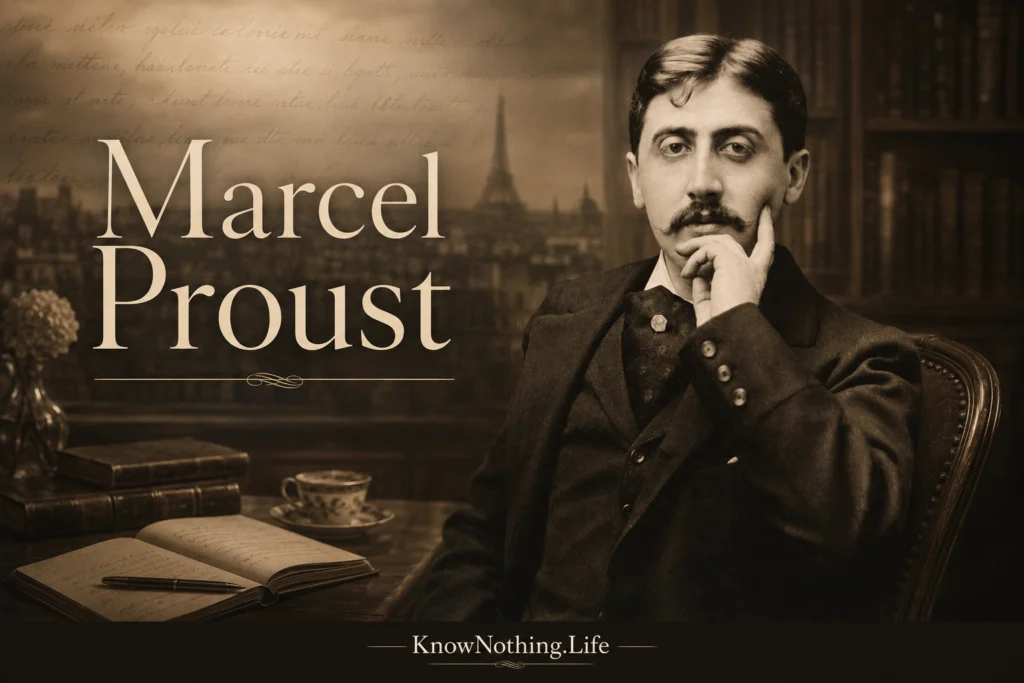
Marcel Proust was a French novelist, essayist, and critic whose writing transformed the representation of memory, identity, desire, and time. His monumental novel cycle, In Search of Lost Time, follows a narrator who gradually discovers that the apparently vanished past survives in sensations, habits, artworks, and involuntary memories. Proust turned drawing rooms, childhood bedrooms, seaside hotels, jealous suspicions, and fleeting social gestures into material for an immense investigation of consciousness. His achievement was not simply to remember a lost society but to reveal how experience is continually revised by attention and the passage of time.
Proust is often reduced to the famous madeleine dipped in tea, yet his work ranges far beyond nostalgia. He analyzed romantic obsession, social ambition, antisemitism, homosexuality, illness, art, class, war, grief, and the instability of personality. His characters change depending on who observes them and when. In Swann’s Way, the narrator remarks that “our social personality is created by the thoughts of other people,” capturing Proust’s awareness that identity is relational. People inhabit multiple versions of themselves produced by memory, desire, reputation, and circumstance.
Early Life, Family, and Illness
Valentin Louis Georges Eugène Marcel Proust was born on July 10, 1871, in Auteuil, near Paris. His father, Adrien Proust, was a respected physician and public-health specialist, while his mother, Jeanne Weil, came from an educated Jewish family and possessed a deep knowledge of French literature. Proust was baptized and raised as a Catholic, but his maternal Jewish background remained important within the political and social world he later depicted. His younger brother, Robert, became a surgeon and helped oversee the posthumous publication of the final volumes of his brother’s masterpiece.
Proust suffered his first serious asthma attack as a child and remained chronically ill throughout his life. Illness limited his freedom, disrupted sleep, and intensified his dependence on familiar rooms and routines. It also sharpened his sensitivity to breathing, sound, temperature, scent, fatigue, and bodily discomfort. The vulnerable child waiting for his mother’s goodnight kiss in Swann’s Way draws upon emotional patterns from Proust’s childhood without making the novel a simple autobiography. He transformed private experience into a wider study of attachment, anxiety, habit, and imagination.
Education, Society, and Early Writing
Proust attended the Lycée Condorcet, performed military service, and studied law and philosophy in Paris. Although he briefly worked at the Bibliothèque Mazarine, he had little interest in a conventional profession. During the 1890s, he entered literary and aristocratic salons, where he observed the rituals of reputation, fashion, exclusion, and social advancement. Figures including Robert de Montesquiou, the Comtesse Greffulhe, Anatole France, and composer Reynaldo Hahn contributed traits or experiences that Proust later reshaped in fiction. He was fascinated by high society while becoming increasingly alert to its vanity and cruelty.
His first book, Pleasures and Days, appeared in 1896 with a preface by Anatole France. Its stories, portraits, and prose poems already explored snobbery, regret, fragile pleasure, and passing time, although critics sometimes dismissed it as the work of a fashionable amateur. Proust then began the unfinished autobiographical novel Jean Santeuil, which he abandoned around 1899. Published decades after his death, it contains early treatments of vocation, memory, social hierarchy, love, and the transformation of life into art.
The Dreyfus Affair, Ruskin, and Artistic Development
The Dreyfus Affair divided France after Jewish army officer Alfred Dreyfus was falsely convicted of treason. Proust became an active Dreyfusard, signing petitions and using personal connections in support of Dreyfus’s defense. The controversy exposed the antisemitism and political hostility beneath polished French society. It later became a major historical force within In Search of Lost Time, separating friends, reorganizing salons, and revealing that social judgments often follow loyalty and prejudice rather than evidence. Proust joined psychological observation to a broader anatomy of collective belief.
Proust also devoted years to English art critic John Ruskin. With help from his mother and friends, he translated and annotated The Bible of Amiens and Sesame and Lilies. The work disciplined his attention to architecture, painting, reading, and the moral claims made for art. Proust eventually rejected Ruskin’s authority, insisting that artistic truth could not simply be received from a master. His unfinished critical project Against Sainte-Beuve similarly opposed explaining an author’s work primarily through biography and social character. The deeper creative self, he believed, emerged through writing.
The Making of In Search of Lost Time
Proust began the work that became In Search of Lost Time around 1908 or 1909. He wrote largely at night, often from bed, in a bedroom lined with cork to reduce noise. Drafts expanded through notebooks, pasted additions, and long paper strips as new scenes entered the design. Publishers initially rejected the manuscript, and Proust paid Bernard Grasset to issue Swann’s Way in 1913. The volume introduced Combray, the madeleine episode, the symbolic walks toward Méséglise and Guermantes, and Charles Swann’s destructive love for Odette de Crécy.
The First World War delayed the series but allowed Proust to enlarge its architecture and incorporate wartime Paris. In 1919, In the Shadow of Young Girls in Flower received the Prix Goncourt, bringing national recognition. The Guermantes Way and Sodom and Gomorrah followed during his lifetime. The Captive, The Fugitive, and Time Regained were published after his death. The seven-volume cycle became a panorama of French life unified by the narrator’s delayed discovery of his vocation.
Memory, Love, and the Meaning of Art
Proust’s most famous contribution is his exploration of involuntary memory. Deliberate recollection often produces only a thin outline of the past, while an unexpected taste, texture, or sound can restore an earlier world with emotional force. Before the madeleine releases Combray, the narrator observes that “the past is hidden somewhere outside the realm, beyond the reach of intellect.” What returns is not an exact recording. It is recovered through present consciousness, carrying meanings that could not have been understood when the original experience occurred. Memory becomes both recovery and creation.
His treatment of love is equally unsentimental. Swann’s fixation on Odette and the narrator’s possessiveness toward Albertine show desire feeding on uncertainty, absence, jealousy, and imagination. Lovers often seek not another person as they truly exist but access to a life beyond their control. Social perception works similarly: aristocratic names, glamorous places, and celebrated artists acquire imaginary radiance that fades when approached. Art can organize these disappointments into knowledge. The narrator eventually understands that suffering and lost time need not remain meaningless if transformed into a work revealing patterns hidden within experience.
Final Years and Enduring Legacy
Proust’s health declined as he worked urgently to revise the novel. The deaths of his father in 1903 and his mother in 1905 intensified his grief and withdrawal, while later years brought increasing isolation. He nevertheless remained connected to friends through letters and occasional nocturnal outings. In 1919, he published Pastiches and Miscellanies, displaying his ability to imitate other writers’ styles. Proust died in Paris on November 18, 1922, at fifty-one, while still revising the later sections of his masterpiece.
His influence extends through modernism, literary theory, philosophy, psychology, queer studies, sociology, and research on autobiographical memory. Writers and thinkers have drawn upon his long sentences, shifting perspectives, and insight that perception changes the reality perceived. Proust’s greatest legacy is his account of artistic attention. Ordinary life seems lost because people rarely experience it fully while it is happening. Through memory and form, the artist can recover relationships among moments that appeared separate. In Search of Lost Time ultimately argues that time destroys appearances, but art can disclose the meanings created through that destruction.