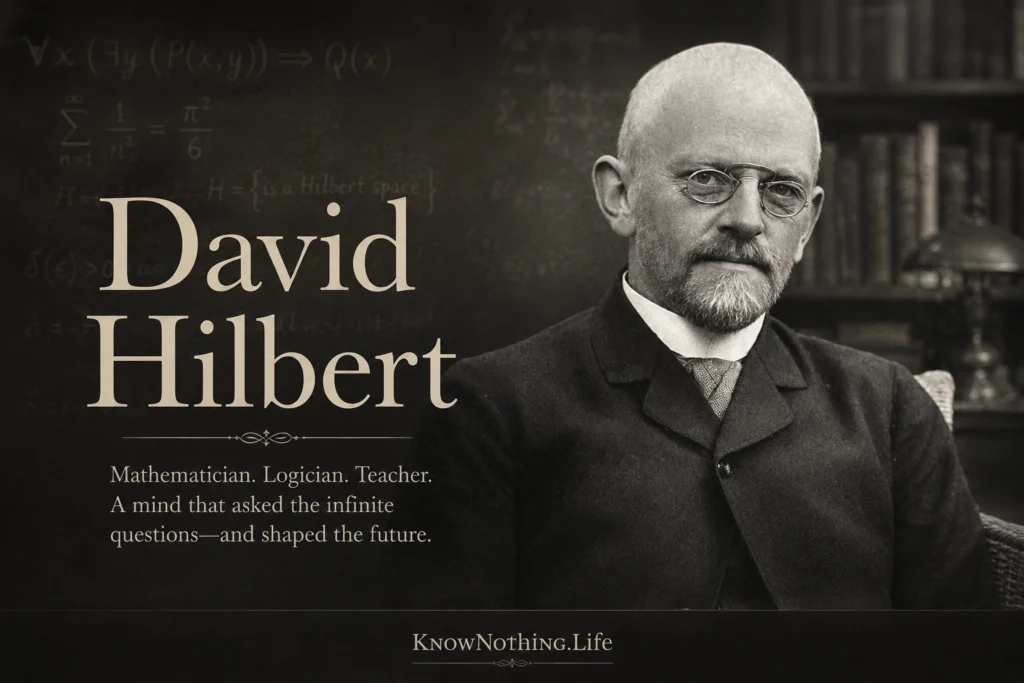
David Hilbert was born on January 23, 1862, in Königsberg, Prussia, a city already famous in intellectual history as the home of Immanuel Kant. Hilbert grew up in a world where German universities were becoming centers of modern mathematical research, and his own gifts appeared early. He studied at the University of Königsberg, where he formed important friendships with Hermann Minkowski and Adolf Hurwitz. These relationships shaped his development because Hilbert’s genius was not isolated from conversation. He learned, argued, collaborated, and absorbed problems from the mathematical culture around him.
Hilbert earned his doctorate in 1885 with a dissertation on invariant theory, and soon became one of the leading young mathematicians in Germany. His early career was marked by intensity and range. He could enter a difficult field, see the structure of its deepest problems, and reorganize the subject with remarkable clarity. This ability would become the pattern of his whole life. Hilbert was not only a solver of problems; he was a maker of frameworks. He changed the way mathematicians understood algebra, geometry, logic, physics, and the very nature of proof.
Invariant Theory and the Power of Existence Proofs
Hilbert first became famous for his work in invariant theory, a branch of algebra concerned with expressions that remain unchanged under transformations. In the late nineteenth century, invariant theory was filled with complex symbolic calculations. Hilbert transformed the field by proving general existence theorems instead of producing long lists of explicit formulas. His basis theorem showed, in effect, that certain systems of invariants are finitely generated. This was a startling achievement because it proved that a finite basis exists even when it did not construct the basis directly.
This method was controversial. Paul Gordan, an older master of invariant theory, reportedly objected that Hilbert’s proof was “not mathematics” but “theology,” because it established existence without giving a constructive formula. Yet Hilbert’s approach pointed toward the future of modern mathematics. He showed that abstraction could be more powerful than calculation. A proof could illuminate structure even when it did not hand over a concrete object. In this sense, Hilbert helped move mathematics into the twentieth century, where existence, structure, axioms, and generality became central tools.
The Foundations of Geometry
In 1895, Hilbert moved to the University of Göttingen, which became one of the greatest mathematical centers in the world. There he published Foundations of Geometry in 1899, one of his most influential works. Euclid’s Elements had stood for centuries as the model of mathematical rigor, but Hilbert saw that geometry needed a clearer axiomatic foundation. He reorganized geometry through explicitly stated axioms concerning incidence, order, congruence, parallels, and continuity. The result was not merely a correction of Euclid, but a new understanding of what axiomatic method could accomplish.
Hilbert’s approach treated mathematical concepts according to their roles in a system of relations. The famous remark often associated with him is that one could replace “points, lines, and planes” with “tables, chairs, and beer mugs,” provided the axioms and relations remained intact. The point was not flippancy. It was structuralism before the word became fashionable. Mathematics did not depend on the intuitive nature of its objects, but on the relations specified by axioms. This insight influenced logic, formalism, model theory, and philosophy of mathematics.
Hilbert’s Problems and the Future of Mathematics
In 1900, Hilbert delivered a legendary address at the International Congress of Mathematicians in Paris. There he presented a list of problems meant to guide the future of mathematical research. The full published list contained twenty-three problems, touching set theory, number theory, geometry, analysis, physics, logic, algebra, and the foundations of mathematics. Few speeches in the history of science have had such lasting influence. Hilbert did not merely summarize what was known; he gave mathematics an agenda.
The power of the problems came from Hilbert’s faith in the solvability of mathematical questions. He believed that genuine mathematical problems should not be treated as permanent mysteries. In that spirit, he rejected the pessimistic slogan “ignoramus et ignorabimus”—we do not know and we shall not know. His later motto became famous: “We must know. We will know.” The phrase captured Hilbert’s almost heroic confidence in reason. Even when later discoveries complicated that optimism, the motto remained one of the great declarations of mathematical courage.
Hilbert Space, Analysis, and Mathematical Physics
Hilbert’s name is attached to Hilbert space, one of the central concepts of modern mathematics and physics. His work on integral equations helped create the functional-analytic framework later used in quantum mechanics. A Hilbert space generalizes ordinary Euclidean space into an abstract setting that can handle infinite-dimensional systems. This became crucial for twentieth-century physics, especially as scientists tried to describe wave functions, operators, and states in quantum theory.
Hilbert also worked in mathematical physics, including the foundations of mechanics, kinetic gas theory, radiation theory, and general relativity. Around the same time as Albert Einstein developed the field equations of general relativity, Hilbert independently formulated a variational approach now associated with the Einstein-Hilbert action. The relationship between Hilbert and Einstein has been debated by historians, but Hilbert’s contribution to the mathematical formulation of physical theory is undeniable. He saw that physics, like geometry, could be clarified through axioms, structures, and formal principles.
Formalism and Hilbert’s Program
Hilbert’s later career became increasingly focused on the foundations of mathematics. He wanted to defend classical mathematics against paradoxes in set theory and challenges from intuitionists such as L. E. J. Brouwer. Hilbert admired Georg Cantor’s set theory and transfinite numbers, famously declaring, “No one shall expel us from the paradise that Cantor has created.” He believed that the infinite was too fruitful and beautiful to abandon because of foundational anxiety.
Hilbert’s program aimed to formalize mathematics and prove, using secure finite methods, that the resulting formal systems were consistent. The project was ambitious: mathematics would be treated as a formal system of symbols and rules, and its reliability would be guaranteed by a proof of consistency. This was not a rejection of meaning, but an attempt to protect mathematics from contradiction. Hilbert wanted to show that mathematicians could use ideal objects, infinite sets, and abstract methods without fear that the whole structure would collapse.
Gödel and the Limits of the Program
Hilbert’s program met its greatest challenge in 1931, when Kurt Gödel proved the incompleteness theorems. Gödel showed that any sufficiently strong, consistent formal system capable of expressing arithmetic contains true statements that cannot be proved within that system, and that such a system cannot prove its own consistency by its own resources. These results did not destroy mathematics, but they did show that Hilbert’s original foundational hope could not be fulfilled in the simple form he had imagined.
Yet Gödel’s results should not make Hilbert look naïve. Hilbert’s program helped create proof theory, mathematical logic, formal systems, and the very framework within which Gödel’s theorems could be stated. Even the limits of formalization were discovered using tools Hilbert had helped sharpen. In this sense, Hilbert’s failure was historically productive. He asked the question so clearly that later mathematics could prove exactly where the boundary lay. Few intellectual projects have been so influential even in defeat.
Göttingen, Students, and Mathematical Culture
Hilbert helped make Göttingen the center of world mathematics. His students and colleagues included figures who shaped algebra, analysis, physics, logic, and geometry. Emmy Noether, Hermann Weyl, John von Neumann, Richard Courant, and many others were connected to the Göttingen world that Hilbert helped define. He supported Noether’s appointment at a time when women faced severe barriers in academia. When critics objected to a woman teaching at the university, Hilbert reportedly replied, “We are a university, not a bathhouse.”
That remark, whether remembered with some variation, reflects Hilbert’s impatience with social prejudice when it interfered with mathematics. He believed mathematics crossed national, racial, and political boundaries. Another line attributed to him states, “Mathematics knows no races or geographical boundaries; for mathematics, the cultural world is one country.” This ideal was tragically challenged by the rise of Nazism, which devastated Göttingen’s mathematical community by driving out Jewish and politically targeted scholars.
Legacy and Lasting Importance
David Hilbert died on February 14, 1943, in Göttingen. By then, the mathematical world he had helped build had been damaged by political catastrophe, but his intellectual legacy survived. His major works and contributions include Foundations of Geometry, invariant theory, algebraic number theory, Hilbert’s problems, Hilbert space, mathematical physics, proof theory, and Hilbert’s program. Few mathematicians have influenced so many fields at such a foundational level.
Hilbert’s lasting importance lies in his belief that mathematics advances by asking the right questions with maximum clarity. He gave mathematics problems, methods, structures, and ambitions. He helped replace intuition with axioms, calculation with structure, and scattered problems with unified programs. Even where his hopes exceeded what later logic allowed, his courage enlarged mathematics. Hilbert remains one of the great symbols of disciplined optimism: the conviction that reason must press forward, not because every mystery is easy, but because the search for knowledge is itself one of humanity’s highest forms of freedom.