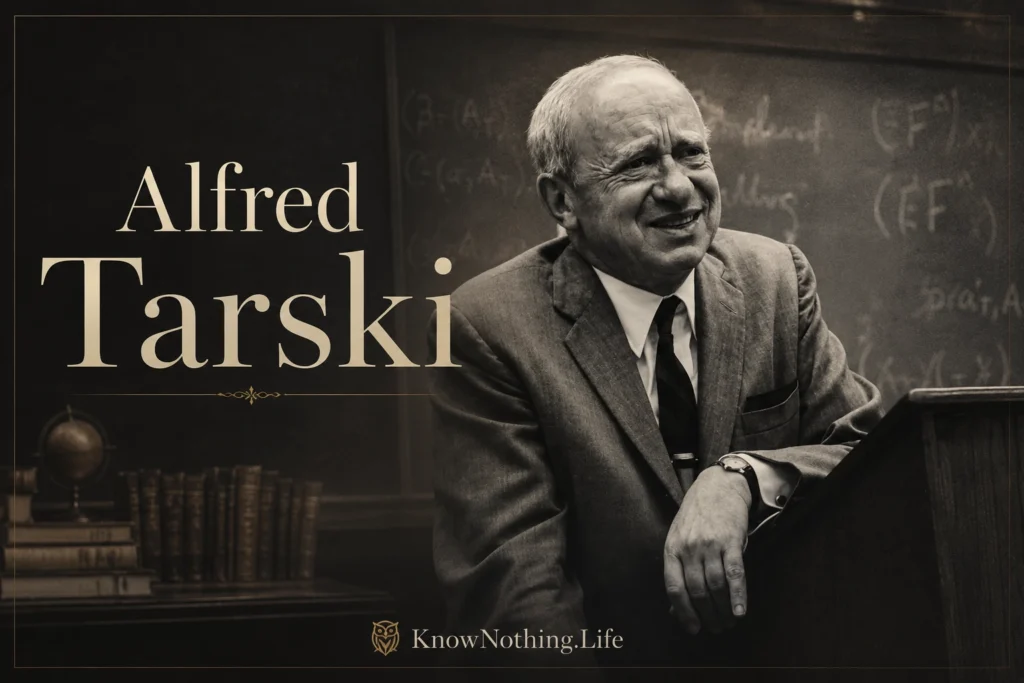
Alfred Tarski was born Alfred Tajtelbaum, often rendered Teitelbaum, on January 14, 1901, in Warsaw, then part of the Russian Empire. He grew up in a well-educated Jewish family during a period of enormous political and intellectual change in Poland. As a student, he originally planned to study biology, but the reborn University of Warsaw exposed him to one of the strongest mathematical and logical communities in Europe. Under the influence of figures such as Stanisław Leśniewski, Jan Łukasiewicz, Wacław Sierpiński, Stefan Mazurkiewicz, and Tadeusz Kotarbiński, he moved decisively toward mathematics and logic.
In 1923, he changed his surname to Tarski and converted to Roman Catholicism, partly in the context of Polish nationalism and widespread antisemitic barriers in academic life. He earned his doctorate at the University of Warsaw in 1924 under Leśniewski’s supervision. From early adulthood, Tarski combined technical power with a broad philosophical imagination. He later described himself modestly as “a mathematician, as well as a logician, and perhaps a philosopher of a sort.” That self-description understates his influence. Tarski became one of the central figures in modern logic, ranked with Aristotle, Frege, and Gödel as one of the great architects of formal reasoning.
Warsaw Logic and the Rise of a Reputation
The Warsaw school gave Tarski a rare intellectual environment. Logic there was not treated as a narrow branch of philosophy, but as a rigorous mathematical discipline connected to set theory, semantics, foundations, and the structure of scientific knowledge. Tarski absorbed Leśniewski’s demand for precision, Łukasiewicz’s work in formal logic, and Sierpiński’s mathematical depth. By the late 1920s and 1930s, he was already producing important work on set theory, definability, metamathematics, algebra, and the foundations of logic.
Yet Tarski’s career in Poland was limited by institutional politics and antisemitism. Although his international reputation grew, he supported himself mainly by teaching mathematics in a high school while holding minor university posts. In 1929, he married Maria Witkowska, and they had two children, Ina and Jan. By 1939, Tarski was famous enough among specialists to be considered one of Europe’s leading logicians, yet he failed to secure a permanent professorship in Poland. His life and career were about to be transformed by catastrophe.
Truth in Formalized Languages
Tarski’s most famous work is his theory of truth. In 1933, he published The Concept of Truth in Formalized Languages, first in Polish, later in German, and eventually in English translation. The problem sounds simple: what does it mean for a sentence to be true? But Tarski approached it with unusual rigor. He wanted a definition that was “materially adequate and formally correct.” In other words, it had to capture our ordinary idea of truth while also avoiding paradox and meeting exact formal standards.
His most famous device is Convention T. A proper truth definition should imply equivalences of the form: “X is true if and only if p,” where X names a sentence and p states what the sentence says. The standard example is: “‘snow is white’ is true if and only if snow is white.” This may look obvious, but Tarski turned the obvious into a powerful formal tool. He showed that truth for a language must be defined in a richer metalanguage, not inside the same language without restriction. This helped explain why self-referential paradoxes such as the liar paradox are so dangerous.
Object Language, Metalanguage, and the Semantic Conception
Tarski’s distinction between object language and metalanguage became foundational. The object language is the language being studied. The metalanguage is the language used to talk about it. If we want to define truth for a formal language, we must step into a metalanguage capable of naming its sentences, describing their structure, and assigning satisfaction conditions. This hierarchy was not a mere technical trick. It gave philosophy and logic a disciplined way to talk about language without collapsing into paradox.
His semantic conception of truth also shaped later philosophy of language, model theory, mathematics, and computer science. Tarski did not claim to solve every philosophical problem about truth in ordinary language. His achievement was narrower and deeper: he showed how truth can be defined for formalized languages with mathematical precision. By doing so, he gave philosophers a new model of clarity. Truth was no longer only a metaphysical slogan or correspondence intuition. In formal settings, it could be analyzed through satisfaction, structure, and interpretation.
Logical Consequence and Model Theory
Tarski’s 1936 paper “On the Concept of Logical Consequence” was another landmark. It gave a model-theoretic account of when a conclusion follows from premises: roughly, an argument is logically valid when every model that makes the premises true also makes the conclusion true. This approach became central to modern logic. It allowed logicians to study validity not merely through derivation rules, but through interpretations and structures.
This work helped create model theory, the branch of logic concerned with the relationship between formal languages and the mathematical structures that interpret them. In model theory, one asks what a theory says about possible structures, whether different structures satisfy the same sentences, and how syntax and semantics interact. Tarski’s work on truth, satisfaction, and consequence provided essential tools for this field. His influence reaches into mathematics, linguistics, computer science, artificial intelligence, database theory, and the formal study of meaning.
War, America, and Berkeley
In August 1939, Tarski traveled to the United States to attend a Unity of Science congress. Soon afterward, Germany invaded Poland, and World War II made it impossible for him to return. The trip saved his life, but it also separated him from his wife and children, who remained in Poland during the war. They survived and joined him in Berkeley in 1946, but other family members were killed by the Nazis. Like many European intellectuals of his generation, Tarski’s career was reshaped by exile.
After temporary positions at Harvard, City College of New York, and the Institute for Advanced Study, Tarski joined the University of California, Berkeley, in 1942. Berkeley became the institutional center of his later career. He received tenure in 1945, became professor of mathematics, and helped build one of the world’s strongest programs in logic and the methodology of science. Tarski was a demanding and charismatic teacher who trained many important logicians. His influence was not only in papers and books, but in the school of research he created.
Major Works and Mathematical Range
Tarski’s major works include The Concept of Truth in Formalized Languages, “On the Concept of Logical Consequence,” Introduction to Logic and to the Methodology of Deductive Sciences, Logic, Semantics, Metamathematics, A Decision Method for Elementary Algebra and Geometry, Undecidable Theories with Andrzej Mostowski and Raphael Robinson, Cardinal Algebras, and later works on relation algebras and cylindric algebras with collaborators such as Leon Henkin and Donald Monk. He also contributed to the famous Banach-Tarski paradox, set theory, measure theory, topology, algebra, geometry, and decidability.
His mathematical range is one reason Tarski is hard to categorize. Philosophers remember him for truth and logical consequence. Mathematicians remember him for model theory, set theory, algebraic logic, decidability, and metamathematics. Computer scientists inherit his influence through semantics, formal languages, decision procedures, and model-theoretic methods. Tarski was not simply applying mathematics to philosophy. He was transforming the boundary between them.
Legacy and Lasting Importance
Alfred Tarski died on October 26, 1983, in Berkeley, California. By then, he had changed the intellectual landscape of the twentieth century. His work gave logic a semantic foundation, gave truth a formal structure, and gave model theory many of its central tools. He showed that clarity about language requires distinctions between levels of language, between syntax and semantics, and between proof and satisfaction.
Tarski’s lasting importance lies in the discipline he brought to the concept of truth. Philosophers had argued about truth for centuries, but Tarski showed that at least in formal languages, truth could be studied with mathematical exactness. His work did not make truth simple. It made truth precise enough to reveal its dangers, limits, and power. In doing so, Alfred Tarski became one of the indispensable thinkers of modern logic: a mathematician of truth, a logician of language, and one of the great founders of the formal study of meaning.