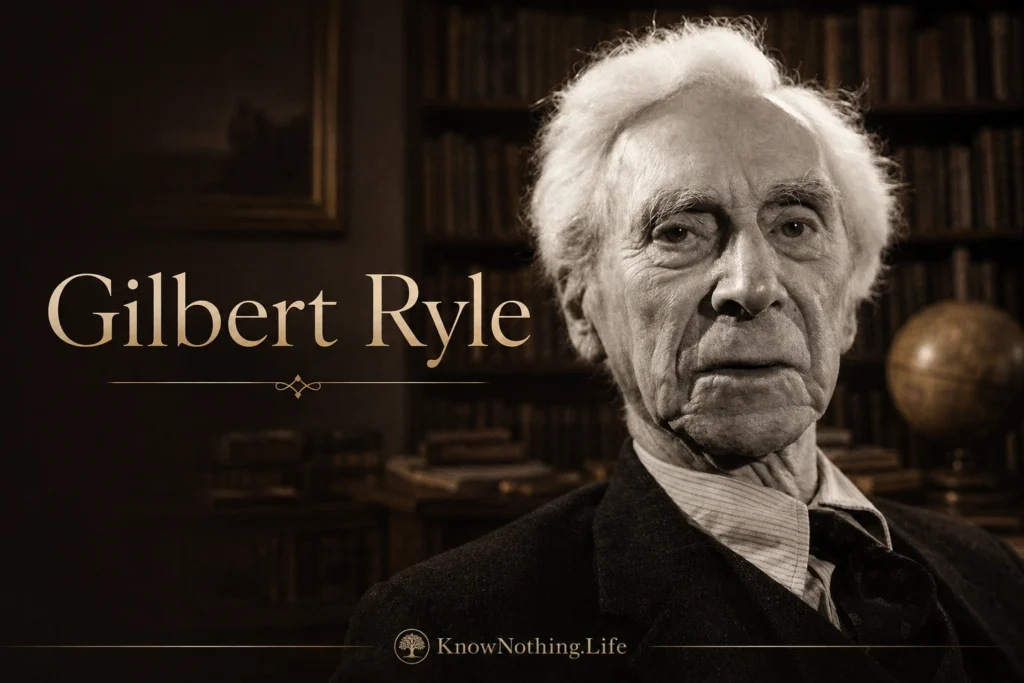
Gilbert Ryle was born on August 19, 1900, in Brighton, Sussex, England, into a large, educated, intellectually lively family. His father was a physician with interests in philosophy and astronomy, and Ryle grew up with access to books, conversation, and habits of independent inquiry. That atmosphere mattered because Ryle’s later philosophy would always resist pompous abstraction and empty technicality. He preferred clarity, exactness, wit, and examples drawn from ordinary life.
Ryle was educated at Brighton College and entered Queen’s College, Oxford, in 1919. He began with Classics but soon turned toward philosophy, graduating in 1924 with first-class honors in the new school of Philosophy, Politics, and Economics. After graduation, he was appointed to a lectureship at Christ Church, Oxford, where he remained for the rest of his academic career. His Oxford formation placed him in the rising world of analytic philosophy, but he never became a mere follower of any school. He admired clarity, but not narrowness; ordinary language, but not laziness; logical analysis, but not sterile formalism.
A Career at Oxford
Ryle became one of the dominant philosophical figures in mid-twentieth-century Oxford. In 1945, he was elected Waynflete Professor of Metaphysical Philosophy, one of Oxford’s most prestigious philosophical chairs. During the Second World War, he served in military intelligence and rose to the rank of major, an experience that interrupted but did not define his intellectual career. After the war, he resumed his role in Oxford philosophy with renewed authority.
In 1947, Ryle succeeded G. E. Moore as editor of Mind, then one of the most influential philosophy journals in the English-speaking world. He held that position until 1971. Through teaching, editing, criticism, and personal influence, he helped shape the tone of British analytic philosophy: impatient with obscurity, suspicious of grand metaphysical machinery, and alert to the way philosophical confusion often grows out of misuse of language. Ryle could be sociable and generous, but in argument he was formidable. He disliked pretension, jargon, and the artificial inflation of philosophical problems.
Philosophy as Conceptual Cartography
Ryle saw philosophy not as the discovery of hidden objects but as the clarification of conceptual geography. Philosophers, in his view, often go wrong when they treat words as if each must name a special entity. They invent mysterious objects because they misunderstand how ordinary expressions work. His task was to map the uses, implications, limits, and interconnections of concepts that people already use competently in daily life.
This is why Ryle’s philosophy is often associated with ordinary language philosophy, though he had his own distinctive method. He thought philosophical problems arise when familiar “implication threads” cross, tangle, or pull against one another. In ordinary life, people know how to use words such as mind, belief, will, intelligence, action, and knowledge. Trouble begins when philosophers theorize about these words as if they must refer to hidden inner objects or ghostly processes. Philosophy, for Ryle, was the disciplined work of untangling such confusions.
The Concept of Mind
Ryle’s most famous book, The Concept of Mind, was published in 1949. It became one of the classics of twentieth-century philosophy and one of the most influential attacks on Cartesian dualism. Ryle described the book as a “sustained piece of analytical hatchet-work,” and the phrase fits its tone. It was not a polite adjustment to the mind-body debate. It was a demolition of what he called the “official doctrine”: the view that a human being is a physical body inhabited or directed by a private, nonphysical mind.
Ryle’s most famous phrase for this picture was “the ghost in the machine.” By this, he meant the idea that the body is a kind of mechanism and the mind a hidden inner operator. Ryle argued that this picture rests on a “category mistake.” It treats the mind as if it were a special thing parallel to the body, when mental concepts actually work differently. To speak of someone’s intelligence, belief, courage, attention, or skill is not necessarily to report secret inner episodes. It is often to describe capacities, tendencies, performances, and patterns of conduct in the world.
Category Mistakes and the Mind
Ryle’s idea of a category mistake became one of his lasting contributions. A category mistake occurs when something is placed in the wrong logical category, producing confusion even though the grammar appears acceptable. Ryle’s well-known examples show how natural this error can be. Someone shown the colleges, libraries, and offices of a university may still ask, “But where is the university?” The mistake is to look for the university as one more building rather than understanding it as the organized institution constituted by those parts and activities.
Ryle thought Cartesian philosophy made a similar mistake about the mind. It looked for the mind as one more object, hidden behind or inside behavior. But mental language, he argued, does not function like the language of invisible machinery. To call someone intelligent is not to say that a ghostly inner engine is producing intelligent acts. It is to say, in part, that the person can act, speak, solve, notice, adapt, and respond in appropriate ways. Mental life is not abolished by this analysis. It is rescued from a misleading mythology.
Knowing How and Knowing That
One of Ryle’s most influential distinctions is between “knowing how” and “knowing that.” Philosophers had often treated knowledge primarily as possession of propositions: knowing that something is the case. Ryle insisted that many forms of intelligence are practical abilities. A person may know how to ride a bicycle, play chess, compose music, cook well, argue carefully, or recognize a joke without first consulting a set of inner rules. Skill is not always the application of theory. Often theory is a later codification of skill.
This argument attacked what Ryle called the intellectualist legend: the belief that intelligent action must always be guided by prior acts of inner contemplation. If every intelligent performance required a previous intellectual operation, then that previous operation would itself need guidance, and a regress would begin. Ryle’s point was not anti-intellectual. He was not denying the value of rules or reflection. He was denying that rules explain all intelligent action from the outside. Human intelligence often lives in trained performance before it appears as explicit doctrine.
Works Beyond The Concept of Mind
Although The Concept of Mind remains Ryle’s best-known work, his writings covered a wide field. His earlier essays explored philosophical analysis, categories, systematic ambiguity, and the dangers of turning concepts into metaphysical objects. His later books included Dilemmas in 1954, Plato’s Progress in 1966, and posthumous collections such as On Thinking and Collected Papers. These works show that Ryle was not merely a philosopher of mind. He wrote on language, logic, Greek philosophy, imagination, perception, self-knowledge, thinking, and method.
His book Dilemmas developed his view that philosophical puzzles often arise when two familiar ways of speaking appear to conflict. The philosopher’s task is not always to choose one side and abolish the other, but to show how the apparent conflict came about. Ryle’s later writings on thinking also complicated the simple image of him as a crude behaviorist. He did not reduce thought to muscular movement. He tried to understand the many different things people do when they calculate, ponder, compose, plan, hesitate, imagine, and attend.
Ryle, Behaviorism, and Misunderstanding
Ryle has often been labeled a logical behaviorist, but that label can mislead. He did reject the idea of a private mental substance hidden inside the body. He also treated many mental concepts as connected to behavior, dispositions, capacities, and publicly intelligible criteria. But he did not simply deny inner life or claim that people are only bodies in motion. His target was not consciousness itself but a distorted picture of consciousness as an occult inner theater.
A more charitable reading sees Ryle as a philosopher of conceptual practice. He wanted to know how mental language actually works: when it is used, what it permits us to infer, what it rules out, and what mistakes arise when it is forced into the wrong model. His influence can be seen in later philosophy of mind, philosophy of action, discussions of skill, debates about know-how, and critiques of overly intellectualized accounts of human agency. Even philosophers who reject Ryle’s conclusions often continue to work inside the questions he sharpened.
Final Years and Lasting Legacy
Ryle retired from Oxford in 1968 and lived in Islip with his twin sister Mary. He remained intellectually active, continued writing, and kept the habits that friends associated with him: walking, gardening, conversation, and a strong dislike of needless solemnity. He died on October 6, 1976, at Whitby in Yorkshire after walking on the moors. The end seems fitting for a philosopher who preferred open air, plain speech, and practical intelligence to metaphysical fog.
Gilbert Ryle’s lasting importance lies in his effort to dissolve false mysteries without flattening human life. He challenged the idea that the mind must be either a ghostly substance or a mechanical process. He showed that many philosophical problems arise because language is more flexible, layered, and practical than theory allows. His work remains essential because the temptation he attacked still returns in new forms: the urge to explain persons by inventing hidden inner objects, private theaters, or abstract mechanisms that do the work of thinking for them. Ryle’s best lesson is still bracing: before building a theory of the mind, look carefully at how our concepts of mind already work.