Eye Movement Desensitization and Reprocessing, usually called EMDR, is a psychotherapy approach developed to help people process traumatic memories and reduce the distress attached to them. It is best known as a treatment for post-traumatic stress disorder, but it has also been explored for anxiety, grief, phobias, chronic pain, depression, and other conditions where distressing memory, fear, or emotional reactivity plays a major role. EMDR is unusual because it combines elements of exposure, memory processing, body awareness, cognitive restructuring, and bilateral stimulation, often through guided eye movements, tapping, or alternating sounds.
The central idea behind EMDR is that trauma can become “stuck” in the nervous system in a way that keeps the past emotionally alive. A person may know, rationally, that the event is over, yet the body and mind still react as if danger is present. A sound, smell, image, phrase, place, or facial expression can trigger panic, shame, anger, numbness, or flashbacks. EMDR does not claim to erase memory. Instead, it aims to help the brain reprocess traumatic memory so it becomes less overwhelming, less intrusive, and more integrated into ordinary autobiographical memory.
Francine Shapiro and the Origins of EMDR
EMDR was developed by psychologist Francine Shapiro in the late 1980s. Shapiro reported that she noticed her own distressing thoughts seemed to lose emotional intensity when her eyes moved rapidly from side to side. This observation led her to develop a more formal clinical method, initially called Eye Movement Desensitization. Her 1989 study on traumatic memories introduced the technique to the field and sparked both enthusiasm and controversy. Later, as the method expanded beyond desensitization into broader cognitive and emotional processing, it became known as Eye Movement Desensitization and Reprocessing.
Shapiro’s major clinical work, Eye Movement Desensitization and Reprocessing: Basic Principles, Protocols, and Procedures, helped define EMDR as a structured therapy rather than a simple eye-movement trick. She also developed the Adaptive Information Processing model, often called AIP. According to this model, psychological symptoms can arise when distressing experiences are inadequately processed and stored in maladaptive form. EMDR attempts to activate those memories while allowing the brain to process them in a safer, more adaptive way.
How EMDR Works in Practice
EMDR is typically organized into eight phases. These include history taking, preparation, assessment, desensitization, installation, body scan, closure, and reevaluation. The process begins with careful assessment, not immediate exposure to trauma. A therapist first learns about the person’s history, symptoms, strengths, triggers, and readiness. Preparation may include grounding skills, emotional regulation tools, and a clear plan for what to do if distress becomes intense. This matters because trauma therapy can be powerful, and safety must come before memory processing.
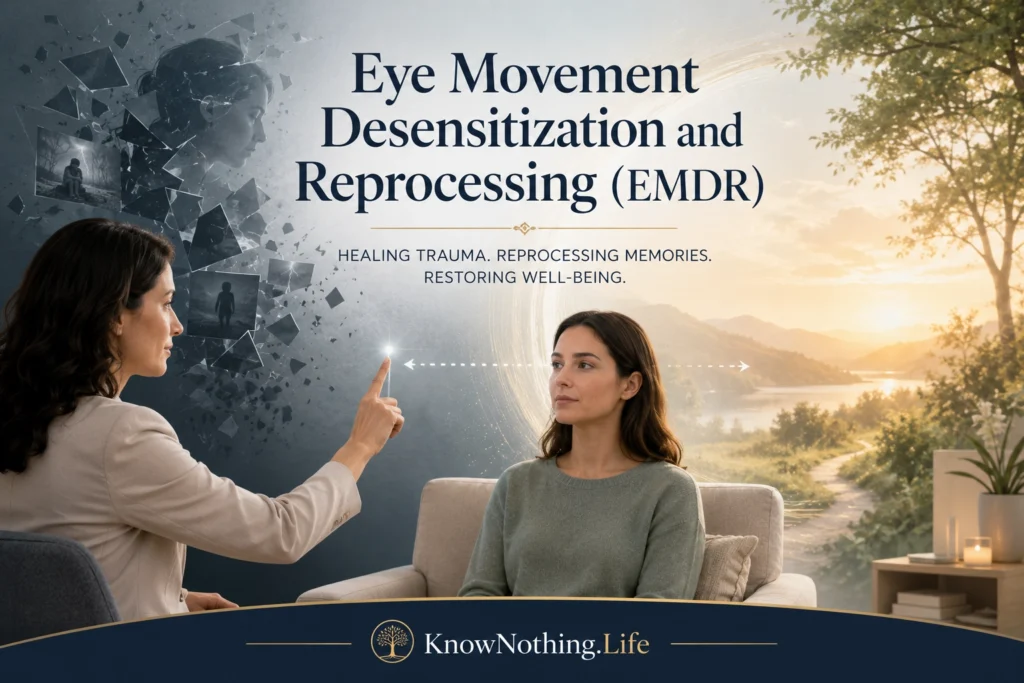
During the reprocessing phase, the client focuses on a target memory while noticing associated images, emotions, body sensations, and negative beliefs. A common negative belief might be “I am powerless,” “I am unsafe,” “It was my fault,” or “I am not good enough.” The therapist then guides bilateral stimulation, often by moving fingers back and forth so the client’s eyes track the motion. Other forms may include alternating taps or tones. After each short set, the client reports what they notice. The therapist does not force a specific interpretation; the process allows images, sensations, emotions, and meanings to shift.
Bilateral Stimulation and the Memory System
The most recognizable feature of EMDR is bilateral stimulation. In classic EMDR, this is eye movement from side to side, but many clinicians also use tactile tapping or alternating sounds. The exact mechanism remains debated. Some theories compare EMDR to rapid eye movement sleep, when the brain processes emotional memory. Others suggest that eye movements tax working memory, making traumatic images less vivid and less emotionally intense. Another view is that bilateral stimulation supports orienting responses, helping the person remain anchored in the present while recalling distressing material.
The working-memory explanation has become especially influential. When a person holds a traumatic image in mind while also performing a task that consumes attention, the image may become less vivid and emotionally charged. This does not mean the memory becomes false or disappears. Rather, the person may become able to remember without being overwhelmed. The memory moves from “I am back there” toward “that happened to me, and I am here now.”
Trauma, Belief, and the Body
One reason EMDR has become popular is that trauma is not stored only as a story. It is also stored as sensation, emotional reaction, defensive posture, shame, fear, and bodily memory. A person may talk about a traumatic event many times and still feel frozen, panicked, or unsafe when reminded of it. EMDR directly includes body sensations in the therapeutic process. The therapist may ask where the memory is felt in the body, how intense the distress feels, and whether the body changes as processing continues.
EMDR also targets beliefs. Trauma often leaves behind meanings that become attached to the self: “I should have stopped it,” “I am permanently damaged,” “I cannot trust anyone,” or “I am weak.” These beliefs may persist even when the person intellectually knows they are unfair. EMDR attempts to loosen the emotional power of the old belief and strengthen a more adaptive one, such as “I survived,” “I am safe now,” “I did the best I could,” or “I have choices.”
EMDR and PTSD
EMDR is most strongly associated with PTSD. PTSD can occur after exposure to actual or threatened death, serious injury, sexual violence, combat, assault, disaster, accident, abuse, or other overwhelming events. Symptoms may include intrusive memories, nightmares, avoidance, negative mood changes, hypervigilance, irritability, shame, emotional numbing, and exaggerated startle responses. EMDR is considered a trauma-focused therapy because it directly engages traumatic memories rather than focusing only on present coping.
Many clinical guidelines recognize EMDR as an evidence-based treatment for PTSD. It is often discussed alongside trauma-focused cognitive behavioral therapy, prolonged exposure, and cognitive processing therapy. The goal is not to make the person forget what happened, nor to convince them that the trauma was insignificant. The goal is to reduce the memory’s emotional grip so the person can live with greater freedom in the present.
Why EMDR Can Feel Different From Talk Therapy
EMDR can feel different from traditional talk therapy because it does not always require detailed verbal description of the trauma. The client must bring the memory to mind, but they may not need to narrate every detail aloud. For some people, this feels less overwhelming than repeatedly describing the event. For others, the structure of EMDR gives them a clear framework: target the memory, notice what arises, use bilateral stimulation, pause, report, and continue.
This does not mean EMDR avoids emotion. In fact, it can bring up intense feelings, images, sensations, and associations. A person may move from fear to grief, from shame to anger, from numbness to sadness, or from self-blame to compassion. Good EMDR therapy includes pacing, stabilization, and closure. A trained therapist should help the client remain within a tolerable emotional range rather than pushing them into flooding or dissociation.
Criticism and Debate
EMDR has been controversial since its beginning. Some critics questioned whether the eye movements were necessary, arguing that EMDR might work mainly because it includes exposure, cognitive processing, and therapist support. Others viewed early claims as overstated. Over time, research has generally supported EMDR for PTSD, but debate continues over why it works and which elements are essential.
This debate is important because EMDR is sometimes marketed in exaggerated ways. It is not magic, hypnosis, memory erasure, or a guaranteed cure. It is a structured psychotherapy with evidence for trauma treatment, especially PTSD, but it must be used carefully. The strongest version of EMDR is not simply “move your eyes and heal.” It is a full clinical protocol guided by assessment, preparation, memory targeting, emotional processing, and integration.
EMDR Beyond PTSD
Clinicians have applied EMDR to many problems beyond PTSD, including panic, complicated grief, performance anxiety, addiction-related triggers, chronic pain, phobias, and depression. The logic is that many psychological difficulties involve emotionally charged memories or learned associations. If a painful memory network can be reprocessed, symptoms may soften. However, the evidence base is not equally strong for every condition. PTSD remains the area where EMDR is most established.
This distinction matters. A therapy can be promising in many areas without being equally proven in all of them. Responsible clinicians should explain what EMDR is being used for, what the evidence suggests, what alternatives exist, and what risks may apply. For complex trauma, dissociation, severe instability, active substance dependence, or unsafe living situations, EMDR may require longer preparation and careful clinical judgment.
Final Thoughts
Eye Movement Desensitization and Reprocessing is one of the most influential trauma therapies of the modern era. Developed by Francine Shapiro and grounded in the Adaptive Information Processing model, EMDR treats trauma not as a memory to be erased but as an experience to be reprocessed. Its structured use of memory focus, bilateral stimulation, body awareness, emotional tracking, and adaptive belief work has made it a major treatment for PTSD.
The appeal of EMDR lies in its respect for how trauma actually feels. Trauma is not only a story. It is a body state, a belief, a reaction, a fragment, a fear, and sometimes a memory that refuses to become past. EMDR tries to help the nervous system learn what the thinking mind may already know: the danger is over, the memory is not the present, and survival can become more than endurance. Its best use is careful, ethical, and clinically grounded. When practiced well, EMDR offers a path from being haunted by memory toward remembering with less fear, less shame, and more freedom.