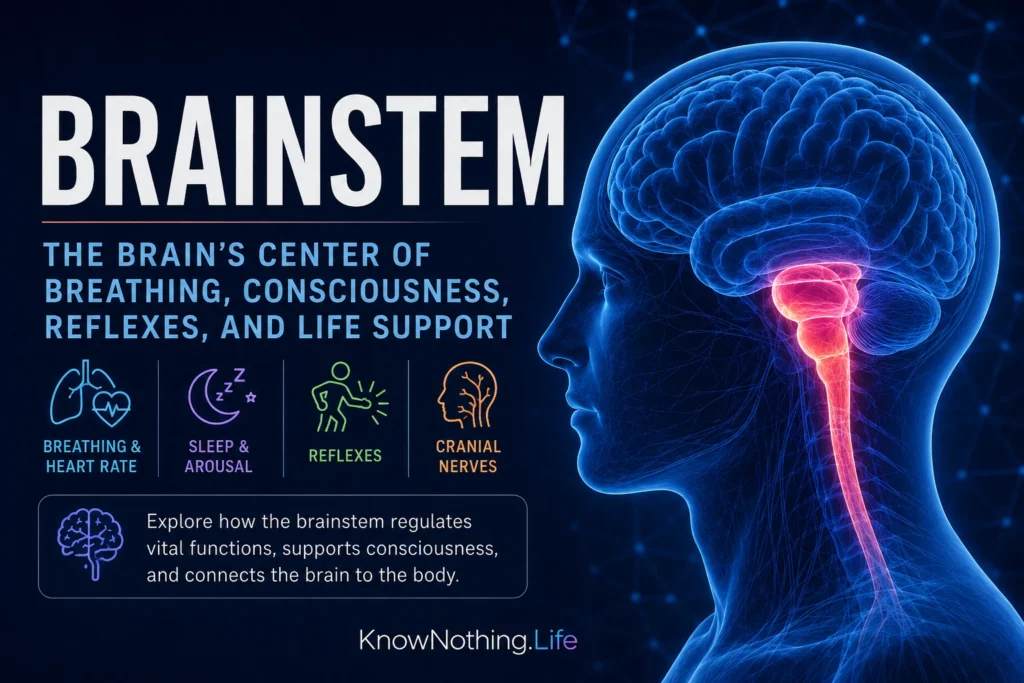
The brainstem is the narrow but essential structure that connects the cerebrum and cerebellum to the spinal cord. It sits deep at the base of the brain and is composed of three major parts: the midbrain, pons, and medulla oblongata. Although it is much smaller than the cerebral hemispheres, the brainstem is one of the most important structures in the nervous system because it supports basic life functions such as breathing, heart rate, blood pressure regulation, sleep-wake control, swallowing, consciousness, and many reflexes. A person can survive damage to many areas of the cerebral cortex, depending on severity and location, but severe injury to the brainstem can quickly threaten life because it affects the systems that keep the body awake, breathing, and internally regulated.
The brainstem is sometimes treated as primitive because it is evolutionarily older than the cerebral cortex, but “primitive” should not be mistaken for simple. It is a dense crossroads of neural pathways, cranial nerve nuclei, autonomic control centers, sensory relays, motor tracts, and arousal systems. Nearly every major signal traveling between the brain and body passes through or near the brainstem. It is where the nervous system becomes visibly continuous with the body, linking thought to action, perception to reflex, and consciousness to biological stability. Without the brainstem, the brain would not merely lose a support structure; it would lose the living foundation that makes higher mental activity possible.
The Three Main Parts of the Brainstem
The midbrain is the uppermost portion of the brainstem, located below the diencephalon and above the pons. It contains structures involved in eye movement, visual and auditory reflexes, motor control, pain modulation, and alertness. The superior colliculi help orient the eyes and head toward visual stimuli, while the inferior colliculi participate in auditory processing. The midbrain also contains the substantia nigra, a dopamine-producing region important for movement. Degeneration of dopamine neurons in the substantia nigra is a major feature of Parkinson’s disease, showing how a relatively small brainstem-related structure can have enormous effects on movement, posture, and voluntary action.
The pons lies between the midbrain and medulla. Its name comes from the Latin word for “bridge,” which reflects its role in connecting different parts of the nervous system. The pons contains major fiber pathways between the cerebrum and cerebellum, helping coordinate movement, posture, balance, and motor planning. It also contains cranial nerve nuclei involved in facial sensation, facial movement, eye movement, hearing, balance, and aspects of swallowing and salivation. The pontine tegmentum includes the reticular formation and other important nuclei, while the basilar pons carries fibers that connect the cortex to the cerebellum.
The medulla oblongata is the lowest part of the brainstem and is continuous with the spinal cord. It contains vital autonomic centers involved in breathing, heart rate, blood pressure, swallowing, coughing, vomiting, and other survival functions. The medulla also contains important crossing pathways, including the pyramidal decussation, where many motor fibers from the cerebral cortex cross to the opposite side of the body. This is one reason the left side of the brain controls much voluntary movement on the right side of the body, and the right side controls much movement on the left. The medulla is therefore both a life-support center and a major communication route between the brain and body.
Breathing, Heart Rate, and Autonomic Control
One of the brainstem’s most essential jobs is regulating breathing. Respiratory centers in the medulla and pons help generate and adjust the rhythm of respiration. The medulla contributes strongly to the baseline breathing rhythm, while pontine centers help shape the smoothness and timing of breathing patterns. These systems respond to chemical signals such as carbon dioxide, blood pH, and oxygen levels, as well as sensory feedback from the lungs and body.
The medulla is also deeply involved in cardiovascular regulation. It helps adjust heart rate, blood vessel tone, and blood pressure through autonomic pathways. These functions are not usually conscious, but they are constantly active. Standing up, exercising, sleeping, becoming frightened, or losing blood all require rapid internal adjustments. The brainstem helps coordinate these changes so the brain continues receiving oxygenated blood. This is why brainstem injuries can be so dangerous: they can disrupt the body’s ability to maintain the internal conditions needed for survival. The brainstem is not simply a cable between the brain and spinal cord; it is a real-time regulator of the body’s most basic physiological rhythms.
Cranial Nerves and Reflexes
The brainstem contains nuclei for most of the cranial nerves, making it essential for sensation and movement of the face, head, eyes, mouth, throat, and several internal organs. These cranial nerves support eye movement, facial expression, chewing, hearing, balance, taste, swallowing, voice, tongue movement, and parasympathetic regulation of organs. The midbrain is associated with cranial nerves III and IV, the pons with cranial nerves V through VIII, and the medulla with cranial nerves IX through XII. Through these nerves, the brainstem controls many of the functions that make social life and survival possible: looking, speaking, swallowing, hearing, orienting, and expressing emotion through the face.
Reflexes reveal the brainstem’s speed and importance. Blinking when something approaches the eye, coughing when the airway is irritated, gagging when the throat is stimulated, adjusting pupil size to light, and stabilizing gaze during head movement all depend on brainstem circuits. These reflexes are not signs of low-level machinery in a dismissive sense. They are sophisticated protective systems. A conscious person may decide where to look, but the brainstem helps keep vision stable when the head moves. A person may choose to speak, but brainstem circuits help coordinate breathing, vocalization, swallowing, and airway protection. Much of what feels effortless in daily life depends on brainstem reflexes working correctly.
Consciousness, Sleep, and the Reticular Activating System
The brainstem is central to arousal, wakefulness, and consciousness. A major historical breakthrough came from Giuseppe Moruzzi and Horace Magoun’s 1949 research on the brainstem reticular formation. Their work showed that stimulation of the brainstem reticular formation could activate the electroencephalogram, replacing synchronized slow activity with low-voltage fast activity associated with wakefulness. This helped establish the concept of an ascending reticular activating system, a network that contributes to alertness and the sleep-wake cycle.
Modern neuroscience no longer treats consciousness as located in one simple “on switch,” but the brainstem remains essential. In their influential article “Consciousness and the Brainstem,” Javad Parvizi and Antonio Damasio argued that brainstem structures are fundamental to the biological basis of consciousness, especially because they regulate the body’s internal state and support the background conditions for subjective experience. The cerebral cortex contributes richly to perception, memory, language, and thought, but the cortex depends on brainstem arousal systems to remain conscious and functionally integrated. The brainstem helps make the mind awake enough to have a world.
Brainstem Injury and Clinical Importance
Brainstem injury can produce dramatic and often life-threatening symptoms. Depending on the location, damage may cause abnormal breathing, loss of consciousness, paralysis, double vision, swallowing problems, facial weakness, vertigo, hearing problems, speech difficulty, or disruption of heart and blood pressure regulation. Strokes in the brainstem can be especially serious because small lesions may affect dense clusters of vital pathways. In some cases, damage to the pons can produce locked-in syndrome, a devastating condition in which consciousness may remain intact while most voluntary movement is lost, except sometimes vertical eye movement and blinking.
Clinicians often examine brainstem function through pupil responses, eye movements, corneal reflexes, gag reflexes, breathing patterns, facial movements, and levels of consciousness. These signs matter because they reveal whether crucial neural circuits are intact. In emergency medicine, neurology, and intensive care, the brainstem is often central to determining the severity of brain injury. Its condition can separate reversible impairment from catastrophic damage. This is also why the brainstem plays a major role in discussions of coma and brain death: it is closely tied to arousal, respiration, reflexes, and the body’s ability to sustain life.
Why the Brainstem Matters
The brainstem matters because it reminds us that the mind depends on life-support. Thought, memory, imagination, language, and self-awareness do not float above the body. They require breathing, circulation, wakefulness, posture, sensory orientation, and autonomic regulation. The brainstem provides these foundations continuously. It is active while a person sleeps, speaks, eats, walks, dreams, startles, coughs, laughs, cries, and wakes up in the morning. It is the hidden infrastructure of consciousness and embodied life.
The brainstem also challenges the idea that the “higher” brain is automatically the most important brain. The cerebral cortex may support complex thought, but the brainstem sustains the conditions that allow thought to occur at all. It connects the brain to the body, regulates essential physiology, coordinates reflexes, and helps maintain wakefulness. To understand the brainstem is to understand that human experience begins not with abstract reasoning, but with a living organism staying awake, breathing, sensing, responding, and surviving moment by moment.