Protein synthesis is the biological process by which cells build proteins from genetic instructions. Proteins are the working molecules of life: they form enzymes, receptors, ion channels, transporters, antibodies, structural fibers, hormones, signaling molecules, and countless cellular machines. In the nervous system, proteins help neurons fire, synapses change, neurotransmitters bind, memories stabilize, and glial cells support brain function. In the body as a whole, proteins build muscle, regulate metabolism, repair tissue, defend against infection, and allow cells to communicate. Protein synthesis is therefore not just one cellular process among many. It is the process through which genetic information becomes biological function.
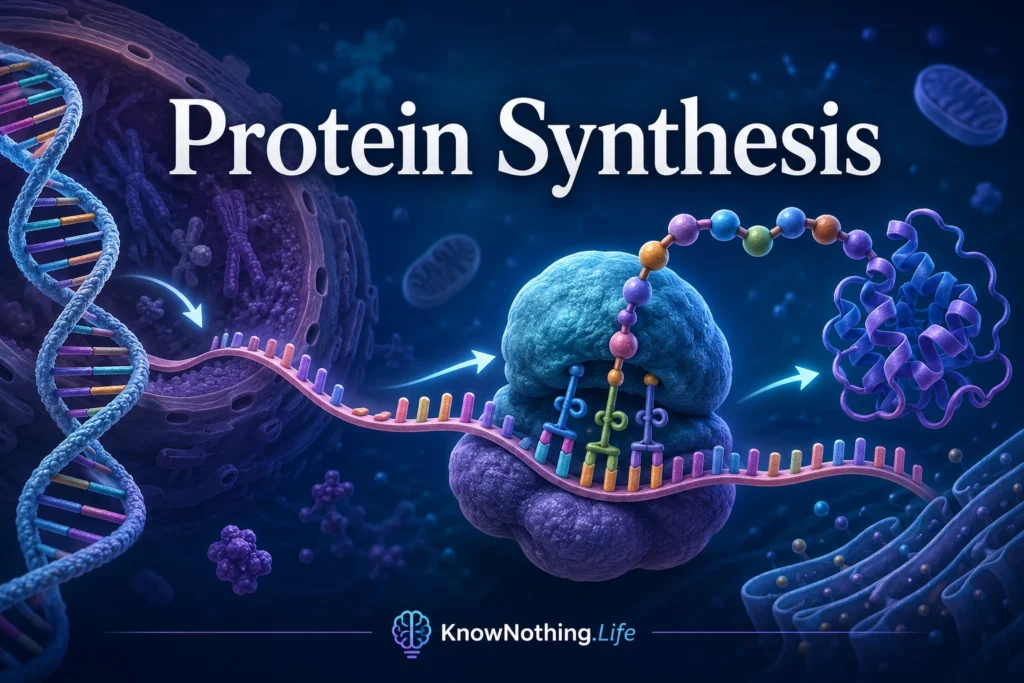
In strict molecular biology, protein synthesis usually refers to translation, the process in which ribosomes read messenger RNA and assemble amino acids into a polypeptide chain. In broader explanations, it is often discussed together with transcription, because transcription produces the mRNA template that translation uses. This flow of biological information is connected to Francis Crick’s central dogma of molecular biology, which described the transfer of sequence information among DNA, RNA, and protein. Crick’s idea helped define the logic of modern molecular biology: DNA can be copied, DNA can be transcribed into RNA, and RNA can be translated into protein, but sequence information does not flow back out of protein into nucleic acid.
From DNA to Messenger RNA
The first major step in making a protein is transcription. During transcription, a gene’s DNA sequence is copied into RNA. In eukaryotic cells, including human cells, transcription occurs in the nucleus. RNA polymerase and many regulatory proteins interact with DNA to produce a primary RNA transcript. That transcript is then processed into mature messenger RNA, or mRNA. Processing includes adding a 5′ cap, adding a poly-A tail, and removing noncoding introns through splicing. The mature mRNA can then exit the nucleus and enter the cytoplasm, where ribosomes translate it into protein.
This step matters because cells do not use every gene all the time. Gene expression is regulated. A liver cell, muscle cell, neuron, and astrocyte contain essentially the same DNA, but each uses different genes at different levels. Transcription controls which protein instructions are copied and made available. In the brain, this regulation is especially important because neurons and glial cells must change their molecular state during development, learning, stress, injury, and aging. Protein synthesis begins with the availability of the right mRNA at the right time, in the right cell, and sometimes even in the right part of a cell.
Translation and the Ribosome
Translation is the central event of protein synthesis. During translation, the ribosome reads the mRNA sequence in three-letter units called codons. Each codon corresponds to a specific amino acid or to a stop signal. Transfer RNAs, or tRNAs, act as adaptors by matching mRNA codons with the correct amino acids. As the ribosome moves along the mRNA, it links amino acids together in the correct order, forming a growing polypeptide chain. NCBI’s Molecular Biology of the Cell explains that mRNA is pulled through the ribosome, codons enter the ribosome’s active site, tRNAs add amino acids, and the completed protein is released when a stop codon is reached.
The ribosome is one of biology’s most extraordinary molecular machines. It is made of ribosomal RNA and proteins, and it performs the essential work of translating nucleic-acid language into protein language. The importance of ribosome structure was recognized by the 2009 Nobel Prize in Chemistry, awarded to Ada Yonath, Thomas Steitz, and Venkatraman Ramakrishnan for mapping the ribosome at the atomic level. The Nobel Prize organization describes the ribosome as the cell’s protein factory, reading information in messenger RNA and producing protein through translation.
Initiation, Elongation, and Termination
Translation is commonly divided into three main stages: initiation, elongation, and termination. During initiation, the small ribosomal subunit binds to the mRNA, an initiator tRNA recognizes the start codon, and the large ribosomal subunit joins to form a functional ribosome. During elongation, tRNAs bring amino acids to the ribosome according to the sequence of mRNA codons. The ribosome forms peptide bonds between amino acids and moves along the mRNA in the 5′ to 3′ direction. During termination, a stop codon enters the ribosome, release factors help end translation, and the completed polypeptide is released. NCBI’s overview of mRNA translation describes translation as proceeding through initiation, elongation, and termination.
This process is highly accurate but not perfect. Cells use proofreading and quality-control systems to reduce errors, because the wrong amino acid in the wrong position can alter protein shape and function. Protein synthesis is also energy-intensive, requiring ATP and GTP, amino acids, charged tRNAs, ribosomal subunits, initiation factors, elongation factors, release factors, and many regulatory proteins. The cell must therefore balance speed, accuracy, and resource use. Translation is not a mechanical copying process in the simple sense. It is a coordinated molecular performance.
Amino Acids, Folding, and Protein Function
A protein begins as a chain of amino acids, but its function depends on how that chain folds. The amino-acid sequence determines how the chain bends, twists, interacts with water, forms helices or sheets, and creates a three-dimensional structure. Some proteins fold mostly on their own, while others require chaperone proteins that help prevent misfolding or aggregation. After translation, many proteins also undergo post-translational modifications, such as phosphorylation, glycosylation, methylation, acetylation, cleavage, or the addition of lipid groups. These modifications can change where a protein goes, how active it is, and what other molecules it interacts with.
This is why protein synthesis does not end when the ribosome releases a polypeptide. A newly made protein may need to fold, be modified, travel to a membrane or organelle, assemble with other proteins, or be degraded if it fails quality control. In neurons, this can be especially important. A receptor protein may need to reach a synapse, an ion channel may need to be inserted into a membrane, and a cytoskeletal protein may help reshape dendritic spines. Protein function depends not only on being made, but on being correctly folded, modified, transported, and regulated.
Regulation of Protein Synthesis
Cells regulate protein synthesis at many levels. They regulate which genes are transcribed, which mRNAs are processed, which mRNAs are exported from the nucleus, which mRNAs are stabilized or degraded, and which mRNAs are translated. Translational control is especially powerful because it allows a cell to rapidly change protein production without needing to start from DNA every time. A review on principles of translational control explains that regulation of protein synthesis occurs at both global and specific mRNA levels.
This regulation allows cells to respond to changing conditions. During stress, cells may reduce general protein synthesis while selectively translating stress-response proteins. During growth, they may increase synthesis of structural and metabolic proteins. During learning, neurons may locally translate proteins near active synapses. Regulation also prevents waste. A cell does not want to synthesize every possible protein at all times. It needs the right proteins in the right amounts. Too little protein synthesis can impair growth, repair, and plasticity; too much or mistimed synthesis can disrupt cellular balance.
Protein Synthesis in Neurons
Neurons create special challenges for protein synthesis because they are highly polarized cells. A neuron’s cell body may be far from its dendrites, axon terminals, and synapses. If every protein had to be made only in the soma and then transported long distances, responses at distant synapses could be slow. For this reason, neurons can transport certain mRNAs into dendrites and axons and translate them locally. This allows proteins to be produced near the synapses or cellular compartments where they are needed.
Local protein synthesis is especially important for synaptic plasticity, the ability of synapses to strengthen or weaken with experience. Sutton and Schuman’s influential review argued that local protein synthesis can make proteins available to specific synaptic sites, helping explain how individual synapses can change in response to local activity. Other reviews describe dendritic translation as important for long-term potentiation and long-term depression, two major forms of synaptic plasticity. In the brain, protein synthesis is therefore not just a housekeeping process. It is part of how experience reshapes neural circuits.
Protein Synthesis, Memory, and Plasticity
Long-term memory depends partly on new protein synthesis. Short-term changes can often occur through existing proteins, but long-lasting changes usually require new molecules that stabilize altered synapses and support structural remodeling. Eric Kandel’s work on the molecular biology of memory helped connect learning to synaptic change, protein synthesis, and gene expression. His research showed that long-term memory involves molecular pathways that alter synaptic strength and structure over time.
This does not mean a memory is a single protein or that one protein “stores” an experience. Memory is distributed across circuits and synapses. But protein synthesis helps make temporary neural activity become lasting biological change. Klann and colleagues proposed that altered translation contributes to long-term memory formation, emphasizing that changes in protein synthesis help support memory consolidation. The basic idea is that learning changes neural activity, neural activity changes molecular signaling, molecular signaling changes protein synthesis, and new proteins help remodel synapses. Memory is psychological, but it is also molecular.
Clinical Importance of Protein Synthesis
Protein synthesis is essential for health, and disruptions can contribute to disease. Mutations that alter protein-coding genes can produce abnormal proteins. Defects in ribosome function, RNA processing, translation regulation, protein folding, or protein degradation can damage cells. In the nervous system, abnormal protein synthesis or protein handling is relevant to neurodevelopmental disorders, intellectual disability, fragile X syndrome, autism-related pathways, neurodegenerative diseases, cancer biology, and aging. Many antibiotics also work by targeting bacterial ribosomes, which is possible because bacterial and human ribosomes differ enough for selective drug action; the Nobel Prize organization notes that ribosomes are major antibiotic targets.
Protein synthesis also matters because cells must balance production with degradation. Proteins wear out, misfold, become damaged, or need to be removed after their job is done. The ubiquitin-proteasome system and autophagy help degrade proteins and recycle components. Memory research has even suggested that protein synthesis and protein degradation can both be important for long-term memory formation, because circuits need both construction and remodeling. Healthy cells do not simply make more protein. They maintain a dynamic balance between synthesis, folding, modification, transport, use, and removal.
Why Protein Synthesis Matters
Protein synthesis matters because it is how genetic information becomes living cellular machinery. DNA provides instructions, RNA carries messages, ribosomes translate those messages, amino acids become polypeptides, and folded proteins carry out the work of the cell. Every enzyme reaction, synaptic receptor, ion channel, structural scaffold, hormone response, immune defense, and memory-related synaptic change depends on proteins being made correctly.
The deeper lesson is that life is not encoded in DNA alone. DNA is a library of possibility, but protein synthesis turns selected instructions into action. In the brain, this process becomes especially meaningful because new proteins help neurons adapt to experience. Learning, memory, development, repair, and disease all depend on when, where, and how cells make proteins. To understand protein synthesis is to understand one of biology’s central transformations: information becoming structure, structure becoming function, and cellular function becoming life.