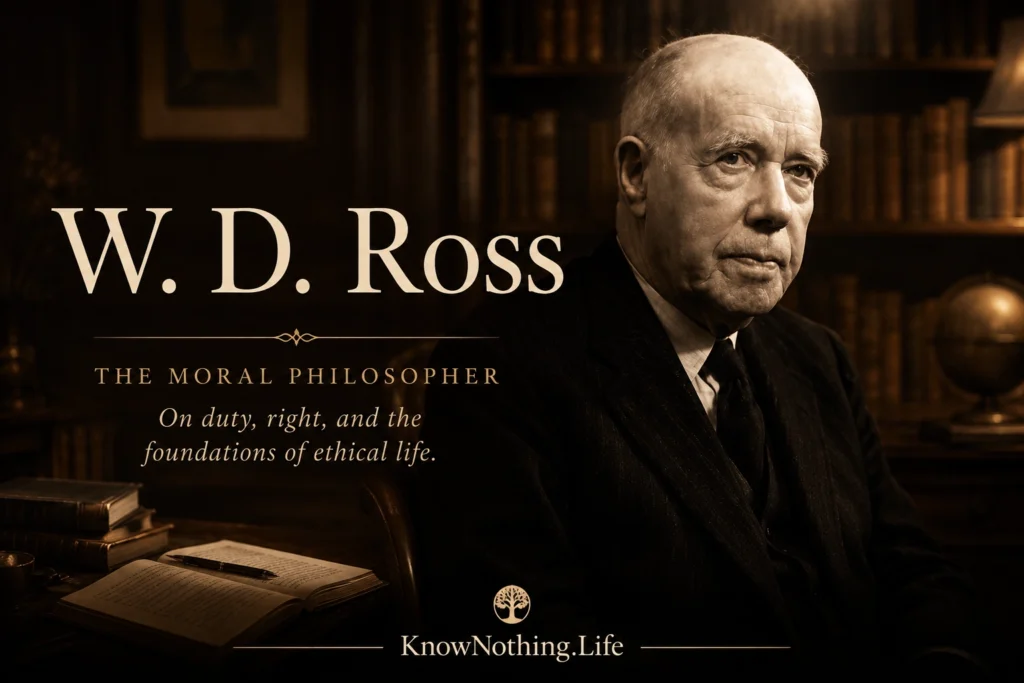
William David Ross was born on April 15, 1877, in Thurso, Scotland, but his earliest childhood was partly spent far from Scotland, in Travancore, India, where his father served as principal of Maharaja’s College. Ross later returned to Scotland for formal education, studying at the Royal High School in Edinburgh and then at the University of Edinburgh, where he graduated with first-class honors in classics in 1895. His early formation was classical, disciplined, and textual, and this background shaped both sides of his later career: his scholarship on ancient philosophy and his careful style of moral argument.
Ross then went to Balliol College, Oxford, where he earned first-class honors in classical moderations in 1898 and in literae humaniores in 1900. Oxford became the center of his intellectual life. He was elected to a fellowship at Merton College and soon became fellow and tutor in philosophy at Oriel College, a position he held for many years. Ross was not a dramatic philosophical personality in the style of Nietzsche, Russell, or Wittgenstein. His influence came from sobriety, exactness, fairness, and the belief that moral philosophy must be faithful to the complexity of ordinary moral life.
Oxford, Public Service, and Academic Leadership
Ross’s life combined scholarship, university administration, and public service. During the First World War, he joined the army and later served in the Ministry of Munitions with the rank of major. He was awarded an OBE after the war and later became a Knight Commander of the Order of the British Empire. His career shows the older Oxford ideal of the scholar-administrator: a person expected not only to write and teach, but also to serve institutions, committees, public bodies, and national life.
In 1929, Ross became Provost of Oriel College, a position he held until 1947. He was elected a Fellow of the British Academy in 1927 and served as its president from 1936 to 1940. During the Second World War, he served on public tribunals and was Vice-Chancellor of Oxford from 1941 to 1944. These administrative roles might seem distant from his moral philosophy, but they are not irrelevant. Ross’s ethics is about judgment under pressure, competing responsibilities, institutional obligations, and the impossibility of reducing all decisions to one simple rule. His life placed him repeatedly inside such practical tensions.
Aristotle and Ancient Philosophy
Before Ross became famous in moral philosophy, he was already one of the leading Aristotelian scholars of the twentieth century. He served as general editor of the Oxford translation series of Aristotle and personally translated major works including the Metaphysics and the Nicomachean Ethics. He also edited Greek texts for the Oxford Classical Texts series and produced major scholarly studies such as Aristotle and Plato’s Theory of Ideas. His work helped make Aristotle available to generations of English-speaking students and philosophers.
This Aristotelian background matters because Ross’s moral philosophy is not abstractly rule-bound in the modern bureaucratic sense. Like Aristotle, he believed ethical judgment requires perception, maturity, and attention to the particulars of a situation. Moral life cannot be managed by a mechanical formula. The good person must see what matters here and now, in this circumstance, with these promises, harms, benefits, loyalties, and risks. Ross’s ethics is analytic in style, but it preserves an Aristotelian respect for practical wisdom.
The Right and the Good
Ross’s most famous philosophical work, The Right and the Good, was published in 1930 and remains one of the central books of twentieth-century moral philosophy. It was written partly in response to G. E. Moore’s ideal utilitarianism and partly against ethical theories that tried to explain all moral obligation through one master principle. Ross thought utilitarianism captured something important: consequences matter. But he rejected the idea that maximizing good is the only thing that matters.
In The Right and the Good, Ross argued that moral life contains several basic kinds of obligation. Promises matter because they are promises. Past wrongs matter because they call for repair. Benefits received matter because they call for gratitude. Harms matter because we have duties not to injure others. Need, virtue, justice, and self-improvement also matter. Ross famously described his account as “a prima facie classification of the duties which reflection on our moral convictions seems actually to reveal.” The phrase shows his method: moral philosophy should begin not by forcing life into a theory, but by reflecting carefully on what thoughtful moral experience discloses.
Prima Facie Duties
Ross’s best-known idea is the doctrine of prima facie duties. The phrase can be misleading, because “prima facie” may sound as if the duty is merely apparent or superficial. Ross did not mean that. He meant that certain moral considerations have real weight, even when they can be overridden by stronger considerations in a particular case. A promise creates a genuine moral reason to keep it, but if keeping that promise prevents one from saving a life, the duty of beneficence or non-maleficence may override it.
Ross’s main prima facie duties include fidelity, reparation, gratitude, justice, beneficence, self-improvement, and non-maleficence. This plurality made his theory different from both Kantian absolutism and utilitarian monism. For Ross, it is wrong to pretend that all moral reasons are secretly one kind of reason. A broken promise, an unpaid debt of gratitude, an avoidable injury, and a chance to help someone are morally different. They may conflict, but conflict does not prove that one of them is unreal. It proves that moral life is complex.
Moral Knowledge and Intuition
Ross is often called an ethical intuitionist, but the word “intuition” can easily mislead modern readers. He did not mean a private hunch, emotional impulse, or mystical feeling. He meant that some moral truths become evident to mature reflection, much as certain logical or mathematical truths become evident when properly understood. In The Right and the Good, he compared confidence in basic moral propositions to confidence in mathematics, arguing that both involve trust in reason rather than proof from something more basic.
This does not mean Ross thought every moral decision is obvious. He sharply distinguished general prima facie duties from actual duty in a concrete case. We may know that promises should generally be kept and harms avoided, but when duties conflict, judgment becomes difficult. Ross wrote that “this sense of our particular duty in particular circumstances, preceded and informed by the fullest reflection we can bestow on the act in all its bearings, is highly fallible.” That sentence is central to his moral realism. Ethics involves knowledge, but not omniscience. We often must act on our best considered judgment.
Foundations of Ethics and Later Moral Work
Ross continued his moral philosophy in Foundations of Ethics, published in 1939. There he clarified and revised parts of his earlier view, responding to critics and developing his ideas about moral knowledge, obligation, goodness, and the relation between right acts and good outcomes. He also wrote Kant’s Ethical Theory, a commentary on Kant’s Groundwork of the Metaphysics of Morals, showing both his respect for Kant and his disagreement with any theory that makes duty depend on one supreme formal principle.
Ross’s later ethical writings remained committed to pluralism. He did not deny the importance of system, but he distrusted simplicity when it falsified experience. One of his most memorable lines is: “Loyalty to the facts is worth more than a symmetrical architectonic or a hastily reached simplicity.” That sentence could stand as the motto of his philosophy. Ross preferred a less elegant theory that preserved moral reality to a beautiful theory that erased half of it. He thought moral philosophy should be answerable to what we actually recognize when we think honestly about promises, harm, justice, gratitude, and responsibility.
Criticism and Influence
Ross’s theory has faced many criticisms. Some philosophers argue that intuitionism cannot explain disagreement. Others question how prima facie duties are weighed against one another. If duties conflict and there is no single supreme rule, how do we know what to do? Ross’s answer is deliberately modest: there may be no mechanical procedure. Judgment requires attention, comparison, reflection, and moral perception. Critics see this as a weakness; defenders see it as realism about the actual difficulty of ethical life.
His influence has grown again in contemporary moral philosophy. Rossian pluralism speaks powerfully to debates about moral dilemmas, medical ethics, professional obligations, war, promises, justice, and partiality. It also challenges modern impatience with complexity. In many real situations, people face not good versus evil, but one real duty against another. A doctor, judge, parent, teacher, citizen, or friend often must balance fidelity, beneficence, fairness, and harm-avoidance. Ross gave philosophy a vocabulary for that experience.
Death and Lasting Legacy
W. D. Ross died in Oxford on May 5, 1971. His legacy is double. As a scholar of ancient philosophy, he helped define twentieth-century English-language Aristotle studies through translations, editions, and commentaries. As a moral philosopher, he gave modern ethics one of its most enduring alternatives to utilitarianism and Kantianism. His work remains important because it protects the plurality of moral life against theories that explain too much by ignoring too much.
Ross’s lasting importance lies in his disciplined moral honesty. He did not promise that ethics could be made easy. He did not reduce right action to calculation, obedience, sentiment, or self-interest. He taught that moral life contains many kinds of reasons, that those reasons can conflict, and that mature judgment must take them all seriously. W. D. Ross remains essential because he gave philosophy a theory for what ordinary conscience already knows: sometimes more than one thing matters, and wisdom begins by refusing to pretend otherwise.