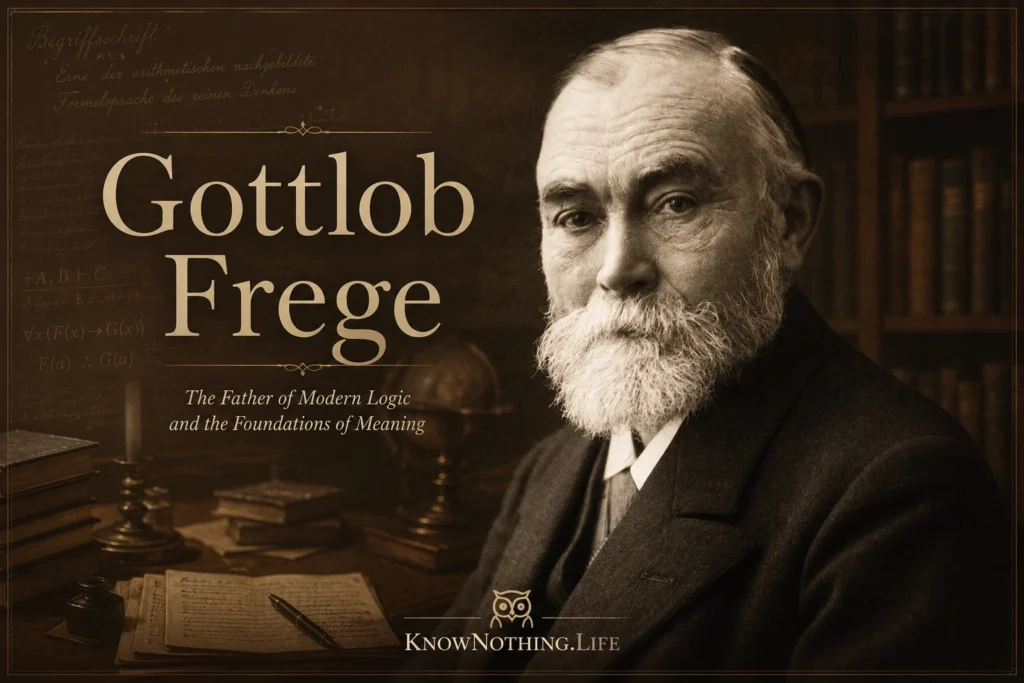
Friedrich Ludwig Gottlob Frege was born on November 8, 1848, in Wismar, then part of Mecklenburg-Schwerin in northern Germany. His father, Alexander Frege, directed a girls’ school, and his mother, Auguste Bialloblotzky Frege, also had connections to education. Frege grew up in a disciplined academic environment, but he did not become a public intellectual, political celebrity, or fashionable lecturer. He became something quieter and, in the long run, more revolutionary: a mathematician who changed the basic language of logic.
Frege studied first at the University of Jena and then at Göttingen, earning his doctorate in mathematics in 1873. In 1874, he completed his habilitation and began teaching at Jena, where he would spend nearly his entire academic career. His official position was in mathematics, not philosophy, yet his work transformed philosophy as deeply as it transformed logic. Frege’s central question was deceptively simple: what makes arithmetic true? His answer led him to rebuild logic, analyze language, and create tools without which modern analytic philosophy would be almost unimaginable.
Jena and the Quiet Life of a Revolutionary
Frege’s career at the University of Jena was outwardly modest. He lectured on mathematics, including geometry, calculus, differential equations, and mechanics, and he did not attract large numbers of students. His manner was reserved, and during his lifetime his work was understood by only a small circle. This limited recognition makes his later influence even more striking. While better-known thinkers were shaping public philosophical culture, Frege was quietly inventing a new logical machinery that later generations would recognize as foundational.
His intellectual temperament was severe and exacting. He distrusted psychologism, the view that logic should be understood as a branch of psychology or as a description of how people happen to think. For Frege, logic concerned objective laws of truth, not mental habits. He wanted to separate the logical from the psychological, the objective from the subjective, and the structure of thought from the accidents of human feeling. This anti-psychologism became one of the guiding principles of analytic philosophy.
Begriffsschrift and the Birth of Modern Logic
In 1879, Frege published Begriffsschrift, usually translated as Concept Script or Conceptual Notation. The book’s subtitle described it as “a formula language of pure thought” modeled on that of arithmetic. Its notation looked strange, even forbidding, and it never became the standard symbolic notation used by later logicians. But its conceptual breakthrough was immense. Frege created a formal system capable of representing quantified statements, multiple generality, logical dependence, and patterns of inference that older Aristotelian logic could not adequately handle.
The importance of Begriffsschrift is hard to exaggerate. Traditional logic had centered on subject-predicate propositions and syllogisms. Frege replaced that framework with an analysis based on functions and arguments, quantifiers, variables, and formal proof. This made it possible to represent claims such as “everyone loves someone” in ways that showed their logical structure clearly. Modern predicate logic begins here. Frege did not merely improve logic; he changed what logic was able to see.
Logicism and The Foundations of Arithmetic
Frege’s great philosophical ambition was logicism: the thesis that arithmetic is grounded in logic. He rejected the Kantian idea that arithmetic depends on pure intuition and the empiricist idea that arithmetic is generalized from experience. Numbers, he argued, are not psychological images, physical marks, or collections of objects. Arithmetic truths are objective, necessary, and logical. To show this, he had to explain numbers using purely logical concepts.
His 1884 book The Foundations of Arithmetic is one of the masterpieces of philosophy of mathematics. In it, Frege set out three methodological principles, including the famous context principle: “never to ask for the meaning of a word in isolation, but only in the context of a proposition.” This sentence helped change philosophy by shifting attention from isolated terms to the role expressions play in complete judgments. Frege’s question was not what mental picture attaches to the word “number,” but how number words function in true propositions.
Sense, Reference, and the Philosophy of Language
In the early 1890s, Frege developed ideas that made him one of the founders of modern philosophy of language. His 1892 essay “On Sense and Reference” introduced the distinction between the sense of an expression and its reference. The reference of “the morning star” and “the evening star” is the same object, the planet Venus. But the two expressions present that object in different ways. Their senses differ even though their reference is identical.
This distinction solved a deep puzzle about identity statements. “The morning star is the morning star” is trivial, but “the morning star is the evening star” is informative. If both names simply refer to the same object, why should one statement tell us something new? Frege’s answer was that meaning involves more than reference. It also involves a mode of presentation. This insight shaped later debates about language, belief, meaning, knowledge, and intensional contexts. When we speak about what someone believes, hopes, doubts, or discovers, the way an object is presented can matter as much as the object itself.
Concepts, Objects, and Thoughts
Frege’s philosophy depends on sharp distinctions. One of the most important is the distinction between concept and object. Objects are complete; concepts are unsaturated or incomplete, functioning like predicates that require an argument. The expression “is a philosopher” does not name an object in the same way “Socrates” does. It signifies a concept under which objects may fall. Frege thought many philosophical confusions arise when concepts and objects are treated as if they belonged to the same logical category.
He also developed a powerful account of thoughts. A thought, for Frege, is not a private mental event. It is the objective sense of a sentence, something that can be grasped by different thinkers and judged true or false. In “The Thought,” he emphasized how difficult this is to explain because a thought cannot simply be held up for inspection like a physical object. He wrote that he was not in the position of a mineralogist who could show readers a crystal. The thought must be presented through language, even though language can distort it. This tension between thought and language runs through all of Frege’s work.
Basic Laws and Russell’s Paradox
Frege’s most ambitious technical work was Grundgesetze der Arithmetik, or Basic Laws of Arithmetic, published in two volumes in 1893 and 1903. In it, he tried to derive arithmetic from logical axioms using his formal system. The project was vast, difficult, and heroic. Frege believed he had given arithmetic the foundation it required: not intuition, not experience, not psychology, but logic.
Then, just as the second volume was going to press, Bertrand Russell wrote to Frege and showed that one of Frege’s basic principles led to contradiction. The result became known as Russell’s paradox. Frege understood the seriousness immediately. In the appendix to the second volume, he wrote that “hardly anything more unfortunate can befall a scientific writer” than to have a foundation shaken after the work is complete. His proposed repair did not succeed. The logicist project, in Frege’s own form, was broken at its foundation.
Influence Through Russell, Wittgenstein, and Analytic Philosophy
Frege’s life was marked by limited recognition, but his influence spread through some of the most important philosophers of the next generation. Bertrand Russell recognized his greatness and drew heavily on his work in the development of logicism and analytic philosophy. Ludwig Wittgenstein studied Frege closely and visited him before turning to Russell. Through Russell and Wittgenstein, Frege became a central ancestor of the analytic tradition, even though many philosophers came to know him only after his most creative years had passed.
His influence extends into mathematical logic, philosophy of mathematics, philosophy of language, semantics, computer science, linguistics, and theories of meaning. The formal logic used in contemporary philosophy, mathematics, and computer science is not simply Frege’s notation, but it descends from the revolution he began. His sense-reference distinction still frames debates about names, descriptions, belief reports, identity, and meaning. His anti-psychologism helped define the idea that logic and mathematics are objective disciplines.
Personal Views and Historical Complexity
Frege’s intellectual greatness must be held together with the difficulties of his personal and political views. Later diary materials revealed strongly conservative, nationalist, and antisemitic opinions. These views were not the source of his logic, and they do not cancel the significance of his technical and philosophical work, but they belong honestly to the historical record. Like many major thinkers, Frege cannot be turned into a simple monument without distortion.
This complexity matters because Frege’s work is devoted to objectivity, clarity, and truth, while his private political judgments show how even a great logician can be morally and socially limited. The lesson is not to dismiss his achievements, but to read him with adult seriousness. Intellectual rigor in one domain does not guarantee moral wisdom in every domain. Frege remains a foundational figure, but not a saint.
Death and Lasting Legacy
Gottlob Frege died on July 26, 1925, in Bad Kleinen, Germany. He did not live to see the full scale of his influence. During his lifetime, much of his work was neglected, misunderstood, or appreciated only by a few. Yet after his death, philosophers and logicians increasingly recognized that he had transformed the foundations of several fields at once. He gave logic a new formal power, gave philosophy of language a new set of problems, and gave philosophy of mathematics one of its most ambitious programs.
Frege’s lasting importance lies in the depth of his demand for clarity. He wanted thought to be freed from the ambiguities of ordinary language without losing its connection to truth. He wanted arithmetic to rest on secure foundations. He wanted logic to be objective rather than psychological. His own system failed at a crucial point, but the failure became part of the history of modern logic. Gottlob Frege remains essential because he showed that the smallest words, the simplest numbers, and the most ordinary statements can conceal the deepest structures of reason.