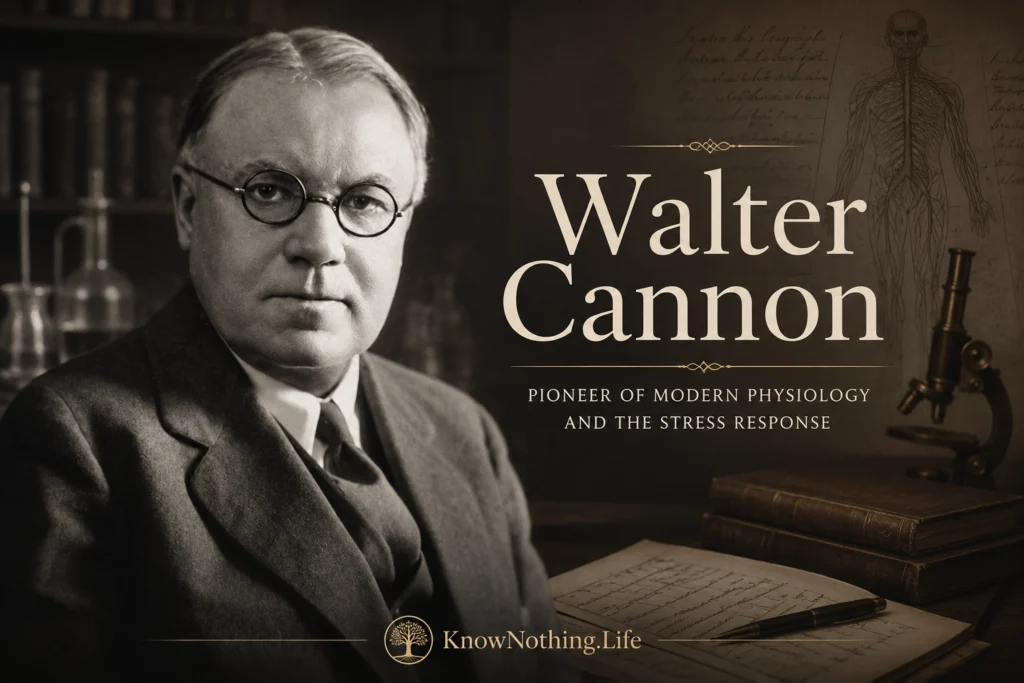
Walter Bradford Cannon was an American physiologist whose research changed how scientists understand digestion, emotion, stress, and the internal regulation of the body. Working at Harvard Medical School during the formative decades of modern physiology, Cannon used new imaging methods and carefully designed experiments to study living processes as they unfolded. His investigations helped explain how emotional excitement affects digestion, how the sympathetic nervous system prepares an organism for danger, and how multiple organs cooperate to maintain a relatively stable internal environment.
Cannon is most closely associated with the fight-or-flight response and the concept of homeostasis, but his achievements extended into medical education, traumatic-shock research, emotion theory, and humanitarian activism. His major books include The Mechanical Factors of Digestion, Bodily Changes in Pain, Hunger, Fear and Rage, Traumatic Shock, The Wisdom of the Body, and The Way of an Investigator. Across these works, he presented the organism as an active, coordinated system that continually adjusts to threats and disturbances rather than remaining passively balanced.
Early Life and Harvard Education
Walter Bradford Cannon was born on October 19, 1871, in Prairie du Chien, Wisconsin. His father worked for the railroad, and his mother was a schoolteacher. Cannon entered Harvard College, where he developed interests in biology, philosophy, and psychology, graduating summa cum laude in 1896. He then attended Harvard Medical School and received his medical degree in 1900. Although trained as a physician, he became increasingly attracted to experimental investigation and the possibility of discovering general principles underlying bodily function.
Cannon remained at Harvard after graduation, first as an instructor and later as a professor. In 1906, he succeeded Henry Pickering Bowditch as George Higginson Professor of Physiology and chair of the physiology department, positions he held until 1942. Cannon also promoted the case method in medical education, arguing that students could learn more effectively by studying actual clinical records and reasoning through problems rather than memorizing textbooks alone. His approach reflected a career-long preference for active inquiry over passive reception.
X-Rays and the Physiology of Digestion
Cannon began his first major research program while still a medical student. Shortly after Wilhelm Röntgen announced the discovery of X-rays, Bowditch encouraged Cannon and fellow student Albert Moser to use the new technology to examine swallowing and digestion. By mixing radiopaque substances with food, they could observe the movement of material through an intact animal’s esophagus, stomach, and intestines. Earlier methods often required surgery or isolated organs, interventions that could substantially alter normal digestive activity.
These studies showed that digestion was a coordinated mechanical process involving muscular contractions, sphincters, nervous control, and changing pressures. Cannon summarized much of this work in The Mechanical Factors of Digestion, published in 1911. During the experiments, he also noticed that frightened or agitated animals displayed reduced stomach and intestinal movement. This apparently incidental observation redirected his research toward the bodily consequences of emotion and eventually helped connect gastrointestinal physiology with the emerging science of stress.
Emotion and the Fight-or-Flight Response
In Bodily Changes in Pain, Hunger, Fear and Rage, first published in 1915, Cannon investigated the physiological reactions accompanying intense emotion. He described fear, rage, pain, and hunger as “primitive experiences” shared by human beings and other animals. These states were accompanied by coordinated changes involving the heart, blood vessels, breathing, digestion, blood sugar, and adrenal glands. The reactions were not random disturbances; Cannon interpreted them as adaptive preparations for urgent action.
Cannon showed that sympathetic nervous-system activation and the release of adrenaline could accelerate the heart, redirect blood toward skeletal muscles, mobilize stored energy, and inhibit digestive activity. This coordinated emergency response became known as the fight-or-flight response. An animal confronting danger might attack or escape, but both actions required rapid circulation, energy, alertness, and muscular readiness. Cannon thereby connected emotional experience with a whole-body survival system whose effects could be observed experimentally.
The Cannon–Bard Theory of Emotion
Cannon’s findings also led him to challenge the James–Lange theory, which held that emotional experience results from perceiving changes occurring in the body. Cannon argued that visceral reactions were often too slow and too similar across different emotional and nonemotional conditions to account fully for distinct feelings such as fear or anger. People could also experience emotion even when bodily feedback had been reduced, suggesting that conscious feeling could not be explained solely as an interpretation of the heartbeat, muscles, or internal organs.
Working with his student Philip Bard, Cannon developed what became known as the Cannon–Bard theory of emotion. In its historical form, the theory assigned important roles to the thalamus and hypothalamus and proposed that emotional experience and bodily arousal occur through parallel processes rather than one simply causing the other. Later neuroscience substantially revised this anatomical model, but Cannon and Bard’s work helped move emotion research toward the brain and challenged overly simple accounts of the relationship between feeling and physiology.
Homeostasis and The Wisdom of the Body
Cannon’s broadest theoretical contribution appeared in The Wisdom of the Body, published in 1932. Building upon Claude Bernard’s idea of a stable internal environment, Cannon introduced homeostasis as a name for the coordinated processes that preserve important bodily conditions within workable ranges. Temperature, blood sugar, oxygen, water, salts, and acid-base balance must remain sufficiently regulated even as activity and the external environment continually change.
Homeostasis did not mean perfect constancy or motionless equilibrium. Cannon described it as “a condition which may vary, but is relatively constant.” The body maintains stability through adjustment: sweating cools it, shivering generates heat, thirst encourages fluid intake, and hormones mobilize or store energy. This view helped establish regulation and negative feedback as central principles of physiology. It later influenced endocrinology, neuroscience, cybernetics, stress research, ecology, and systems theory.
War, Traumatic Shock, and Humanitarian Work
During the First World War, Cannon served in France with a Harvard medical unit and later worked near the front at a British casualty clearing station. He investigated traumatic shock, a poorly understood condition in which severely injured soldiers developed dangerously low blood pressure and inadequate circulation. Cannon emphasized the role of blood-volume loss and insufficient oxygen delivery to tissues, helping clarify the physiological processes that made shock fatal. His findings were later presented in Traumatic Shock.
Cannon’s public commitments extended beyond the laboratory. During the Spanish Civil War, he chaired organizations providing medical assistance to the Spanish Republic and supported physicians, nurses, and refugees affected by fascist violence. His humanitarian involvement reflected his belief that scientific knowledge carried social responsibilities. A hospital serving Spanish Republican exiles in Toulouse later added Walter B. Cannon’s name in recognition of his assistance.
Scientific Method and Major Works
Cannon described the personal and practical realities of research in The Way of an Investigator, published in 1945. The book combined autobiography with reflections on observation, intuition, mistakes, collaboration, and experimental design. He resisted romantic images of discoveries appearing through inspiration alone. Productive research required freedom to think, familiarity with a problem, patience with failure, and enough uninterrupted time to follow unexpected evidence. “Time,” he wrote, “is an essential requirement for effective research.”
His bibliography reveals the unity of his scientific project. The Mechanical Factors of Digestion examined coordinated movement within the gastrointestinal system. Bodily Changes in Pain, Hunger, Fear and Rage explained emergency physiology. Traumatic Shock addressed circulatory collapse after injury, while The Wisdom of the Body developed a general theory of internal regulation. The Way of an Investigator completed the sequence by examining how such knowledge is created. Each work moved from specific observations toward larger principles without losing contact with experimental evidence.
Final Years and Lasting Influence
Cannon retired from his Harvard chair in 1942 but continued writing, traveling, and conducting research despite declining health. He died on October 1, 1945, shortly before his seventy-fourth birthday. By then, his work had established him as one of the leading American physiologists of the twentieth century. Harvard’s medical archives preserve extensive records of his research, administration, correspondence, teaching, and public activities.
Cannon’s enduring contribution was a dynamic vision of biological stability. Organisms survive not because their internal conditions never change, but because coordinated systems detect disturbances and respond before those disturbances become destructive. His studies of emotional arousal showed how survival mechanisms can interrupt digestion and reorganize the body for action, while his theory of homeostasis explained how the same body returns toward stability. Modern accounts of stress are more complex, but they continue to develop within the scientific landscape Cannon helped create.