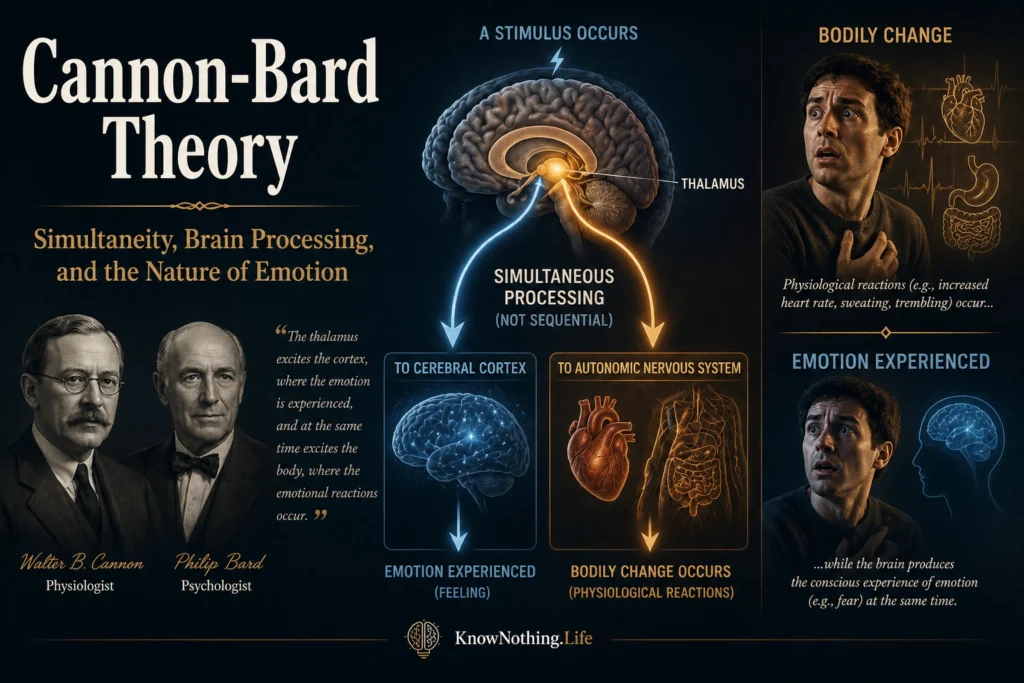
The Cannon-Bard theory of emotion emerged as a direct challenge to earlier physiological models, particularly the James-Lange theory, which argued that emotions arise from the perception of bodily changes. Developed by Walter Cannon and later refined by Philip Bard, the Cannon-Bard model proposed a fundamentally different sequence: emotional experience and physiological arousal occur simultaneously, not sequentially.
This theory marked a shift in emphasis from the body to the brain, particularly central neural mechanisms involved in emotional processing. It argued that emotions are not merely interpretations of bodily states but are generated by brain activity that also triggers physical responses. Cannon, in his work Bodily Changes in Pain, Hunger, Fear, and Rage, contended that “the same visceral changes can occur in very different emotional states,” challenging the idea that each emotion corresponds to a distinct physiological pattern. The Cannon-Bard theory thus laid the groundwork for modern neuroscience approaches to emotion, emphasizing central processing and integration.
Historical Context and Development
The development of the Cannon-Bard theory took place in the early 20th century, a period of rapid advancement in physiology and neuroscience. By this time, researchers had begun to question the sufficiency of purely peripheral explanations of emotion. Cannon’s critique of the James-Lange theory was grounded in both experimental evidence and logical analysis, highlighting inconsistencies in the idea that bodily changes alone could account for emotional experience.
Cannon conducted studies on animals, demonstrating that even when certain physiological pathways were disrupted, emotional behaviors could still be observed. These findings suggested that the brain, rather than the body, played a primary role in generating emotional responses. Bard extended this work by identifying specific brain regions, particularly the thalamus, as critical for emotional processing.
This shift toward central mechanisms reflected a broader trend in psychology and neuroscience, moving away from purely descriptive accounts of behavior toward explanations rooted in biological systems. The Cannon-Bard theory represents a key moment in this transition, integrating physiological research with psychological theory to produce a more comprehensive model of emotion.
Core Principles of the Theory
The central claim of the Cannon-Bard theory is that emotional stimuli are processed by the brain, which simultaneously produces both the subjective experience of emotion and the physiological response. When an individual encounters a stimulus—such as a threatening situation—the sensory information is transmitted to the brain, particularly the thalamus, which then sends signals to both the cortex and the autonomic nervous system.
The cortex is responsible for the conscious experience of emotion, while the autonomic nervous system generates bodily responses such as increased heart rate or sweating. These processes occur in parallel, rather than one causing the other. For example, upon seeing a dangerous animal, an individual would simultaneously feel fear and experience physiological arousal, rather than one preceding the other.
This model addresses several limitations of earlier theories. By proposing simultaneous activation, it explains how emotions can occur rapidly, without the delay that would be required for bodily changes to be perceived and interpreted. It also accounts for the similarity of physiological responses across different emotions, suggesting that the brain plays a key role in differentiating emotional experiences.
The Role of the Brain in Emotion
A central contribution of the Cannon-Bard theory is its emphasis on the brain as the primary site of emotional processing. Cannon and Bard identified the thalamus as a critical structure in this process, acting as a relay station that integrates sensory information and coordinates responses. While later research has refined this view, identifying additional structures such as the amygdala and hypothalamus, the basic principle of central processing remains fundamental.
Neuroscientist Joseph LeDoux expanded on these ideas by demonstrating that emotional processing involves multiple pathways in the brain. His research on fear responses showed that the amygdala plays a key role in detecting threats and initiating rapid responses, supporting the notion that emotions can be generated independently of conscious awareness.
The brain’s role in emotion highlights the integration of cognitive and physiological processes. Emotional experiences are not isolated events but are embedded within broader neural networks that involve perception, memory, and decision-making. This perspective aligns with contemporary views of the brain as a complex system in which multiple regions interact to produce behavior.
Criticisms and Challenges
Despite its influence, the Cannon-Bard theory has faced criticism and revision. One major challenge is the identification of specific brain regions responsible for emotion. While Cannon and Bard emphasized the thalamus, later research has shown that emotional processing is distributed across multiple areas, including the amygdala, prefrontal cortex, and limbic system.
Another limitation is the theory’s relative neglect of cognitive processes. While it acknowledges the role of the brain, it does not fully account for how interpretation and context influence emotional experience. This gap was addressed by later theories, such as the Schachter-Singer model, which incorporated cognitive appraisal into the understanding of emotion.
Additionally, some evidence suggests that bodily feedback does play a role in emotional experience, supporting aspects of the James-Lange theory. For example, changes in facial expression or posture can influence how emotions are felt, indicating that the relationship between body and emotion is more complex than either theory alone can explain.
Influence on Modern Emotion Theories
The Cannon-Bard theory has had a lasting impact on the study of emotion, particularly in its emphasis on central neural mechanisms. It paved the way for contemporary neuroscience research, which focuses on the brain’s role in generating and regulating emotional responses. The identification of neural circuits involved in emotion has built on the foundation established by Cannon and Bard, expanding our understanding of how emotions are processed.
Modern theories often integrate elements of both peripheral and central approaches, recognizing that emotion involves interactions between the brain and body. For example, the somatic marker hypothesis proposed by Antonio Damasio suggests that bodily states influence decision-making and emotion, combining insights from both the James-Lange and Cannon-Bard traditions.
The legacy of the Cannon-Bard theory is also evident in clinical applications. Understanding the neural basis of emotion has informed treatments for disorders such as anxiety and depression, leading to interventions that target specific brain systems. This integration of theory and practice demonstrates the enduring relevance of the model.
Philosophical Implications
The Cannon-Bard theory raises important philosophical questions about the nature of emotion and the relationship between mind and body. By emphasizing the role of the brain, it challenges views that locate emotion primarily in the body or in subjective experience alone. Instead, it suggests that emotions are constructed through neural processes that integrate sensory input and generate both feeling and action.
This perspective has implications for understanding consciousness and self-awareness. If emotions are generated by brain activity, then subjective experience is closely tied to neural processes, raising questions about the nature of mental states and their relationship to physical systems. These issues remain central to debates in philosophy of mind and cognitive science.
Cannon himself was aware of these broader implications, viewing emotion as a key aspect of the organism’s adaptation to its environment. His work reflects an effort to bridge physiological and psychological perspectives, contributing to a more unified understanding of human experience.
Conclusion
The Cannon-Bard theory represents a pivotal development in the scientific study of emotion, shifting the focus from peripheral bodily responses to central brain mechanisms. By proposing that emotional experience and physiological arousal occur simultaneously, it addressed key limitations of earlier models and laid the groundwork for modern neuroscience approaches.
Although subsequent research has refined and expanded its claims, the core insight of the Cannon-Bard theory—that the brain plays a central role in generating emotion—remains influential. It highlights the complexity of emotional processes and the need for integrative models that account for the interplay between brain, body, and environment. In doing so, it continues to shape our understanding of how emotions arise and how they influence behavior.