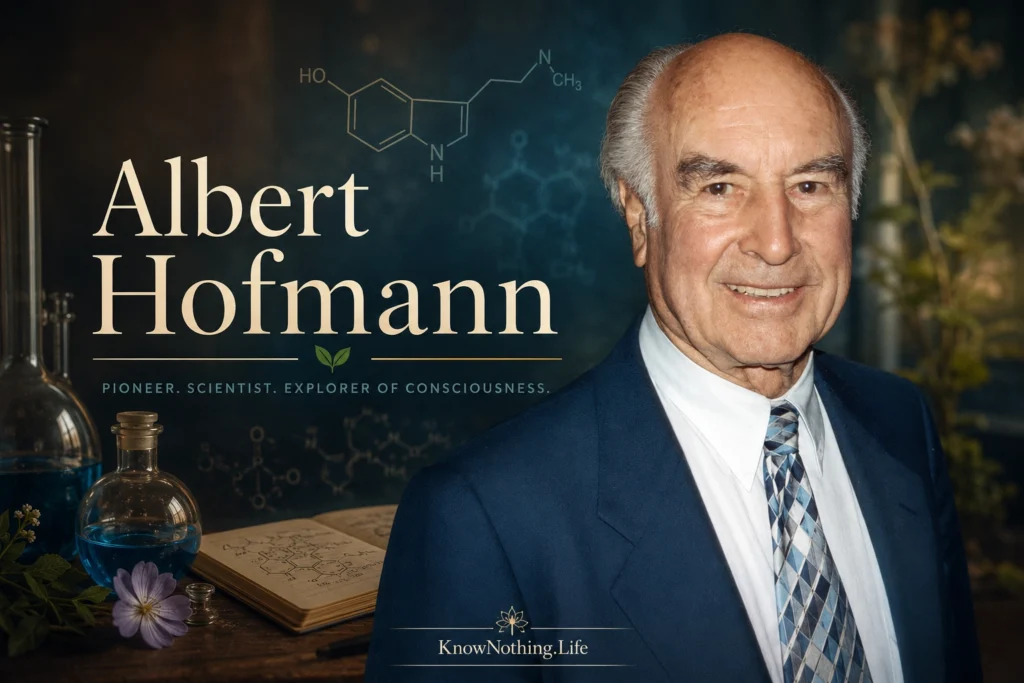
Albert Hofmann was a Swiss chemist whose investigations of medicinal plants produced one of the twentieth century’s most consequential scientific discoveries. While studying compounds derived from ergot, a fungus that grows on rye and other grains, he synthesized lysergic acid diethylamide, better known as LSD. Hofmann initially created the substance in 1938 while searching for a possible circulatory and respiratory stimulant. Five years later, after unexpectedly experiencing its extraordinary psychological effects, he recognized that minute quantities could profoundly alter perception, emotion, thought, and the experience of self.
Although LSD made Hofmann internationally famous, it represented only one part of a long and productive scientific career. He helped develop medically useful ergot derivatives, identified the active compounds in psychedelic mushrooms, investigated psychoactive seeds used in Indigenous Mexican ceremonies, and wrote extensively about chemistry, consciousness, nature, and mystical experience. His major works include The Ergot Alkaloids, LSD: My Problem Child, Insight Outlook, Plants of the Gods, and The Road to Eleusis. Hofmann spent much of his later life defending the careful scientific study of psychedelics while warning against uncontrolled and irresponsible use.
Early Life and Scientific Education
Albert Hofmann was born on January 11, 1906, in Baden, Switzerland. He grew up as the eldest of four children in a family of modest means. His father worked as a factory toolmaker, and financial assistance from Hofmann’s godfather helped make higher education possible. Hofmann became fascinated by the natural world during childhood, especially by moments in forests and meadows when familiar surroundings seemed suddenly radiant and interconnected. Those experiences later influenced his belief that scientific knowledge and mystical wonder did not have to oppose one another.
At twenty, Hofmann began studying chemistry at the University of Zurich under Nobel Prize-winning chemist Paul Karrer. His interests centered on the chemistry of living organisms rather than industrial materials, and his doctoral research examined the structure of chitin, a carbohydrate found in animals such as insects and shellfish. He completed his doctorate with distinction in 1929 and joined the pharmaceutical department of Sandoz Laboratories in Basel that same year. The position allowed him to work with natural substances whose active components might be isolated, understood, and transformed into medicines.
Sandoz and the Chemistry of Ergot
At Sandoz, Hofmann entered a research group led by Arthur Stoll, a pioneering investigator of medicinal plant compounds. One of the department’s principal subjects was ergot, the hardened fungal growth that infects rye. Ergot had a disturbing history: contaminated grain could cause severe poisoning, convulsions, hallucinations, circulatory damage, and death. Yet some of its alkaloids also had valuable medical properties, particularly their ability to contract the uterus and influence blood vessels. Sandoz researchers hoped to separate these therapeutic effects from the fungus’s dangers.
Hofmann became an authority on lysergic acid, the chemical foundation shared by several ergot alkaloids. His work contributed to compounds used in obstetrics, migraine treatment, and circulatory medicine. Drugs associated with his research included Methergine, used to control bleeding after childbirth, and other ergot derivatives developed for vascular conditions. These achievements would have secured Hofmann a distinguished pharmaceutical career even without LSD. They also demonstrate that he was not pursuing intoxication or mystical experience when he created his most famous compound; he was conducting systematic medicinal chemistry within an established research program.
The Synthesis and Rediscovery of LSD
In 1938, Hofmann combined lysergic acid with diethylamide, producing the twenty-fifth substance in a series of related compounds. It was therefore labeled LSD-25. The goal was to create a stimulant affecting respiration and circulation without producing the strong uterine contractions associated with some other ergot derivatives. Initial animal testing did not reveal effects that interested Sandoz pharmacologists enough to justify further development, and LSD-25 was set aside.
Hofmann nevertheless retained what he later described as a peculiar intuition that the substance possessed overlooked properties. In April 1943, he synthesized it again. On April 16, he unexpectedly experienced restlessness, dizziness, vivid imagery, and unusually intensified colors, apparently after absorbing a minute trace during laboratory work. The experience was so remarkable that he decided to conduct a deliberate self-experiment. Hofmann later summarized the unusual path of discovery in three words: “LSD came to me.”
Bicycle Day and the First Deliberate LSD Experience
On April 19, 1943, Hofmann ingested 0.25 milligrams of LSD, believing this to be an extremely small dose. He did not yet know that the compound was active in microgram quantities. As its effects intensified, wartime restrictions prevented the use of a car, so his laboratory assistant accompanied him home by bicycle. The journey later became known as Bicycle Day. Streets and objects appeared distorted, his sense of movement became unreliable, and he feared that he was losing his mind or dying.
At home, Hofmann’s anxiety deepened as ordinary surroundings assumed frightening forms. A physician found no grave physical abnormality apart from dilated pupils, and the threatening phase gradually gave way to streams of extraordinary colors and shapes. The following morning, Hofmann felt physically refreshed and perceived the world with unusual vividness. Describing his struggle during the experience, he wrote that “every exertion of my will” seemed unable to stop the dissolution of his familiar reality. The episode revealed both LSD’s remarkable potency and its ability to produce experiences ranging from terror to wonder.
Psychiatry, Research, and Cultural Conflict
Sandoz introduced LSD to researchers under the trade name Delysid in 1947. Psychiatrists investigated whether it could help patients access difficult psychological material, while some therapists took the substance themselves in an effort to understand altered or psychotic states. Early research explored its possible use alongside psychotherapy for anxiety, addiction, trauma, and distress associated with serious illness. The compound also became an important research tool for studying serotonin and the biological foundations of consciousness.
During the 1960s, LSD moved from clinical settings into the counterculture and became associated with Timothy Leary, political rebellion, mass experimentation, and recreational use. Hofmann was distressed by this development. He believed LSD could be valuable when administered carefully to prepared individuals in controlled surroundings, but he regarded careless use as dangerous. He emphasized the importance of dose, mental preparation, supervision, and environment, noting that powerful psychedelic experiences could cause panic or lasting harm in vulnerable people. Legal restrictions imposed from the late 1960s onward sharply reduced legitimate research for decades.
Psilocybin and the Study of Sacred Plants
Hofmann’s research expanded beyond ergot after ethnomycologist R. Gordon Wasson drew scientific attention to ceremonial mushroom use in Mexico. Working with cultivated specimens of Psilocybe mexicana, Hofmann and his colleagues isolated psilocybin and smaller quantities of psilocin in 1958. Hofmann then determined their chemical structures and synthesized them. The discovery connected modern pharmaceutical chemistry with psychoactive mushrooms that had been used within Mesoamerican religious and healing traditions for centuries.
He also investigated ololiuqui, seeds employed ceremonially by Indigenous Mexican communities, and discovered that their active constituents included lysergic acid amides closely related to LSD. With ethnobotanist Richard Evans Schultes, he produced Plants of the Gods, a richly illustrated examination of culturally significant psychoactive plants. In The Road to Eleusis, written with Wasson and classicist Carl Ruck, Hofmann considered whether an ergot-derived preparation might have contributed to visionary experiences during the ancient Greek Eleusinian Mysteries. The hypothesis remains debated, but it exemplified his interest in the historical relationship among chemistry, ritual, and consciousness.
LSD: My Problem Child and Hofmann’s Philosophy
Hofmann explained his most famous discovery and its consequences in LSD: My Problem Child, first published in German in 1979. The title expressed his ambivalence. LSD was a scientific achievement with potential value, but its escape from controlled research had produced sensationalism, prohibition, and suffering. The book combines laboratory history, personal memoir, reports of psychedelic experiences, correspondence with writers such as Aldous Huxley, and reflections on the relationship between matter and mind. It remains his most influential written work.
Hofmann’s later thinking joined scientific realism with reverence for nature. He rejected the view that chemistry necessarily reduces life to meaningless matter. Instead, the extraordinary influence of tiny molecular quantities convinced him that matter and consciousness were linked in ways science had only begun to understand. In a later interview, he urged people to return to gardens, woods, and meadows, calling nature “the circle of life, of which we are an integral part.” Psychedelics, in his view, were not substitutes for such connection but possible tools for recovering an awareness modern technological culture often obscured.
Final Years and Lasting Legacy
Hofmann retired from Sandoz in 1971 but continued lecturing, writing, corresponding with researchers, and advocating for renewed scientific investigation of psychedelic compounds. His honors included an honorary doctorate from ETH Zurich and the Scheele Award from the Swedish Pharmaceutical Society. He lived with his wife, Anita, near Basel and remained intellectually active into extreme old age. Hofmann died from a heart attack on April 29, 2008, at the age of 102.
Albert Hofmann’s legacy extends beyond the accidental discovery of a controversial drug. He was an accomplished natural-products chemist who developed useful medicines, identified psilocybin and psilocin, and helped create a scientific vocabulary for examining psychedelic experience. His life also embodied a tension that remains unresolved: substances capable of producing insight and therapeutic benefit can also cause fear, misuse, and social disruption. Hofmann’s answer was neither unrestricted enthusiasm nor permanent prohibition, but disciplined research guided by caution, respect, and wonder.