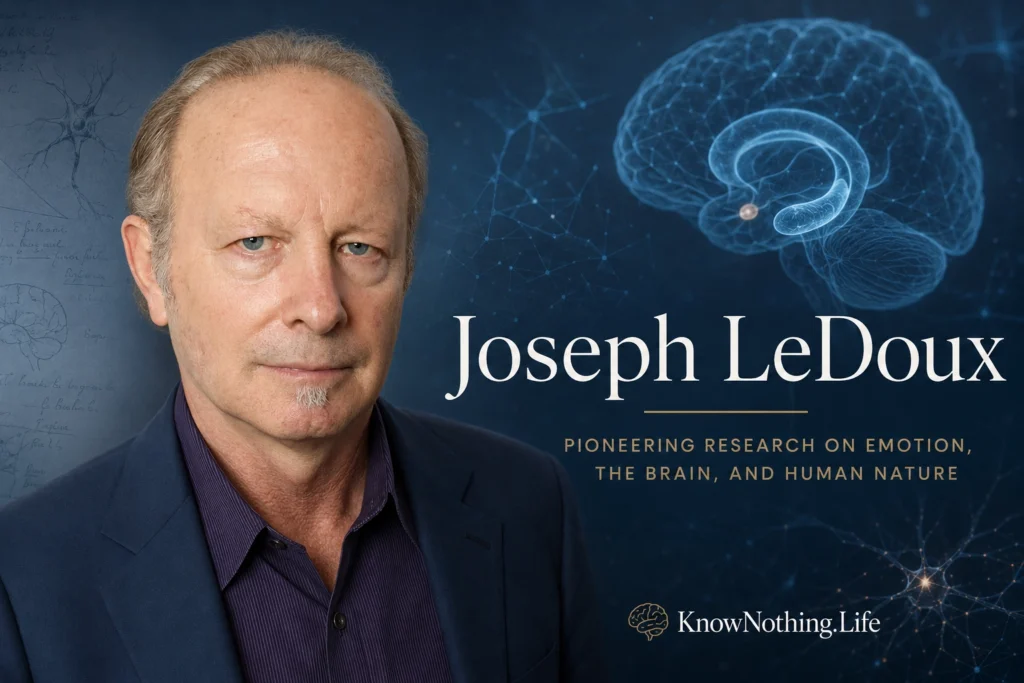
Joseph E. LeDoux is an American neuroscientist whose research transformed the scientific understanding of emotion, memory, anxiety, and consciousness. He became internationally known for tracing the neural pathways through which organisms learn that previously harmless sights or sounds predict danger. This work established the amygdala as a crucial part of the brain systems that detect threats, store defensive associations, and organize bodily responses. Yet LeDoux’s later scholarship also challenged the oversimplified idea that the amygdala is a self-contained “fear center.” His career is distinguished not only by influential discoveries but by his willingness to revise the language used to interpret them.
LeDoux’s major books include The Emotional Brain, Synaptic Self, Anxious, The Deep History of Ourselves, and The Four Realms of Existence. Across these works, he has explored how unconscious survival processes interact with memory, thought, bodily arousal, and conscious feeling. His central message has evolved over time: defensive reactions and emotional experiences are related, but they are not identical. A racing heart, freezing response, or activated amygdala may contribute to fear without being the conscious feeling of fear itself. This distinction has significant consequences for neuroscience, psychology, and the treatment of anxiety disorders.
Cajun Roots and an Unexpected Path into Neuroscience
LeDoux was born on December 7, 1949, in Eunice, Louisiana, a small community in the state’s Cajun region. His father operated a butcher shop and had once ridden bulls, while his mother handled much of the business administration. As a child, LeDoux sometimes helped prepare animal brains for customers, removing the tough outer tissue and locating bullets left from slaughter. He later joked that the experience gave him an unusual familiarity with brain anatomy, although he did not initially plan to become a scientist. His early cultural world of family business, Cajun traditions, country music, and Catholic life would eventually reappear in his writing and music.
At Louisiana State University, LeDoux studied business administration and psychology, earning a bachelor’s degree in 1971 and a master’s degree in 1974. His graduate training combined marketing and psychology, but his interests increasingly shifted toward how people make decisions and become conscious of their own behavior. He entered the psychobiology doctoral program at the State University of New York at Stony Brook and completed his Ph.D. in 1978. Within only a few years, he had moved from business studies into experimental research on some of the most difficult questions in neuroscience.
Split-Brain Research and the Problem of Consciousness
LeDoux conducted his doctoral research with cognitive neuroscientist Michael Gazzaniga, studying patients whose cerebral hemispheres had been surgically disconnected to control severe epilepsy. These split-brain cases offered an extraordinary opportunity to examine how the two hemispheres process information and contribute to conscious experience. LeDoux helped investigate language, spatial behavior, memory, and the extent to which each hemisphere could support independent forms of awareness. Their work contributed to The Integrated Mind, published in 1978, and to several major scientific papers on cerebral lateralization.
One especially influential idea concerned the left hemisphere’s tendency to construct explanations for behavior even when it lacked access to the real cause. When information was presented only to the right hemisphere, the left could sometimes invent a plausible narrative explaining an action it had not initiated. This “interpreter” concept suggested that conscious self-understanding is partly constructed after events occur. LeDoux would later carry this insight into his theories of emotion: conscious feelings may be interpretations assembled from bodily signals, memories, perceptions, and knowledge rather than automatic products released from a single emotional center.
Mapping Threat Learning and the Amygdala
After completing his doctorate, LeDoux spent approximately a decade at Cornell University Medical College. Because the available methods for studying emotional consciousness directly in humans were limited, he turned to animal research and Pavlovian conditioning. In these experiments, a neutral sound was paired with an unpleasant event. After learning the association, the sound alone produced defensive reactions such as freezing and changes in heart rate. By tracing the auditory pathways involved, LeDoux and his colleagues identified the lateral amygdala as a critical site where sensory information about the sound converged with information about the aversive event.
LeDoux joined New York University’s newly established Center for Neural Science in 1989 and built a research program examining the cellular, molecular, and circuit mechanisms of threat learning. His laboratory demonstrated how sensory inputs reach the amygdala, how synaptic plasticity allows threatening associations to be stored, and how different amygdala outputs control behavioral, hormonal, and autonomic responses. The research helped show that emotional learning could be analyzed with the same experimental precision applied to perception and ordinary memory. It also supplied biological foundations for understanding why reminders of traumatic events can automatically provoke intense physical reactions.
The Emotional Brain and Emotional Memory
LeDoux brought this research to a broad audience in The Emotional Brain, published in 1996. The book explained how evolutionarily ancient brain systems can respond to danger before a person has consciously identified what is happening. His influential description of relatively direct and indirect sensory routes became widely known as the “low road” and “high road.” A rapid subcortical route can initiate a rough defensive response, while more detailed cortical processing evaluates the stimulus with greater accuracy. The framework helped explain why people sometimes react first and understand their reactions afterward.
The book also distinguished between explicit and implicit forms of emotional memory. A person may consciously remember a distressing event through systems involving the hippocampus while separately carrying conditioned bodily responses supported by amygdala circuits. These memories can remain partly independent: someone may know that a situation is safe yet continue to experience sweating, tension, or avoidance. This division became important for theories of trauma and anxiety because changing a person’s conscious beliefs may not automatically erase learned defensive reactions.
Synaptic Self and the Biological Foundations of Identity
In Synaptic Self: How Our Brains Become Who We Are, LeDoux expanded from emotion to personality and identity. He argued that genes, development, learning, relationships, and culture affect who people become by shaping connections among neurons. Synapses are continuously modified by experience, allowing the brain to preserve aspects of the past while remaining capable of change. The self is therefore neither an immaterial entity outside biology nor a permanently fixed object. It is supported by patterns of connectivity built through the interaction of inherited capacities and lived experience.
LeDoux summarized the book’s argument with the memorable line, “You are your synapses. They are who you are.” The statement was not intended to reduce a person to one molecular component. Synapses mattered because they enabled networks to learn, store information, coordinate behavior, and integrate experiences over time. Their plasticity also offered a hopeful implication. Patterns shaped by adversity can be remarkably persistent, but the brain remains capable of forming new connections through later learning, therapeutic relationships, reflection, and practice.
Rethinking Fear and the “Fear Center”
Although LeDoux’s research contributed greatly to the popular image of the amygdala as the brain’s fear center, he later argued that this description confused defensive behavior with conscious experience. In his 2014 paper “Coming to Terms with Fear,” he wrote that calling the threat-response system a fear system “was a mistake that has led to much confusion.” Amygdala activity can detect danger, change bodily physiology, and initiate defensive behavior without necessarily producing a conscious feeling. A rat freezing in response to a conditioned tone demonstrates threat processing, but the behavior cannot by itself reveal whether the animal experiences fear in the human sense.
LeDoux proposed describing these mechanisms as defensive survival circuits and reserving the word fear for conscious experience. “Fear or other emotions are conscious experiences,” he explained, and they can involve substantial cognitive interpretation. A person may experience fear of physical injury, social rejection, failure, death, or imagined future events. These experiences depend on memories, concepts, expectations, and awareness of personal vulnerability. Survival circuits provide information and bodily changes that contribute to emotion, but they are not complete emotional states stored ready-made within the amygdala.
Anxiety, Reconsolidation, and Clinical Implications
LeDoux developed the practical significance of this distinction in Anxious: Using the Brain to Understand and Treat Fear and Anxiety. Anxiety disorders often combine conscious worry with nonconscious defensive reactions and habitual avoidance. These components may require different forms of treatment. Cognitive therapy can help patients reconsider beliefs and interpretations, while exposure-based methods can modify learned threat predictions. Medication may affect arousal or mood without necessarily transforming the thoughts through which a person understands danger. No single intervention automatically reaches every level involved.
His laboratory also helped revive interest in memory reconsolidation, the process through which a retrieved memory can temporarily become modifiable before being stored again. Animal studies suggested that interfering with this process could weaken conditioned defensive responses while leaving declarative knowledge of an event intact. LeDoux has presented reconsolidation research cautiously, recognizing the difficulty of translating laboratory findings into dependable clinical treatments. Nevertheless, the work opened a possible path toward reducing the automatic power of traumatic reminders without requiring the factual memory itself to disappear.
Evolution, Consciousness, and the Four Realms
In The Deep History of Ourselves, LeDoux placed the human brain within nearly four billion years of biological evolution. Survival did not begin with neurons or consciousness. Single-celled organisms already had to obtain energy, maintain internal stability, repair damage, and respond to danger. Nervous systems later allowed animals to coordinate these functions with greater speed and flexibility, while increasingly complex brains made cognition and conscious awareness possible. Human behavior therefore contains layers of ancient biological regulation, neural control, learned cognition, and subjective experience.
The Four Realms of Existence develops this layered account into a theory of human being. LeDoux distinguishes bodily, neural, cognitive, and conscious realms that function simultaneously as an “ensemble of being.” The bodily realm sustains life, the neural realm coordinates the organism, the cognitive realm processes information, and the conscious realm supports subjective experience. This framework attempts to replace the vague idea of a single inner self with a more precise account of interacting biological and psychological processes.
Music and Lasting Influence
Alongside his scientific career, LeDoux became the lead singer and songwriter of the Amygdaloids, a band whose songs explore memory, fear, love, anxiety, and the brain. He has described the style as “heavy mental,” combining rock music with ideas from neuroscience and psychology. His musical work has appeared in documentaries, stage productions, lectures, and Werner Herzog’s film Theatre of Thought. Music gave LeDoux another way to communicate the emotional questions that laboratory research can analyze but cannot fully capture through technical language alone.
Now a professor emeritus at New York University, LeDoux remains one of the most influential researchers in affective neuroscience. His achievements include election to the National Academy of Sciences and the American Academy of Arts and Sciences, alongside major awards for contributions to psychology and neuroscience. His deepest legacy may be his insistence on conceptual accuracy. By separating threat detection from conscious fear, and bodily reaction from emotional experience, Joseph LeDoux made the emotional brain more complicated—but also more scientifically understandable.