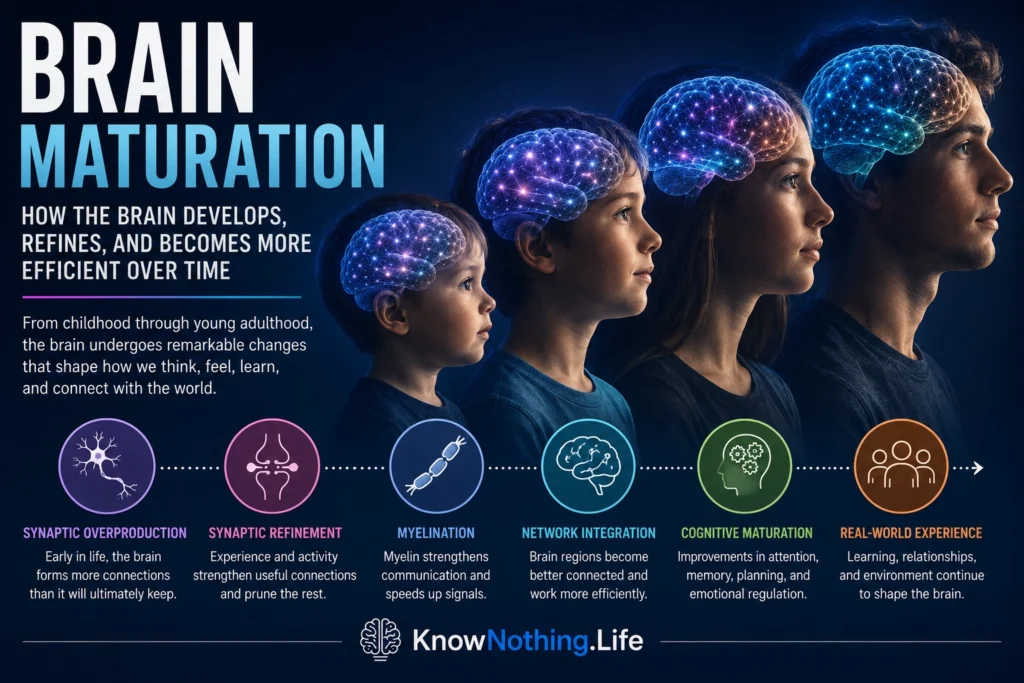
Brain maturation is the gradual process through which neural structures and networks become more specialized, efficient, and coordinated. It includes changes in synapses, dendritic spines, neurotransmitter systems, myelin, white-matter pathways, cortical organization, and communication among distant brain regions. Maturation supports improvements in attention, memory, emotional regulation, language, movement, planning, and social understanding. It does not occur uniformly across the brain, and it cannot be reduced to a single age at which the brain suddenly becomes “fully developed.”
The popular claim that the brain finishes maturing at age twenty-five oversimplifies the evidence. Some measures change rapidly during childhood, others continue through adolescence, and certain forms of white-matter organization and synaptic refinement remain dynamic during the third decade of life. Developmental timing also differs considerably among individuals. Brain maturation is better understood as a collection of overlapping trajectories than as a countdown toward one biological finish line. Longitudinal imaging and postmortem studies consistently show that different neural systems follow different schedules.
Cortical Development and Regional Timing
One of the most influential studies of cortical maturation was conducted by Nitin Gogtay and colleagues. The researchers repeatedly scanned children and adolescents between the ages of four and twenty-one, creating maps of cortical gray-matter change over time. Their 2004 study found that maturation generally progressed from primary sensory and motor regions toward association areas involved in integrating information, planning, and higher-order cognition. The sequence was complex, but prefrontal and temporal association regions were among the areas showing prolonged development.
Earlier longitudinal research by Jay Giedd and colleagues also demonstrated that the brain continues to change substantially during childhood and adolescence. Their magnetic resonance imaging study found regionally specific gray-matter trajectories alongside continued increases in white-matter volume. These findings replaced the older image of the adolescent brain as a nearly completed adult brain with a model of active structural reorganization. The changes observed on MRI do not correspond to one cellular mechanism; they can reflect shifts in synapses, dendrites, glial cells, myelin, water content, and tissue organization.
Synaptic Refinement and Pruning
The immature cortex initially forms more synaptic connections than it will retain permanently. This overproduction provides flexibility, allowing experience and neural activity to help stabilize useful connections while less coordinated or redundant connections weaken. The resulting process is commonly called synaptic pruning. Pruning is not evidence that the adolescent brain is deteriorating. It is part of the refinement through which neural circuits become more selective and efficient.
Research by Zdravko Petanjek and colleagues challenged the assumption that prefrontal synaptic pruning ends early in adolescence. Examining human prefrontal tissue from newborns through older adulthood, they found that dendritic spine density was two to three times higher during childhood than in adulthood and began declining around puberty. However, substantial remodeling continued throughout adolescence and into the third decade of life. The long developmental period of prefrontal synapses may support extended learning and adaptation, but it may also create a prolonged window of sensitivity to experience and disruption.
Myelination and White-Matter Connectivity
Maturation also depends on myelination, the process through which oligodendrocytes form insulating sheaths around many axons. Myelin allows neural signals to travel more rapidly and reliably, improving communication within and between brain regions. Sensory and motor pathways generally mature relatively early, while connections supporting complex cognition, behavioral regulation, and emotional integration often continue changing for much longer.
Christian Beaulieu, Catherine Lebel, and their colleagues used longitudinal diffusion imaging to examine white-matter development in participants between five and thirty-two years of age. Their findings showed that major pathways followed distinct developmental trajectories and that human brain wiring continued to mature well into young adulthood. A later review by Lebel and colleagues similarly concluded that diffusion studies consistently demonstrate continued white-matter maturation during later childhood and adolescence. These changes increase the ability of distant regions to operate as coordinated networks rather than isolated processing centers.
Executive Function and Cognitive Control
Executive functions include working memory, inhibition, flexible attention, planning, and the ability to maintain behavior in pursuit of a goal. These abilities depend heavily on prefrontal systems and their connections with the parietal cortex, hippocampus, basal ganglia, and other regions. They improve substantially during childhood and adolescence, but their development is not simply a matter of the prefrontal cortex turning on at a particular age.
A large analysis published by Brenden Tervo-Clemmens and colleagues in 2023 examined executive-function data from more than 10,000 participants. The researchers identified a common nonlinear trajectory, with particularly rapid development from late childhood through mid-adolescence and greater stability by late adolescence. This does not mean that judgment, planning, or self-control stop changing afterward. Performance remains influenced by sleep, stress, practice, motivation, mental health, social conditions, and the demands of the task.
Longitudinal functional imaging also shows that the networks supporting inhibitory control continue to reorganize from adolescence into young adulthood. Sarah Ordaz and colleagues followed participants between approximately nine and twenty-six years of age and found developmental changes in brain systems involved in response inhibition, executive control, and error processing. Maturation therefore includes both improved behavioral performance and more efficient recruitment of the networks that support that performance.
Reward, Emotion, and Adolescent Behavior
Adolescence is often associated with greater sensitivity to reward, novelty, peer approval, and emotionally significant experiences. B. J. Casey, Rebecca Jones, and Todd Hare proposed that adolescent behavior reflects differences in the developmental timing of interacting neural systems. Reward and emotional circuits may become highly responsive during a period when cognitive-control systems are still becoming more consistent and effectively connected. This imbalance is most visible in exciting, stressful, or socially charged situations rather than in every decision adolescents make.
This model does not portray adolescents as incapable of rational thought. Under calm conditions, many adolescents perform reasoning tasks at levels similar to adults. Differences become more apparent when immediate rewards, strong emotions, or peer observation alter the value of available choices. Heightened reward sensitivity can contribute to risk-taking, but it also supports exploration, rapid learning, social engagement, creativity, and the willingness to pursue new experiences. Adolescent neural maturation is therefore both a period of vulnerability and an important period of adaptation.
Social Brain Maturation
The brain systems used to interpret other people also continue developing throughout adolescence. Understanding intentions, managing reputation, responding to acceptance or rejection, and adjusting behavior to social expectations require communication among the medial prefrontal cortex, temporoparietal junction, superior temporal regions, and other areas. Social experience becomes especially influential during adolescence as independence increases and peer relationships gain importance.
Kathryn Mills and colleagues examined the structural development of regions frequently associated with social cognition. Their longitudinal research found that these areas followed different trajectories rather than maturing as one unified “social brain.” Some showed nonlinear changes in cortical thickness or volume, while others followed more gradual patterns. The findings demonstrate why social maturity cannot be located in one region or assigned to a single age. It depends on the development of multiple systems and on experience within families, friendships, schools, cultures, and digital environments.
Genes, Puberty, and Experience
Brain maturation is shaped by interactions among genes, hormones, health, and experience. Puberty changes hormonal signaling and bodily development, but chronological age and pubertal stage are not interchangeable. Two adolescents of the same age may be at different stages of biological maturation, and those differences can influence sleep, emotional sensitivity, social motivation, and brain development.
Tomáš Paus has emphasized that brain characteristics observed during adolescence reflect an interaction between inherited variation and environmental conditions. Nutrition, education, relationships, stress, substance exposure, physical activity, and opportunity can influence neural development, while genetic differences affect how strongly individuals respond to those experiences. Maturation is therefore neither the automatic unfolding of a fixed genetic program nor the passive imprinting of the environment on an empty brain.
Experience also determines which abilities become practiced and strengthened. Learning a language, playing an instrument, participating in sports, navigating complex social settings, or managing increasing responsibility repeatedly recruits particular networks. Maturation establishes new capacities, but experience helps determine how those capacities are used. An older brain is not automatically more skilled in every domain; effective performance depends on both biological development and opportunities for learning.
Maturation Continues Into Adulthood
Young adulthood brings greater stability to many neural systems, but the brain does not become fixed. White-matter organization, network efficiency, and prefrontal synaptic structure can continue changing during the twenties. Learning, relationships, work, stress, parenthood, illness, and other adult experiences also alter neural activity and connectivity. Maturation gradually becomes less dominated by broad developmental programs and more strongly shaped by individual experience, maintenance, and adaptation.
The idea of continued development should not be used to deny young adults autonomy or responsibility. Neuroscience describes average trajectories, not the competence of a particular person. Individuals mature at different rates, and decision-making always depends on knowledge, context, incentives, and emotional state. Brain research can explain why capacities become more consistent across development, but it cannot identify a precise birthday on which every person acquires mature judgment.
Understanding the Maturing Brain
Brain maturation is a prolonged process of refinement rather than a simple increase in size. Synapses are stabilized and eliminated, axons become more heavily myelinated, distant networks communicate more efficiently, and cognitive control becomes increasingly coordinated with reward, memory, emotion, and social understanding. These developments occur at different rates and remain sensitive to both biological conditions and experience.
The mature brain is not a finished machine. It is a relatively stable but adaptable system shaped by everything that occurred during development and everything the person continues to learn. The most accurate account of brain maturation therefore avoids both biological determinism and the myth of unlimited plasticity. Human development follows real neural constraints, yet within those constraints, experience continues to influence how the brain thinks, feels, connects, and acts.