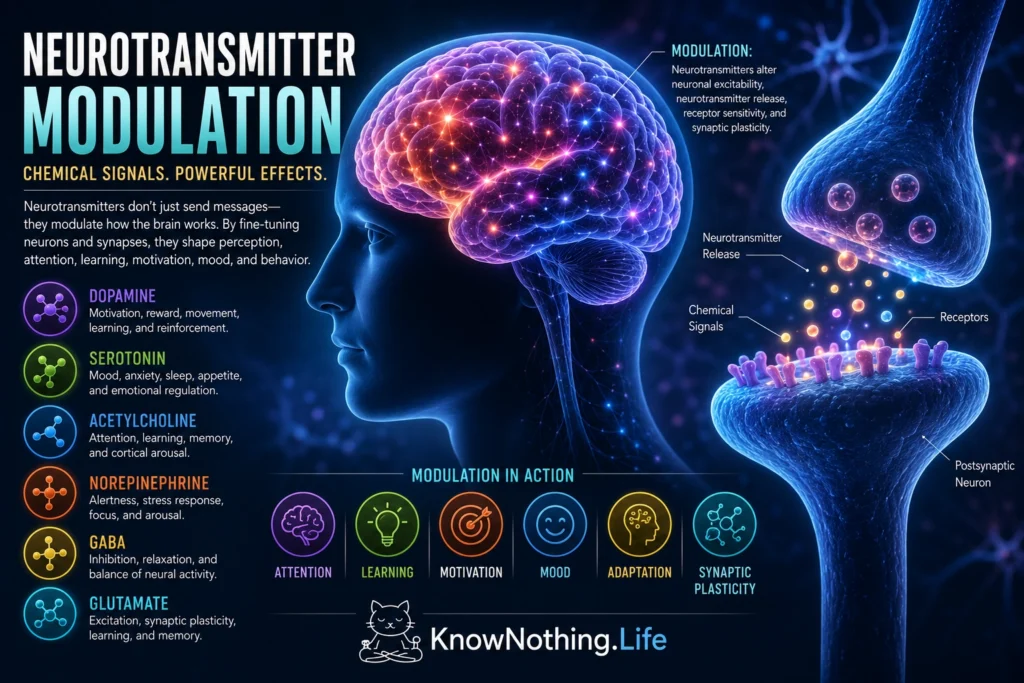
Neurotransmitter modulation is the process by which chemical signals alter how neurons and neural circuits respond to incoming information. Conventional synaptic transmission often carries a relatively direct message from one neuron to another, producing excitation or inhibition within milliseconds. Modulation usually changes the conditions under which those messages are processed. A neuromodulator may increase or decrease neuronal excitability, modify neurotransmitter release, adjust receptor sensitivity, reshape network rhythms, or determine whether active synapses become stronger or weaker.
The distinction is functional rather than absolute. The same substance can operate as a fast transmitter at one synapse and as a slower modulator elsewhere. Dopamine, serotonin, acetylcholine, norepinephrine, endocannabinoids, and many neuropeptides commonly alter broad patterns of neural activity through receptors linked to intracellular signaling. Their effects can last beyond the original chemical signal, allowing attention, motivation, stress, arousal, and previous experience to change how identical sensory inputs are interpreted.
Receptors Determine the Effect of a Signal
A neurotransmitter does not have one fixed effect. Its action depends on the receptor subtype expressed by the receiving cell, the receptor’s location, and the intracellular pathways connected to it. Ionotropic receptors form channels that rapidly alter the flow of charged particles across a membrane. Metabotropic receptors activate G proteins and second-messenger systems that can regulate ion channels, enzymes, gene expression, and synaptic structure. These slower pathways allow one chemical signal to modify several aspects of cellular function at once.
Serotonin illustrates this receptor-dependent diversity. In prefrontal cortical neurons, E. Y. Yuen and colleagues found that activation of inhibitory 5-HT1A receptors reduced NMDA-receptor-mediated currents, thereby changing excitatory transmission. Other serotonin receptors can produce different or opposing effects in the same general brain region. Describing serotonin as simply calming, stimulating, or mood-enhancing therefore misses its biological complexity. The response depends on which receptors are activated, on what cells, and during which pattern of network activity.
Presynaptic Modulation Changes Neurotransmitter Release
Modulation can occur before a neurotransmitter enters the synaptic cleft. Receptors located on presynaptic terminals can change calcium entry, vesicle fusion, and the probability that a nerve impulse will release transmitter. Autoreceptors respond to the neuron’s own chemical messenger and can provide negative feedback, while heteroreceptors respond to substances released by other neurons. Through these mechanisms, a modulator can weaken or amplify communication without directly changing the electrical activity of the postsynaptic cell.
Research on the marine snail Aplysia provided an influential model of presynaptic modulation. Serotonin released near sensory-neuron terminals enhanced transmitter release onto motor neurons, contributing to the strengthening of a defensive withdrawal response. Experiments showed that serotonin acts in the synaptic region and recruits intracellular pathways that increase the effectiveness of sensory-motor transmission. This work helped connect molecular modulation with learning by demonstrating how a modulatory signal can temporarily increase the strength of an existing synapse.
Dopamine and the Selection of Important Information
Dopamine is a major neuromodulator of movement, motivation, working memory, and reinforcement learning. It does not merely turn neurons on or produce pleasure. Dopamine changes how strongly circuits respond to particular inputs and how effectively recent information influences future behavior. Its effects are often concentration-dependent: too little signaling may fail to stabilize relevant activity, while excessive stimulation can introduce noise or suppress useful representations.
Grace Williams and Patricia Goldman-Rakic demonstrated this principle by recording individual prefrontal neurons while monkeys performed a working-memory task. Manipulating D1 dopamine receptors selectively changed the neurons’ memory-related activity without simply disrupting vision or movement. Their results showed that dopamine can tune the strength and precision of neural representations needed to hold information in mind. The study also helped establish that optimal cognitive performance depends on balanced neuromodulation rather than the maximum possible amount of a transmitter.
Dopamine as a Teaching Signal
Dopamine also modulates learning by signaling differences between expected and actual outcomes. In the influential 1997 study A Neural Substrate of Prediction and Reward, Wolfram Schultz, Peter Dayan, and P. Read Montague described how midbrain dopamine-neuron activity changed as animals learned relationships between cues and rewards. Unexpected rewards initially produced strong neuronal responses. Once a cue reliably predicted the reward, the response shifted toward the cue, while omission of an expected reward produced reduced activity.
This pattern resembles a reward-prediction error: a signal indicating whether an outcome was better or worse than expected. Such signals can modulate plasticity in receiving areas, increasing the influence of actions and cues associated with unexpectedly valuable outcomes. Dopamine is therefore less a simple reward substance than part of a system that updates expectations. By altering synapses active near the time of an important outcome, dopamine helps neural circuits decide which recent events deserve to shape future behavior.
Acetylcholine, Attention, and Sensory Processing
Acetylcholine is released by several neural populations, including basal forebrain neurons that project broadly across the cerebral cortex. Cortical acetylcholine can change neuronal excitability, alter the balance between incoming sensory information and internal cortical activity, and increase the processing of behaviorally relevant signals. Its effects vary across nicotinic and muscarinic receptor subtypes, which act through different cellular mechanisms.
Direct measurements during attention tasks support this modulatory role. Jill McGaughy and colleagues found that cortical acetylcholine release increased when rats began performing an attentional task. Selective damage to cholinergic inputs altered both performance and the usual neurochemical response, providing evidence that cortical acetylcholine contributes to the detection and use of relevant signals rather than merely reflecting general movement or arousal. Other lesion studies have found impairments when animals must locate brief visual targets or maintain vigilance.
Norepinephrine and Changes in Behavioral State
Most norepinephrine reaching the cerebral cortex originates from the locus coeruleus, a small brainstem nucleus with widespread projections. This arrangement allows norepinephrine to modify activity across large portions of the brain according to alertness, novelty, uncertainty, and behavioral relevance. Moderate, task-linked activity can improve the contrast between important and unimportant signals. Excessive or poorly regulated activity may increase distractibility, anxiety, or unstable attention.
Experiments manipulating locus-coeruleus activity show that different firing modes can support different behavioral states. Gary Kane and colleagues increased tonic locus-coeruleus activity in rats using designer receptors and found that the animals became more likely to leave a diminishing reward source and search for alternatives. The result supported the idea that norepinephrine can adjust the balance between exploiting a known opportunity and exploring for a potentially better one. Neuromodulation therefore helps determine not only how strongly neurons respond, but also which general strategy an organism adopts.
Endocannabinoids and Retrograde Modulation
Most chemical communication at synapses travels from the presynaptic neuron to the postsynaptic cell. Endocannabinoid signaling can reverse this direction. When a postsynaptic neuron becomes strongly active, it can produce lipid-derived endocannabinoids that travel backward across the synapse and activate CB1 receptors on presynaptic terminals. These receptors commonly reduce further neurotransmitter release, allowing the receiving cell to regulate the strength of its own incoming signals.
Rachel Wilson and Roger Nicoll demonstrated this mechanism in hippocampal neurons, showing that endogenous cannabinoids mediate retrograde suppression of inhibitory transmission. The discovery revealed that the postsynaptic neuron is not simply a passive receiver. It can send feedback to selected terminals and temporarily change their release probability. Endocannabinoid modulation contributes to short-term synaptic regulation and can interact with longer-lasting forms of plasticity, stress responses, appetite, pain, memory, and the effects of cannabis-derived compounds.
Modulation of Synaptic Plasticity
Neuromodulators influence whether patterns of activity produce long-term potentiation, long-term depression, or no durable change. A synapse may receive the same electrical stimulation under two behavioral conditions yet respond differently because dopamine, acetylcholine, serotonin, or norepinephrine has altered receptor function and intracellular signaling. Modulators can therefore act as gates that determine when experience is important enough to become encoded.
This gating helps prevent every passing event from permanently reshaping neural circuits. Attention-related acetylcholine may prioritize incoming sensory information, dopamine may mark an unexpected outcome, norepinephrine may indicate novelty or urgency, and serotonin may alter plasticity according to behavioral state. The effects are not independent; several modulators can act on the same neuron and influence one another’s signaling pathways. Learning emerges from the combined chemical context surrounding active synapses rather than from electrical activity alone.
Clinical Importance of Neurotransmitter Modulation
Many neurological and psychiatric medications work by modifying modulatory systems. Selective serotonin reuptake inhibitors prolong serotonin availability, stimulant medications alter dopamine and norepinephrine transmission, antipsychotic drugs modify dopamine-receptor signaling, and cholinesterase inhibitors increase acetylcholine activity. These drugs do not simply add or remove a single emotion. They alter receptor activation and network conditions, after which the nervous system may adapt over days or weeks.
The same complexity explains why treatments can have both therapeutic effects and side effects. A receptor involved in attention may also contribute to sleep, appetite, movement, or cardiovascular regulation. Individual differences in receptors, metabolism, development, illness, and previous drug exposure further shape the outcome. Neurotransmitter modulation shows that brain chemistry is not a collection of independent substances with single psychological meanings. It is a system of interacting signals that continually adjusts how neurons communicate, learn, and respond to the world.