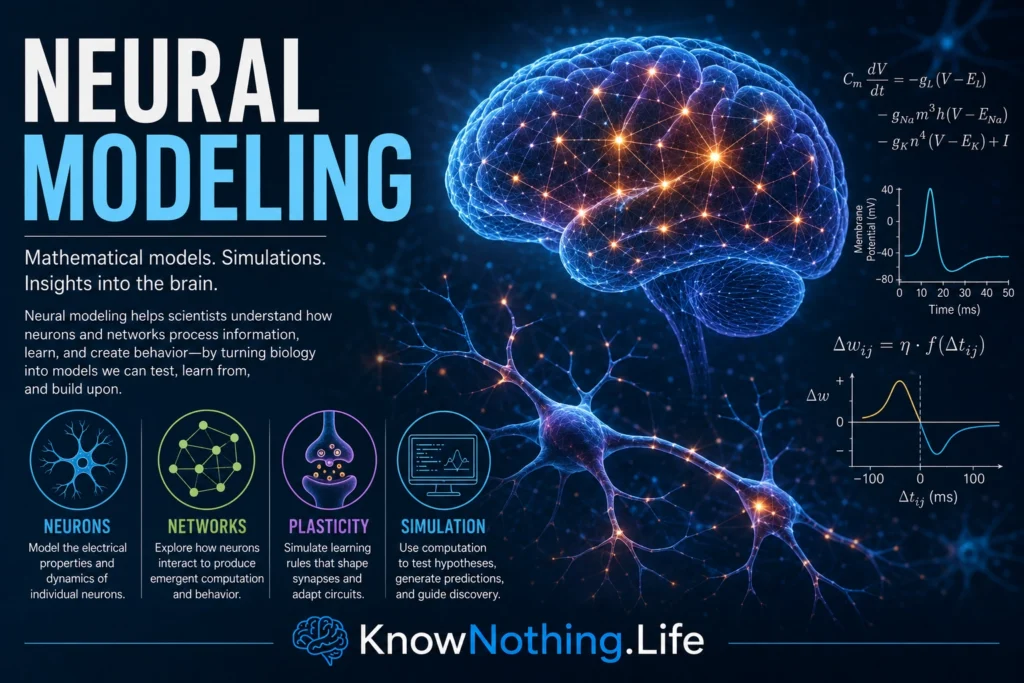
Neural modeling is the practice of using mathematical equations, computer simulations, and statistical frameworks to represent how neurons and neural systems behave. A model may describe the electrical activity of a single cell, the integration of signals across branching dendrites, the interaction of excitation and inhibition within a local circuit, or the coordinated activity of millions of neurons. Researchers use these representations to transform biological observations into mechanisms that can be calculated, tested, and compared with experimental data.
A useful neural model is not simply a digital copy of the brain. Every model leaves out biological detail so that a particular question becomes easier to investigate. A highly detailed simulation may reproduce ion channels, cellular anatomy, and synaptic conductances, while a simpler model may represent each neuron with only a few variables. The appropriate level of detail depends on the problem. Neural modeling therefore involves a continuing tradeoff among biological realism, interpretability, computational cost, and predictive accuracy.
The Hodgkin–Huxley Foundation
Modern neural modeling is often traced to Alan Hodgkin and Andrew Huxley’s quantitative account of the action potential. Their 1952 experiments on the squid giant axon measured how sodium and potassium currents changed with membrane voltage and time. They converted these measurements into coupled differential equations describing membrane capacitance, ionic conductances, and voltage-dependent gating variables. The resulting model reproduced the initiation and shape of an action potential and established that neural excitability could be explained through measurable physical processes.
The Hodgkin–Huxley model remains biologically influential because its variables correspond to recognizable membrane mechanisms. However, that detail creates computational demands. Simulating many conductance-based neurons requires repeatedly solving several nonlinear equations for every cell and time step. Researchers may also need to estimate numerous channel densities, kinetic parameters, and reversal potentials. These difficulties encouraged the development of reduced models that preserve important electrical behaviors while replacing detailed channel descriptions with simpler mathematical relationships.
Simplified Models of Neural Excitability
Richard FitzHugh developed one of the most important reductions of the Hodgkin–Huxley framework. His 1961 model used two principal variables representing excitation and recovery. Although it did not describe individual sodium and potassium channels, it captured essential dynamical features such as thresholds, refractoriness, stable resting states, and repetitive firing. The related FitzHugh–Nagumo system became a widely used tool for studying excitability because its two-dimensional state space makes neural behavior easier to visualize and analyze mathematically.
Integrate-and-fire models simplify the neuron further. They treat the membrane as an electrical integrator that accumulates input until a threshold is reached, at which point the model emits a spike and resets. These models are efficient enough for large networks but do not naturally reproduce every firing pattern observed in biological cells. Eugene Izhikevich addressed part of this limitation with a two-variable model that can generate regular spiking, bursting, fast spiking, and other characteristic behaviors while remaining computationally economical. He demonstrated that tens of thousands of model neurons could be simulated in real time on an ordinary desktop computer available in 2003.
Modeling Dendrites and Synaptic Integration
A neuron is not merely a point that adds incoming signals. Its dendrites form branching structures across which electrical potentials weaken, interact, and sometimes trigger local nonlinear events. Wilfrid Rall applied cable theory to neurons and showed how dendritic length, diameter, branching, and membrane properties influence the transmission of synaptic input toward the cell body. His work provided a mathematical foundation for representing complex dendritic trees as electrically connected compartments or, under defined conditions, as simplified equivalent cables.
Compartmental models divide a neuron into connected segments representing the soma, axon, and dendritic branches. Each compartment has its own voltage and may contain selected ion channels, receptors, and synaptic inputs. This allows researchers to investigate whether the location of a synapse changes its influence, how dendritic spikes affect output, or how cellular morphology shapes information processing. Greater anatomical detail can produce more realistic behavior, but it also increases the number of uncertain parameters. A complex model can therefore appear biologically impressive while remaining difficult to constrain or interpret.
From Individual Cells to Neural Populations
Many brain functions emerge through interactions among large populations rather than the activity of isolated neurons. Hugh Wilson and Jack Cowan introduced equations describing the average activity of coupled excitatory and inhibitory populations. Their model showed how feedback between these groups could generate stable states, oscillations, rapid transitions, and responses that were not obvious from the properties of individual cells. Wilson–Cowan models continue to influence research on cortical rhythms, sensory processing, seizures, attention, and large-scale brain dynamics.
Population models often represent firing rates rather than individual spikes. This reduction is useful when researchers care about the collective state of a circuit and not the precise activity of every neuron. Spiking-network models preserve more temporal detail by representing the exact or approximate times at which cells fire. Reviews of neural simulation strategies show that model choice affects numerical accuracy, speed, treatment of synaptic conductances, and the ability to reproduce timing-dependent plasticity. No single simulator or integration method is best for every biological question.
Modeling Learning and Synaptic Plasticity
Neural circuits change through experience, requiring models that describe how synaptic connections strengthen, weaken, appear, or disappear. Some models apply rate-based versions of Hebbian learning, in which connections become stronger when connected neurons are repeatedly active together. Others model spike-timing-dependent plasticity, or STDP, in which synaptic change depends on the order and interval between presynaptic and postsynaptic spikes. A presynaptic spike arriving shortly before a postsynaptic spike may strengthen a connection, while the reverse order may weaken it.
Sen Song, Kenneth Miller, and Larry Abbott showed that spike-timing-dependent rules could generate competitive Hebbian learning in model networks. Their simulations demonstrated how temporal relationships among spikes could cause some synapses to strengthen while others weakened, contributing to selective connectivity and structured responses. Later research has examined how weight dependence, homeostatic mechanisms, inhibition, and neuromodulators prevent such learning rules from producing unstable excitation or eliminating most synapses.
Large-Scale and Biologically Detailed Simulation
Increasing computing power and experimental data have made it possible to construct models containing thousands or millions of neural components. In 2015, Henry Markram and colleagues reported a digital reconstruction of a small volume of juvenile rat somatosensory cortex. The model contained approximately 31,000 neurons, numerous morphological and electrical cell types, and tens of millions of synaptic connections. The project integrated anatomical and physiological measurements with organizing principles used to fill gaps where direct experimental data were unavailable.
Such reconstructions are valuable because they allow researchers to test how cellular properties, connectivity, and stimulation interact within a shared system. They are not exact replicas of living cortex. The 2015 reconstruction represented a particular brain region, species, and developmental period, and many of its connections were generated algorithmically from incomplete evidence. Large simulations can reveal unexpected collective behavior, but their complexity does not remove uncertainty. Every prediction still depends on the assumptions, parameter estimates, and validation data used to build the model.
Data-Driven and Machine-Learning Models
Traditional neural models usually begin with proposed biological mechanisms and then calculate their consequences. Data-driven models instead learn relationships directly from experimental recordings. Statistical encoding models can predict neural responses from sensory input, while decoding models infer movements, decisions, or stimuli from population activity. Machine-learning systems can also approximate computationally expensive biological models, allowing researchers to run simulations more quickly without solving every underlying biophysical equation.
A 2022 study trained artificial neural networks to reproduce the responses of detailed multicompartmental cortical neuron models. The surrogate networks predicted subthreshold voltage activity and spike generation while generalizing to previously unseen patterns of synaptic input. This approach illustrates how artificial intelligence can accelerate neural simulation, but it also introduces a problem of interpretation. A fast predictor may accurately imitate a detailed model without revealing which biological mechanisms produced the behavior.
Validation, Limitations, and the Future
A neural model should be evaluated against observations it was not explicitly designed to reproduce. Fitting one experiment is not enough because different mechanisms can generate similar activity patterns. Strong validation may compare spike timing, firing rates, membrane voltages, responses to perturbation, network oscillations, connectivity, and behavior across multiple datasets. Researchers must also examine whether small changes in parameters produce radically different results. A model that works only under one carefully tuned configuration may offer limited biological insight.
The future of neural modeling will combine molecular data, cellular physiology, connectomics, large-scale recordings, and behavior across multiple levels of organization. Hybrid models may use mechanistic equations where biological knowledge is strong and machine learning where relationships are too complex or poorly understood. The goal is not necessarily to simulate every molecule or neuron in the brain. The more useful objective is to identify the simplest set of mechanisms capable of explaining the phenomenon under study and predicting what will happen when the nervous system is stimulated, injured, treated, or placed in a new environment.