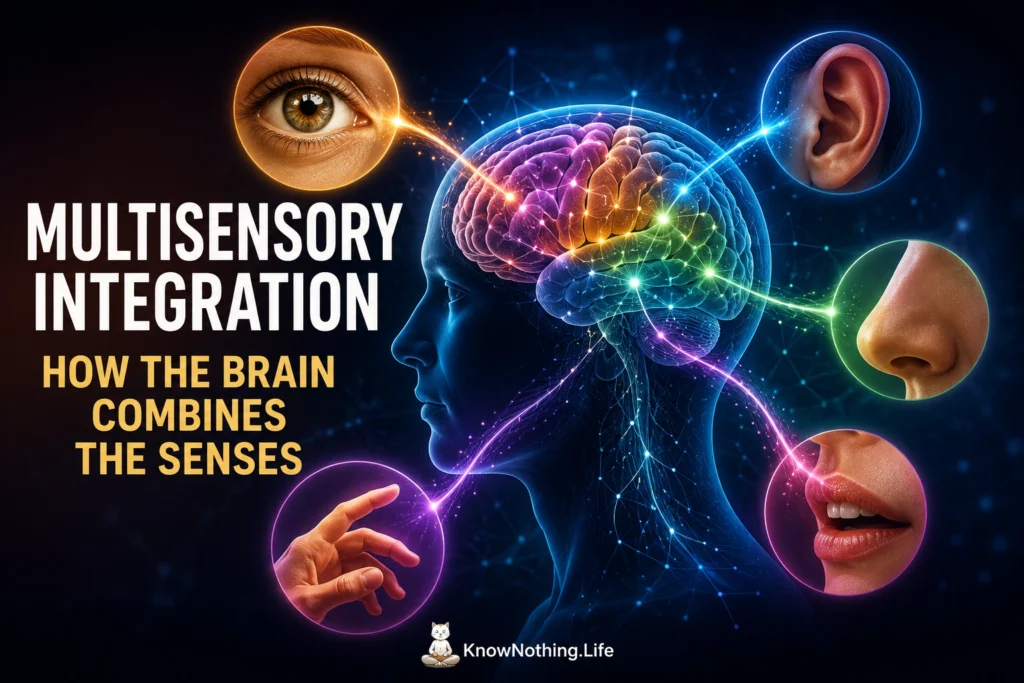
Multisensory integration is the process through which the nervous system combines information from vision, hearing, touch, smell, taste, balance, proprioception, and internal bodily signals. Everyday events rarely stimulate only one sensory system. A conversation includes a voice, facial movements, gestures, and spatial cues; eating combines taste, smell, texture, temperature, and appearance; walking depends on visual, vestibular, and proprioceptive information. The brain must determine which signals belong to the same event, how much confidence to place in each source, and whether the inputs should be combined or treated separately.
This process involves more than adding independent sensory messages together. Signals from one modality can strengthen, weaken, redirect, or transform activity associated with another. A sound may make a dim visual event easier to detect, visible mouth movements may change which syllable is heard, and synchronized sight and touch can alter the perceived location or ownership of a limb. Multisensory integration helps the brain create stable interpretations from sensory inputs that are individually incomplete, noisy, delayed, or ambiguous.
The Superior Colliculus and Orienting Behavior
Some of the clearest early evidence for multisensory neurons came from the superior colliculus, a layered midbrain structure involved in directing the eyes, head, and body toward significant events. In 1983, Mark Meredith and Barry Stein reported that visual, auditory, and somatosensory inputs could converge on individual superior-colliculus neurons. A weak light or sound might produce a modest response alone, while an appropriately paired combination generated a much larger discharge. Other combinations suppressed activity, demonstrating that multisensory integration is selective rather than automatically enhancing every stimulus.
This convergence connects perception with action. Neurons in the deep layers of the superior colliculus project toward motor and premotor systems involved in orienting behavior. A rustling sound aligned with visible movement may therefore produce a faster and more reliable turn toward its source than either cue alone. Studies in alert animals have linked enhanced multisensory neural responses with improved orientation toward weak stimuli, suggesting that integration increases the likelihood that biologically important events will be detected and acted upon.
Space, Time, and Inverse Effectiveness
Multisensory signals are most likely to be combined when they are compatible in space and time. Meredith and Stein found that superior-colliculus neurons responded strongly when visual and auditory stimuli appeared to originate from the same location. Widely separated cues produced less enhancement and could even inhibit one another. Temporal relationships are equally important: signals arriving within a suitable interval are more likely to be interpreted as parts of one event, whereas large delays suggest separate causes. These rules prevent the nervous system from binding unrelated sights, sounds, and touches simply because they occur within the same environment.
Another influential principle is inverse effectiveness. The relative benefit of multisensory integration is often greatest when individual cues are weak or uncertain. A bright, unmistakable visual target may gain little from an accompanying sound, while a faint target may become much easier to detect. Bayesian models of superior-colliculus activity explain this pattern by proposing that an additional sensory cue provides the most information when the first cue leaves substantial uncertainty. Multisensory processing is therefore especially valuable in darkness, background noise, poor visibility, and other difficult conditions.
Cortical Integration and Audiovisual Speech
Multisensory interactions also occur throughout the cerebral cortex. Auditory and visual areas can influence one another, while association regions receive converging information from multiple modalities. The superior temporal sulcus is particularly important for combining dynamic social signals such as voices, facial expressions, and mouth movements. In 2000, Gemma Calvert, Ruth Campbell, and Martin Brammer found that matching audiovisual speech produced enhanced activity in the left superior temporal sulcus, whereas mismatched speech produced a reduced response. Their findings suggested that cortical activity reflects whether sights and sounds form a coherent event.
The McGurk effect provides one of the best-known demonstrations of audiovisual integration. Harry McGurk and John MacDonald presented listeners with the sound of one syllable while showing a face articulating another. Participants frequently reported hearing a third syllable or a sound influenced by the visible articulation. The visual information did not merely help listeners interpret an already completed auditory percept; it changed what they believed they heard. The effect demonstrates that ordinary speech perception is inherently audiovisual, particularly when the acoustic signal is uncertain or degraded.
Crossmodal Illusions and Perceptual Construction
Interactions between the senses are not limited to speech. In the sound-induced flash illusion reported by Ladan Shams, Yukiyasu Kamitani, and Shinsuke Shimojo, a single visual flash accompanied by two brief beeps is often perceived as two flashes. Because hearing normally provides precise temporal information, the additional beep changes the visual experience rather than merely influencing a later verbal judgment. Electrophysiological research has connected the illusion with early interactions between auditory and visual cortical activity, indicating that crossmodal effects can reach relatively early stages of sensory processing.
Such illusions expose assumptions that normally make perception effective. The brain often expects signals occurring near one another in space and time to share a common source. Carefully designed conflicts reveal which modality has the greatest influence over a particular estimate. Vision usually supplies precise spatial information, hearing often provides precise timing, and touch offers reliable information about physical contact and bodily position. Sensory dominance is therefore flexible. It depends on the task, environmental conditions, and reliability of the available evidence rather than belonging permanently to one sense.
Reliability Weighting and Bayesian Integration
The nervous system frequently combines sensory cues according to their relative reliability. Marc Ernst and Martin Banks tested this idea by asking participants to judge object height using vision, touch, or both. When both sources were available, participants behaved similarly to a maximum-likelihood estimator: their combined judgments were more precise than judgments based on either sense alone, and more weight was assigned to the modality carrying less uncertainty. Visual dominance occurred when vision was more reliable, not because visual signals must always override touch.
Effective integration also requires causal inference. Before combining signals, the brain must estimate whether they probably originated from the same object or event. Konrad Körding and colleagues found that audiovisual localization judgments were accurately described by a Bayesian causal-inference model. Nearby sights and sounds were more likely to be treated as sharing a cause and integrated, while widely separated cues were more likely to remain distinct. Later neuroimaging work suggested that these computations unfold across a cortical hierarchy, progressing from separate sensory estimates toward representations that reflect both cue reliability and the probability of a common cause.
Body Ownership and Peripersonal Space
Multisensory integration also contributes to the experienced body. In the rubber-hand illusion introduced by Matthew Botvinick and Jonathan Cohen, a participant watches a visible rubber hand being stroked while the hidden biological hand is touched at the same time. Many participants begin to feel that the artificial hand belongs to them, and their perceived hand position shifts toward it. When visual, tactile, and positional information agree closely enough, the nervous system revises its estimate of where the body is and what belongs to it.
The same general processes help maintain posture, guide movement, and distinguish the body from surrounding objects. Vision, touch, proprioception, and vestibular information must be continuously reconciled when a person reaches, walks, or avoids an approaching object. Multisensory networks also represent peripersonal space—the region immediately surrounding the body in which objects can be touched, grasped, or avoided. These representations connect perception with possible action and can change when tools extend the body’s effective reach or when one sensory channel becomes unreliable.
Development, Experience, and Plasticity
The capacity to integrate the senses develops through experience. Mark Wallace and Barry Stein found that multisensory neurons in young animals did not initially display the mature enhancement observed in adults. Their response properties emerged gradually as the nervous system encountered correlated sights, sounds, and touches. When early audiovisual experience was systematically mismatched in space, superior-colliculus neurons developed abnormal integration patterns reflecting those artificial relationships. The brain therefore learns statistical regularities about which sensory signals normally belong together.
Human multisensory timing also becomes more precise during childhood. The temporal interval within which auditory and visual signals are likely to be bound generally narrows with development, improving the ability to distinguish simultaneous events from separate ones. Learning continues in adulthood: repeated discrepancies can recalibrate where or when a stimulus is perceived, while sensory loss may increase dependence on remaining modalities. Multisensory integration is therefore not a fixed operation performed by one brain area. It is a distributed and adaptive process through which the nervous system continually decides what belongs together and constructs a coherent world from many forms of sensory evidence.