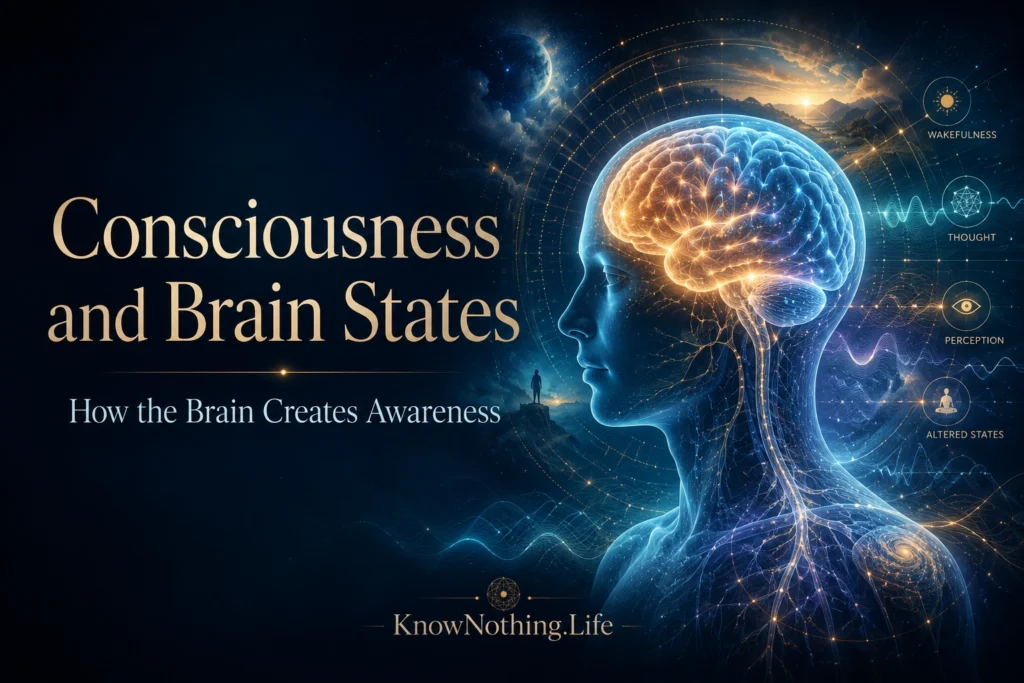
Consciousness is the capacity to have subjective experiences: sensations, thoughts, emotions, perceptions, memories, and an awareness of oneself or the surrounding world. Neuroscientists often distinguish the level of consciousness from its contents. Level refers to whether a person is awake, drowsy, asleep, anesthetized, or comatose. Content refers to what is being experienced within that state, such as a face, pain, a memory, or a dream. The two dimensions can separate. A person may be awake but minimally aware after severe brain injury, while a sleeping person may be disconnected from the environment yet experience vivid dreams.
A brain state is a relatively stable pattern of neural activity, chemical signaling, connectivity, and responsiveness. Wakefulness, rapid eye movement sleep, non-rapid eye movement sleep, general anesthesia, seizures, and coma are distinct states, but none is defined by one brain region or electrical frequency. Consciousness appears to depend on interactions among arousal systems, the cerebral cortex, the thalamus, and large-scale networks. The challenge is therefore not simply to find where consciousness is located, but to understand which forms of neural organization allow experience to occur. Giacomo Moruzzi and Horace Magoun’s landmark 1949 study showed that stimulating the brainstem reticular formation transformed synchronized cortical activity into the low-voltage, faster pattern associated with arousal, helping establish the importance of ascending brain systems in wakefulness.
Arousal, Wakefulness, and the Active Brain
Wakefulness is supported by interacting populations of neurons in the brainstem, hypothalamus, basal forebrain, and thalamus. These systems release neurotransmitters such as acetylcholine, norepinephrine, serotonin, dopamine, histamine, and orexin, altering the excitability and coordination of cortical networks. Rather than creating conscious experiences by themselves, arousal systems establish conditions in which the cortex can respond flexibly to sensory input, maintain attention, and organize behavior. Damage to these pathways can produce profound reductions in wakefulness even when much of the cerebral cortex remains structurally present.
An awake brain generally exhibits differentiated and rapidly changing activity rather than perfect synchronization. This does not mean that faster electrical activity automatically equals greater consciousness. Neural oscillations at different frequencies coordinate activity across different spatial and temporal scales, and the same frequency can serve different purposes in different regions. Brain activity must also remain responsive to perturbation. In wakefulness, stimulation of one cortical area can generate a complex sequence of responses that travels through connected regions. During deep non-rapid eye movement sleep, Massimini and colleagues found that a similar stimulus produced a strong local reaction that quickly faded instead of spreading through the cortex. Their results suggested that consciousness depends partly on the brain’s capacity to sustain differentiated interactions across distributed networks.
Conscious Perception and Global Access
The brain can process information without that information entering conscious awareness. A briefly presented word or image may influence a later response even when a person reports seeing nothing. In a 2001 masking study, Stanislas Dehaene and colleagues found that unseen words activated visual and language-related regions and produced measurable repetition effects. However, their activity was weaker and did not extend into the broad prefrontal and parietal pattern observed when words were consciously perceived. The experiment demonstrated that sensory and semantic processing can begin unconsciously, while conscious access is associated with a more extensive form of neural recruitment.
This evidence helped support the global neuronal workspace model, which proposes that information becomes conscious when it gains access to a distributed network and becomes available to memory, decision-making, attention, and verbal report. Lionel Naccache, Dehaene, and other researchers have described this transition as an “ignition” in which recurrent activity suddenly becomes sustained across distant cortical regions. In an experiment manipulating the visibility of masked numbers, Arnaud Del Cul and colleagues observed a nonlinear transition between weak early processing and later widespread activity associated with conscious reports. The findings do not prove that global broadcasting is the complete explanation of consciousness, but they show that conscious perception differs from unconscious processing in both intensity and large-scale organization.
Sleep, Dreams, and Changing Conscious Experience
Sleep demonstrates that behavioral unresponsiveness is not identical to unconsciousness. During non-rapid eye movement sleep, the cortex commonly produces slow oscillations in which neurons alternate between active and relatively silent periods. These interruptions can limit communication between distant regions even though sensory signals may still reach primary cortical areas. During rapid eye movement sleep, cortical activity becomes more wake-like, muscle tone is strongly reduced, and vivid dreams are common. Massimini and colleagues found that cortical responses during rapid eye movement sleep were more complex and widespread than those observed during non-rapid eye movement sleep, consistent with the richer conscious experiences often reported from this state.
Dreaming can also occur during non-rapid eye movement sleep, showing that sleep stage alone does not determine whether experience is present. Francesca Siclari and colleagues awakened participants repeatedly during sleep and compared reports of dream experience with high-density electroencephalography recorded immediately beforehand. Reports of conscious experience were associated with reduced low-frequency activity in a posterior cortical region during both major sleep states. When dreams contained faces, movement, spatial settings, or speech, higher-frequency activity appeared in cortical areas normally involved in processing those categories while awake. The study suggested that the presence and content of experience can be predicted from localized patterns even when the sleeping brain is largely disconnected from the external world.
General Anesthesia and Reversible Unconsciousness
General anesthesia provides a controlled way to study transitions between consciousness and unconsciousness. Anesthetic drugs do more than reduce overall brain activity. Different agents alter receptors, oscillations, thalamocortical communication, and large-scale connectivity in distinct ways. Patrick Purdon and colleagues gradually administered propofol while recording high-density electroencephalography and repeatedly testing responsiveness. Loss of responsiveness was accompanied by increased slow activity, disappearance of coherent alpha rhythms from posterior regions, and the emergence of highly synchronized frontal alpha activity. These patterns reversed as participants regained responsiveness.
Unconsciousness under anesthesia also resembles deep sleep in the way cortical communication becomes restricted. Ferrarelli and colleagues used transcranial magnetic stimulation with electroencephalography during midazolam-induced unconsciousness. While participants were awake, stimulation produced a complex response that propagated through multiple cortical regions. After consciousness was lost, the response became local, stereotyped, and short-lived. Similar findings across sleep and anesthesia suggest that a brain may remain electrically active yet lose consciousness when its regions can no longer interact in a sufficiently integrated and differentiated manner. These states should not be treated as identical, however, because natural sleep and pharmacological unconsciousness involve different chemistry, physiology, and possibilities for spontaneous awakening.
Measuring the Brain’s Capacity for Consciousness
Ordinary electroencephalography can reveal sleep stages, seizures, anesthesia-related rhythms, and gross abnormalities, but no single waveform proves whether subjective experience is present. Researchers have therefore developed measurements that examine how the brain responds to controlled stimulation. In 2013, Adenauer Casali and colleagues introduced the perturbational complexity index, or PCI. The method uses transcranial magnetic stimulation to perturb the cortex and electroencephalography to record the resulting pattern. A response that is both widespread and differentiated receives a higher complexity score, while a local or highly repetitive response receives a lower score.
PCI distinguished conscious wakefulness and dreaming from deep sleep and several forms of anesthesia in the original study. The approach was designed around the idea that conscious systems must combine integration with differentiation: neural elements must influence one another, but they cannot all behave identically. This principle resembles the framework developed by Gerald Edelman and Giulio Tononi in “Consciousness and Complexity,” which argued that conscious experience requires a large repertoire of integrated neural states. PCI does not directly read thoughts or reveal the contents of experience, but it offers a way to estimate whether the brain retains the capacity to support consciousness without relying entirely on movement or speech.
Disorders of Consciousness and Covert Awareness
Assessing consciousness becomes especially difficult after severe brain injury. A patient may open the eyes and cycle between sleep and wakefulness without showing reproducible evidence of awareness, a condition now often called unresponsive wakefulness syndrome. A minimally conscious patient shows limited but definite behavioral evidence of awareness. These diagnoses depend heavily on observable movement, creating a serious problem when consciousness is present but motor output is damaged. A person who cannot move, speak, or reliably direct the eyes may appear unaware even when some capacity to understand and follow commands survives.
In 2006, Adrian Owen and colleagues asked a behaviorally unresponsive patient to imagine playing tennis or walking through her home. Each instruction produced activity in the same specialized brain regions activated in healthy volunteers performing those imagery tasks. A larger study led by Martin Monti later tested 54 patients and found that five could intentionally alter their brain activity; one patient used the method to answer yes-or-no questions. These results did not imply that every unresponsive patient is conscious, and neuroimaging findings require cautious interpretation. They did establish that behavioral silence cannot always be equated with an absence of awareness.
What Consciousness Research Has—and Has Not—Explained
Major theories emphasize different properties of conscious brain states. Global workspace theories focus on widespread access and broadcasting. Integrated information approaches emphasize the simultaneous integration and differentiation of causal interactions. Other models emphasize recurrent processing, predictive inference, higher-order representation, or the role of particular cortical regions. Experiments involving masking, sleep, anesthesia, and brain injury support the importance of connectivity and complex neural responses, but they have not established one theory as a complete explanation.
The central lesson is that consciousness cannot be identified with wakefulness, responsiveness, one brain region, or a particular electrical rhythm. It is more closely associated with a brain that can sustain rich, coordinated, and differentiated interactions while representing information about the body and the world. Modern neuroscience can increasingly detect transitions in consciousness and sometimes identify awareness in people who cannot communicate. It has not yet explained why these neural processes are accompanied by subjective experience. Consciousness remains both a biological phenomenon open to experimental study and one of the deepest unresolved problems in science.