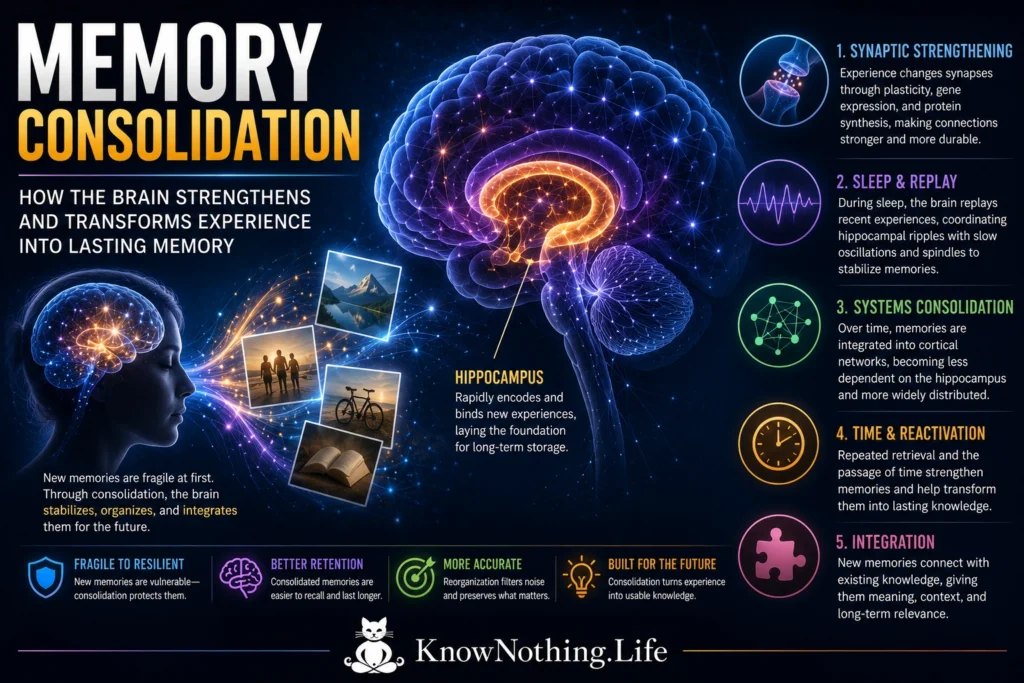
Memory consolidation is the collection of biological processes through which newly acquired information becomes more stable over time. Immediately after learning, a memory can be disrupted by injury, competing experiences, sleep deprivation, medication, or interference with neural activity. Consolidation gradually reduces this vulnerability by changing synapses, activating genes, producing proteins, reorganizing neural networks, and connecting the new experience with existing knowledge. The process does not preserve an untouched recording. As a memory becomes stable, it may also become more generalized, organized, or integrated with related information.
Neuroscientists usually distinguish cellular consolidation from systems consolidation. Cellular consolidation occurs over minutes or hours as activity alters individual neurons and synapses. Systems consolidation unfolds over longer periods as communication among the hippocampus, cerebral cortex, and other structures changes. These two levels are connected rather than independent. A memory cannot become reorganized across large brain networks unless the relevant cells and synapses remain capable of preserving learning-related changes. Consolidation is therefore not one event but a sequence of interacting processes operating across several biological scales.
Cellular Consolidation and Synaptic Change
At the cellular level, consolidation depends partly on synaptic plasticity, the capacity of connections between neurons to become stronger or weaker through experience. A major experimental model is long-term potentiation, or LTP. In 1973, Tim Bliss and Terje Lømo reported that brief high-frequency stimulation of a pathway entering the rabbit hippocampus produced an enhancement of synaptic responses that persisted long after stimulation ended. The finding offered a biological mechanism through which coordinated neural activity during learning could create a more durable pathway for later communication.
Long-lasting synaptic changes may involve altered neurotransmitter release, receptor trafficking, intracellular signaling, gene expression, protein production, and structural modification of dendritic spines. Early experiments by Louis Flexner and colleagues found that administering protein-synthesis inhibitors around the time of learning could produce later amnesia, supporting the idea that durable memory requires newly produced proteins. These drugs can have effects beyond protein synthesis, however, so their results must be interpreted cautiously. Modern neuroscience generally views protein production as one necessary component within a broader cascade rather than as a single molecular switch that permanently stores a memory.
The Hippocampus and Newly Formed Memories
The hippocampus is crucial for rapidly forming many episodic and relational memories. Its importance became clear through the study of Henry Molaison, formerly known as patient H.M. After extensive portions of both medial temporal lobes were removed to treat severe epilepsy, Molaison could maintain a conversation and retain information briefly, but he was profoundly impaired at forming lasting memories of new events and facts. William Scoville and Brenda Milner’s 1957 report demonstrated that immediate perception and short-term retention can remain functional even when the neural machinery needed for long-term declarative-memory formation has been severely disrupted.
The hippocampus is thought to bind the separate elements of an experience into a relational representation. A remembered event may contain a person represented in visual regions, a voice represented in auditory cortex, emotional significance involving the amygdala, and conceptual information distributed across association areas. The hippocampus helps connect these elements so that a partial cue can later reactivate a larger event. During early consolidation, this hippocampal coordination supports retrieval while direct relationships among the relevant cortical representations are still developing.
Systems Consolidation and Memory Transformation
Systems consolidation describes the reorganization of memory across large-scale brain networks. Traditional consolidation theory proposes that episodic memories initially depend strongly on the hippocampus but gradually become supported by more distributed neocortical connections. This does not mean that a complete memory is physically transferred from one location to another. The hippocampus and cortex begin representing the experience during learning, but repeated reactivation can strengthen cortical relationships and alter which structures are most necessary for later retrieval.
Research using genetically identified engram cells has provided direct evidence of this reorganization. Takashi Kitamura and colleagues found that neurons associated with a contextual fear memory were established in the prefrontal cortex during initial learning but were not immediately capable of driving natural recall. Over subsequent weeks, the cortical representation matured while the organization and accessibility of hippocampal memory cells changed. The study showed that remote memory depends on a gradual reconfiguration of interacting engram populations rather than the simple movement of one fixed trace.
Consolidation can also transform what a memory represents. Detailed recollection may continue to recruit the hippocampus, while generalized knowledge, central meaning, and regularities become increasingly represented in cortical networks. Existing knowledge can accelerate this process. Dorothy Tse and colleagues trained rats to learn a structured set of relationships that formed a schema. Once the schema existed, new related associations could become integrated rapidly and showed reduced dependence on the hippocampus much sooner than standard models had predicted. Consolidation therefore depends not only on elapsed time but also on how well new information fits what the brain already knows.
Sleep, Replay, and Neural Coordination
Sleep provides conditions that strongly support memory consolidation. During waking life, recently formed representations compete with continuous sensory input, new learning, and ongoing behavior. Sleep reduces these demands and allows neural patterns associated with earlier experience to reappear. In a landmark 1994 experiment, Matthew Wilson and Bruce McNaughton recorded groups of hippocampal place cells while rats explored an environment. Cells that had been active together during exploration showed coordinated reactivation during later sleep, providing evidence that recently acquired patterns are replayed after learning.
Replay does not appear to be a literal, full-speed recording of experience. Neural sequences may be compressed, reversed, selectively emphasized, or combined with information not experienced in exactly the same order. During non-REM sleep, hippocampal sharp-wave ripples interact with cortical slow oscillations and thalamic sleep spindles. Slow oscillations create periods of widespread cortical receptivity, ripples carry rapidly reactivated hippocampal information, and spindles may help promote plasticity in cortical networks. This coordinated timing offers a mechanism through which hippocampal representations can repeatedly influence longer-term cortical storage.
Human stimulation experiments provide causal evidence for the importance of these rhythms. Lisa Marshall and colleagues applied weak electrical stimulation designed to strengthen slow oscillation-like activity during early non-REM sleep. Participants later retained more hippocampus-dependent declarative information than after a control condition. Stimulation at a frequency associated with a different sleep state did not produce the same benefit. The results supported the idea that slow oscillations actively organize sleep-dependent consolidation rather than merely appearing alongside it.
Targeted Memory Reactivation
Researchers can sometimes influence which memories are consolidated by presenting sensory reminders during sleep. In a widely cited experiment, Björn Rasch and colleagues paired an odor with a spatial-learning task. Presenting the odor again during slow-wave sleep activated the hippocampus and improved later memory, while presenting it during REM sleep or wakefulness did not produce the same effect. The study demonstrated that an external cue can selectively reactivate a recently formed representation during a sleep state favorable to declarative-memory consolidation.
Targeted memory reactivation is not guaranteed to strengthen every cued memory. Its effects depend on the quality of prior learning, the type and intensity of the cue, the sleep stage, the phase of ongoing brain oscillations, and whether stimulation disturbs sleep. Some recent experiments have failed to reproduce selective benefits under particular conditions, while others have found that precisely timing cues to slow oscillations improves their effectiveness. These mixed results indicate that sleep reactivation is a conditional biological process rather than a simple method for inserting or permanently strengthening information.
Consolidation, Reconsolidation, and Lasting Memory
Consolidated memories are stable, but they are not permanently fixed. Retrieval can return an established memory to a temporarily modifiable state, after which it may require reconsolidation. Jacek Debiec, Joseph LeDoux, and Karim Nader found that blocking protein synthesis in the hippocampus disrupted an established contextual fear memory only when the memory had first been reactivated. Their results indicated that even an older memory can temporarily regain hippocampal and cellular dependence when it is brought back into an active state.
Consolidation and reconsolidation allow memory to balance persistence with flexibility. Stabilization preserves useful information, while reactivation allows that information to be updated as circumstances change. Sleep, rehearsal, retrieval practice, emotional significance, prior knowledge, and the timing of new learning all influence which representations survive and how they are transformed. The brain does not consolidate every detail equally. It preserves selected relationships, meanings, skills, and expectations that can guide future behavior.
Memory consolidation is therefore more than the strengthening of a fragile trace. It is an active process through which experience is stabilized, reorganized, integrated, and sometimes simplified. Synaptic changes preserve local patterns, the hippocampus binds new events, sleep reactivates recent representations, and cortical networks gradually incorporate information into established knowledge. A consolidated memory is not a perfect copy of the past. It is a durable but adaptable neural construction designed to remain useful in the future.