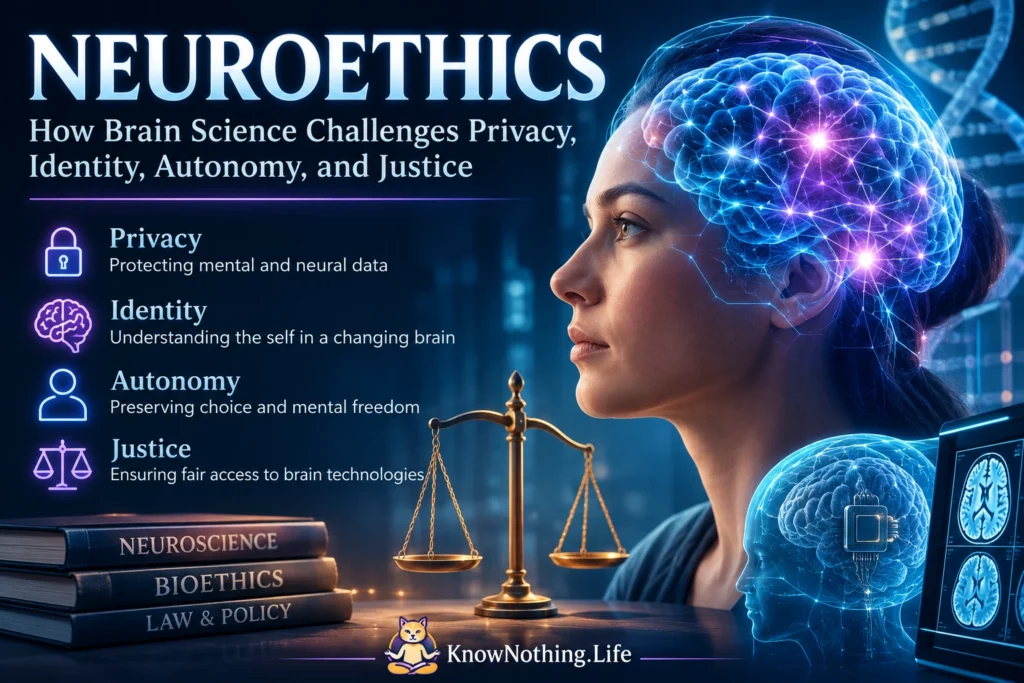
Neuroethics examines the moral, legal, and social questions created by research on the brain and by technologies that measure or alter neural activity. The modern field took recognizable shape in the early 2000s, although its concerns are much older. In “Neuroethics for the New Millenium,” philosopher and neuroscientist Adina Roskies distinguished the ethics of neuroscience from the neuroscience of ethics. The first asks how brain research and neurotechnology should be conducted and used; the second asks what neuroscience can reveal about moral judgment, agency, responsibility, and human values.
Judy Illes and Stephanie Bird later described neuroethics as a meeting point between bioethics, clinical neuroscience, law, public policy, and the public understanding of science. The field includes familiar research questions involving consent, safety, conflicts of interest, and vulnerable participants, but the brain adds unusual stakes. Neural interventions may influence memory, mood, motivation, communication, or personality, while brain data can be interpreted as evidence about a person’s capacities or inner life. Neuroethics therefore studies not only whether an intervention works, but also what kinds of power it gives clinicians, researchers, companies, governments, and users.
Brain Imaging, Prediction, and the Limits of Interpretation
Brain imaging can reveal tumors, vascular abnormalities, patterns of injury, and changes associated with neurological or psychiatric illness. It can also tempt people to treat colorful scans as direct pictures of thoughts, intentions, or character. Eric Racine, Ofek Bar-Ilan, and Illes found that media coverage often assigned broad personal and social meaning to neuroimages while giving limited attention to uncertainty and interpretation. Functional magnetic resonance imaging measures changes related to blood flow rather than thoughts themselves, and most research findings describe group-level associations that do not provide dependable judgments about a particular person.
Imaging research also creates responsibilities when a scan unexpectedly reveals a possible medical problem. Illes and colleagues argued that studies need plans for reviewing, communicating, and following up incidental findings rather than leaving decisions until a concerning image appears. A later analysis of 16,400 research brain scans found potentially clinically significant incidental findings in approximately 4 percent of participants. Disclosure may offer medical benefit, but it can also produce anxiety, unnecessary testing, expense, or ambiguous information. Ethical practice requires clear consent procedures, appropriate expert review, and honest explanation of what a finding does and does not establish.
Neurotechnology, Communication, and Mental Privacy
Brain–computer interfaces can translate neural activity into commands for communication devices, cursors, robotic limbs, or speech systems. In 2016, Mariska Vansteensel and colleagues reported that a fully implanted interface enabled a woman with amyotrophic lateral sclerosis to operate a typing program independently. Such work demonstrates the restorative promise of neurotechnology: a system that reads motor intention can return a degree of communication and control to a person whose muscles no longer reliably express those intentions.
The same capability raises questions about mental privacy. Experimental systems can decode aspects of attempted or imagined speech, although performance remains limited and highly dependent on training, equipment, and the individual user. Neural recordings may also contain information unrelated to the intended function, and data can be stored, shared, combined with other records, or reanalyzed by improved algorithms. Rafael Yuste and colleagues identified privacy, identity, agency, and equality as central ethical priorities for neurotechnology and artificial intelligence. Protection must therefore extend beyond ordinary data security to include meaningful control over collection, secondary use, deletion, commercialization, and access to inferences drawn from neural activity.
Deep Brain Stimulation, Identity, and Consent
Deep brain stimulation uses implanted electrodes to alter activity in selected neural circuits. It is an established treatment for some movement disorders and has been investigated for severe obsessive-compulsive disorder, depression, and other conditions. A randomized study led by Luc Mallet found that subthalamic stimulation could reduce symptoms in severe obsessive-compulsive disorder, but serious adverse events were substantial. Other reports show that small changes in electrode location or stimulation settings can affect mood and behavior, including a case in which stimulation near the substantia nigra produced an immediate, reversible depressive state.
These effects raise questions about identity and authenticity, but they should not be framed as though every neural intervention threatens the “real self.” Relief from disabling symptoms may increase freedom, spontaneity, and the capacity to pursue valued goals. Ethical evaluation should instead ask whether changes are wanted, understood, reversible when possible, and consistent with the person’s values. Consent can be especially difficult when illness affects judgment, hope creates unrealistic expectations, or an experimental device requires years of maintenance. Researchers must discuss surgical risk, uncertain benefit, device failure, programming burdens, future costs, and what will happen after a trial ends.
Enhancement, Fairness, and Social Pressure
Neuroethics also considers interventions used not to treat illness but to improve attention, memory, mood, or performance in healthy people. Prescription stimulants and wakefulness-promoting drugs are sometimes used for studying or demanding work. A systematic review by Dimitris Repantis and colleagues found that expectations often exceeded measured effects: methylphenidate produced some memory improvement but no consistent enhancement across other domains, while modafinil showed benefits that depended on the task and degree of sleep deprivation. Enhancement is therefore not a simple upgrade to a general mental capacity.
Even a safe and effective enhancer would raise questions about fairness, coercion, and access. An intervention chosen freely in one setting can become practically compulsory when classmates, employees, soldiers, or professionals believe others are using it. Benefits may flow mainly to people who can afford them, while risks fall on those under the greatest pressure to compete. Barbara Sahakian and Sharon Morein-Zamir argued that cognitive enhancement must be evaluated through evidence about benefits and harms as well as autonomy and social consequences. The relevant question is not merely whether adults should be permitted to alter themselves, but whether institutions would make refusal costly.
Responsibility, Free Will, and Neuroessentialism
Neuroscience can illuminate mechanisms involved in impulse control, addiction, aggression, empathy, and moral decision-making. These findings may improve treatment and provide relevant context in legal or clinical decisions. They do not automatically settle whether a person understood an action, could respond to reasons, or should be held responsible. A brain explanation is not an excuse by itself because every voluntary action also has a neural basis. Responsibility remains a normative judgment involving evidence about capacity, intention, circumstances, and the standards a society chooses to enforce.
Neuroethics warns against neuroessentialism—the tendency to treat the brain as the complete essence of a person and neural measurements as more truthful than behavior, testimony, history, or social context. Martha Farah observed that neuroscience can challenge beliefs about free will, spirituality, consciousness, and the self, but scientific descriptions do not directly generate moral conclusions. Explaining how a decision occurs does not determine whether it is good, fair, or worthy of punishment. Neuroscience should inform ethical reasoning without displacing philosophy, law, psychology, lived experience, or democratic debate.
Justice and Responsible Innovation
The benefits and burdens of neuroscience are not distributed equally. Advanced imaging, genetic testing, stimulation, and implanted devices are expensive and often concentrated in well-resourced institutions. Research datasets may underrepresent populations whose ancestry, language, disability, or socioeconomic conditions affect how findings generalize. Commercial devices can also shift control from patients and clinicians toward companies that own software, decoding systems, or proprietary data. Justice therefore requires attention to who participates in research, who receives treatment, whose values guide design, and who remains responsible when a device or company disappears.
Post-trial responsibility has become a particularly important issue for implanted neural devices. Interviews with researchers and patient-participants have identified concerns about continuing access, maintenance, cost, removal, and abandonment after experimental studies conclude. A consensus statement proposed that device abandonment includes failures to provide essential consent information or reasonable medical, technical, and financial support during the device’s expected lifetime. Responsible neuroethics must be built into research from the beginning through participant involvement, transparent governance, long-term planning, and enforceable protections. Its purpose is not to stop neuroscience, but to ensure that greater access to the brain does not come at the cost of dignity, agency, or equal moral status.