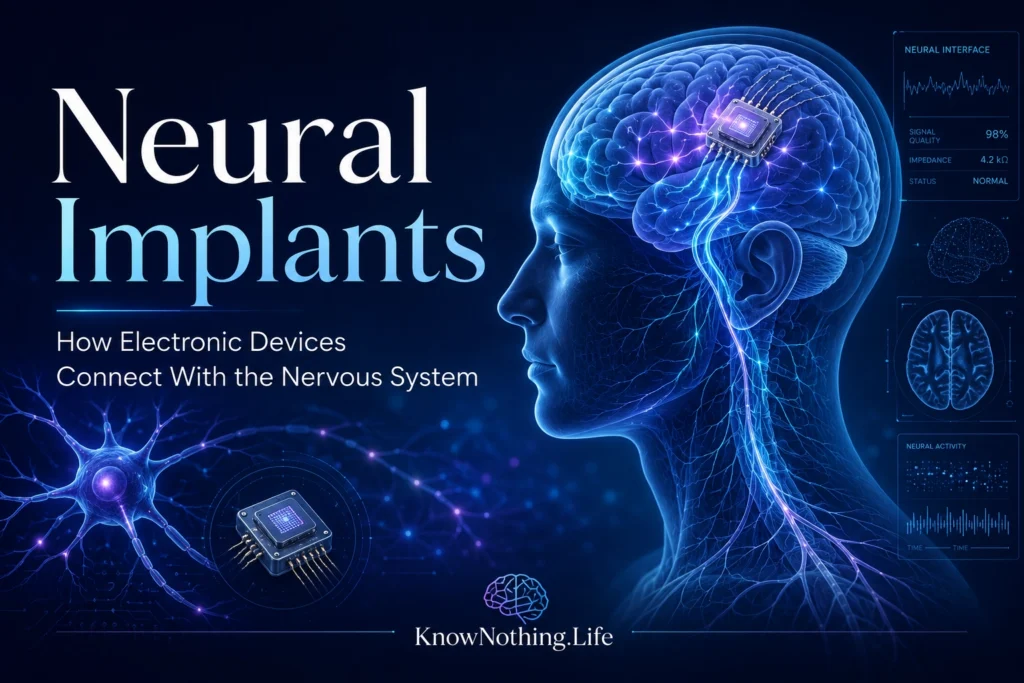
Neural implants are medical devices placed inside or near the nervous system to record electrical activity, deliver stimulation, or exchange information between neural tissue and external technology. Some implants replace missing sensory input, while others modify abnormal activity, restore communication, control prosthetic limbs, or activate surviving pathways after injury. The category includes cochlear implants, deep brain stimulators, responsive epilepsy devices, spinal cord stimulators, retinal prostheses, and implanted brain–computer interfaces. Although these systems differ greatly in purpose, they share the challenge of creating a reliable connection between living neural tissue and engineered hardware.
The nervous system is not a collection of simple wires. Neural signals vary across individuals and change with movement, attention, learning, medication, disease, and time. An implanted device must operate safely in a wet, chemically active biological environment while avoiding excessive inflammation, tissue damage, infection, and signal degradation. It must also provide information or stimulation in a form the brain can interpret. Successful neural implants therefore depend on more than electronics. Their performance emerges from cooperation among surgery, materials science, neuroscience, rehabilitation, software, and the brain’s own capacity to adapt.
Cochlear Implants and Sensory Restoration
Cochlear implants are among the most established neural prostheses. They are designed for people with severe or profound sensorineural hearing loss who receive limited benefit from conventional hearing aids. An external microphone and processor convert sound into coded electrical signals, which are transmitted to an electrode array implanted in the cochlea. The electrodes stimulate auditory nerve fibers, bypassing damaged sensory hair cells. The implant does not recreate natural hearing, but it can provide patterns that the auditory system gradually learns to recognize as environmental sounds and speech.
A prospective randomized trial led by Noel Cohen compared single-channel and multichannel cochlear implants in adults with profound postlingual deafness. Participants with functioning devices could detect sound, but multichannel systems produced substantially better recognition of words and sentences. The study also showed that changes to external speech-processing strategies could improve performance without replacing the implanted component. Cochlear implants illustrate a central principle of neural engineering: the quality of an implant depends not only on the electrode but also on the algorithm that translates information into stimulation.
Deep Brain Stimulation
Deep brain stimulation uses electrodes implanted in selected brain regions and connected to a pulse generator usually placed under the skin of the chest. It is an established treatment for certain cases of Parkinson’s disease, essential tremor, dystonia, and other movement disorders, and it has been investigated for epilepsy, obsessive-compulsive disorder, depression, and additional neurological or psychiatric conditions. The stimulation does not simply turn one brain region on or off. It alters patterns of activity across connected circuits, with the outcome depending on electrode placement, pulse settings, medication, symptoms, and the pathways reached by the electrical field.
In a major randomized trial, Günther Deuschl and colleagues found that subthalamic deep brain stimulation combined with medication produced greater improvements in motor function and quality of life than medication alone among carefully selected patients with advanced Parkinson’s disease. Implantation nevertheless involved risks, and stimulation could produce neurological or psychiatric side effects. More recent systems can record neural activity as well as stimulate it. A 2024 blinded feasibility trial found that personalized adaptive stimulation, which changed output according to detected neural signals, improved motor symptoms and quality of life compared with optimized continuous stimulation in four participants.
Brain Implants for Communication and Computer Control
Intracortical and electrocorticographic implants can record activity from motor and language-related regions of the brain. Machine-learning algorithms then translate those signals into commands for a cursor, keyboard, robotic arm, or speech synthesizer. These systems are primarily being developed for people with severe paralysis caused by amyotrophic lateral sclerosis, spinal cord injury, stroke, or brainstem damage. The implant does not independently read every thought. It is trained to recognize limited patterns associated with intentional actions such as attempting to move a hand, select a letter, or speak a word.
Implanted brain–computer interfaces have progressed from short laboratory demonstrations toward extended independent use. A 2026 report described a participant with ALS who used an intracortical system at home for more than 3,800 hours over 19 months. The device supported speech generation, cursor control, internet use, personal and professional communication, and continued full-time employment. Such results demonstrate that implanted interfaces can restore meaningful independence, but they also reveal the need for dependable hardware, daily calibration, caregiver support, technical maintenance, and long-term clinical oversight.
Restoring Movement and Touch
Motor implants can decode movement intentions from the cerebral cortex and route them around a damaged spinal cord. The resulting commands may control a robotic limb, computer pointer, or electrical stimulation system connected to the person’s own muscles. Early human research demonstrated that movement-related signals could remain detectable years after paralysis. Later studies enabled participants with tetraplegia to reach, grasp, and manipulate objects using neurally controlled robotic arms. These systems do not heal the original injury; they build an alternative pathway between the brain’s motor plan and an external device.
Movement becomes more natural when the implant also restores sensory feedback. Vision alone cannot fully reveal how firmly an object is being held or whether contact has occurred. In 2016, Sharlene Flesher and colleagues showed that stimulating electrodes implanted in the human somatosensory cortex could evoke sensations perceived in specific parts of the hand. A later bidirectional interface combined cortical movement decoding with artificial touch, allowing a participant to complete object-transfer tasks more quickly than with visual feedback alone. These studies suggest that future prostheses may become integrated sensory-motor systems rather than tools controlled only by observation.
Spinal Cord Implants and Digital Bridges
Spinal implants deliver electrical stimulation to neural circuits below an injury. The spinal cord contains networks capable of coordinating standing and stepping, but severe injury may interrupt the commands that normally reach them from the brain. Carefully timed stimulation can increase the excitability of these circuits so that residual voluntary signals and rehabilitation become more effective. Results vary with the location and completeness of the injury, and stimulation must be combined with extensive training.
In 2023, Henri Lorach and colleagues described a “digital bridge” connecting implants over the motor cortex with a spinal stimulation system. Neural activity related to intended leg movement was decoded and used to activate spinal circuits in real time. One participant with chronic tetraplegia regained the ability to stand and walk in community settings with assistance from the system. The study involved a single participant and does not establish a universal cure for paralysis, but it demonstrated how coordinated brain and spinal implants can bypass a damaged section of the nervous system.
Retinal and Visual Implants
Visual implants attempt to create useful perception by stimulating surviving parts of the visual pathway. Retinal prostheses are designed for conditions in which photoreceptors have degenerated while other retinal neurons and the optic nerve remain partly functional. A camera or external projection system converts images into stimulation delivered by electrodes or photovoltaic pixels. The resulting percepts are usually limited compared with ordinary vision and may consist of flashes, patterns, edges, or simplified shapes that require substantial training to interpret.
A clinical study of a subretinal photovoltaic implant included 38 people with central vision loss caused by geographic atrophy associated with age-related macular degeneration. The implant converted projected near-infrared images into electrical stimulation and restored a measure of central visual perception within damaged retinal areas. The result represents important progress, but implant users did not receive normal vision, and surgery, long-term device stability, image resolution, and rehabilitation remain major considerations.
Biological and Engineering Limitations
Implanted electrodes operate inside tissue that responds to foreign material. Immune cells may surround an electrode, microscopic movement can alter its relationship with nearby neurons, and signals may become less stable over months or years. Batteries eventually require replacement or recharging, wires and connectors can fail, and software may need continuing updates. Research measuring chronic intracortical interfaces has documented instability in recorded neural populations, even when users remain able to control a device through recalibration and adaptive decoding.
Engineers are developing flexible electrodes, wireless power systems, biocompatible coatings, higher-density arrays, and algorithms that adjust when signals change. Greater electrode density may increase resolution but can also create more heat, data, and tissue interaction. Wireless systems reduce the need for cables passing through the skin but raise questions about power consumption, security, and signal reliability. Progress therefore requires balancing precision with durability and clinical safety rather than simply placing the largest possible number of electrodes into the nervous system.
Privacy, Autonomy, and Long-Term Care
Neural implants can generate highly sensitive information about attempted movement, communication, symptoms, and responses to stimulation. These recordings may be stored, transmitted, or used to train machine-learning systems. Patients need clear information about who controls the data, whether it can be reused commercially, how it is protected, and what happens when they withdraw from a study. An implanted device can increase autonomy by restoring communication or mobility, but dependence on proprietary software or remote technical support can create a new form of vulnerability.
Long-term responsibility is especially important because an implanted system may remain in a person’s body after a research project, company, or funding source ends. A 2024 multistakeholder consensus defined neurological-device abandonment to include failures to provide adequate information, medical care, technical assistance, financial planning, or support during the expected life of a device. UNESCO’s 2025 Recommendation on the Ethics of Neurotechnology similarly emphasizes mental privacy, informed consent, dignity, autonomy, safety, fairness, and accountability throughout a technology’s life cycle.
The Future of Neural Implants
Future implants will probably become smaller, more adaptive, more wireless, and better able to record and stimulate simultaneously. Closed-loop systems may detect a seizure, tremor, mood-related biomarker, or intended movement and respond within milliseconds. Combined implants could link the brain with the spinal cord, deliver artificial touch to a prosthetic hand, or translate attempted speech into a personalized synthetic voice. Their most significant achievements may involve restoring abilities rather than creating superhuman ones.
The success of neural implants should be judged by more than technical demonstrations. A clinically valuable implant must remain safe, reliable, repairable, affordable, and useful outside a laboratory. It must respect the user’s control over data and treatment, and it must come with realistic plans for rehabilitation and lifelong support. Neural implants reveal that electronic systems can become functional partners with the nervous system, but the person must remain more important than the device. Their future depends on advancing engineering without treating communication, movement, sensation, identity, or autonomy as merely technical problems.