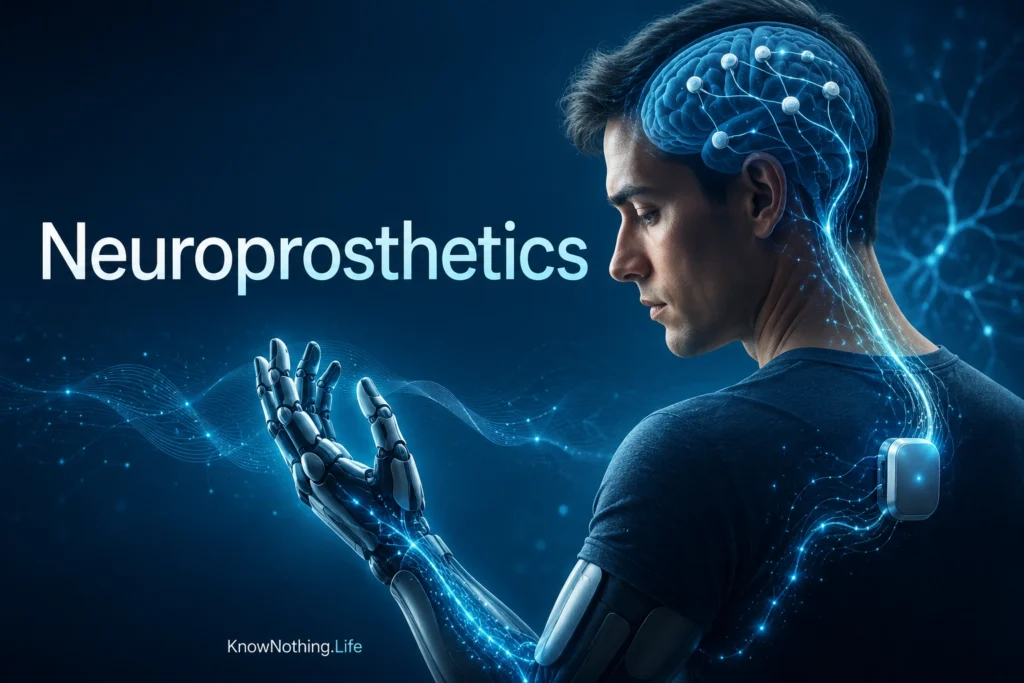
Neuroprosthetics are devices that communicate directly with the nervous system to restore, replace, or support a lost biological function. Unlike a conventional prosthetic limb controlled mechanically or through residual muscle activity, a neuroprosthetic system interprets electrical signals from the brain, spinal cord, peripheral nerves, or muscles and converts them into useful actions. Some devices also stimulate neural tissue to create sensations or modify activity. Neuroprosthetics therefore rebuild a pathway between intention, movement, sensation, and the external world.
The field includes familiar clinical technologies as well as experimental systems. Cochlear implants convert sound into patterns of electrical stimulation delivered to the auditory nerve. Functional electrical stimulation systems activate paralyzed muscles. Brain–computer interfaces decode attempted movement or speech from cortical activity, while retinal and cortical visual prostheses attempt to produce useful visual percepts. Although these technologies differ in maturity, each attempts to bypass a damaged neural pathway.
From Electrical Stimulation to Neural Interfaces
The cochlear implant became one of the clearest demonstrations that an electronic device could substitute for part of a sensory system. In a prospective randomized study published in the New England Journal of Medicine in 1993, Noel Cohen and colleagues compared single-channel and multichannel cochlear implants in adults with profound deafness. Multichannel devices produced substantially better speech recognition, and improvements in external speech-processing software further increased performance. The findings showed that neuroprosthetic success depends not only on implanted hardware but also on how biological information is encoded.
That lesson remains central. A neural interface must record or stimulate the correct tissue, but it must also translate information into a form the nervous system can use. Electrodes capture noisy electrical activity rather than complete thoughts, and stimulation produces simplified patterns rather than natural sensation. Modern systems combine neuroscience, engineering, surgery, robotics, signal processing, and machine learning. Their effectiveness depends on implant stability, signal quality, decoding speed, and the user’s ability to adapt.
Restoring Movement After Paralysis or Limb Loss
Motor neuroprosthetics transform the intention to move into control of a computer, wheelchair, robotic limb, or the user’s own muscles. Electrodes placed in or near the motor cortex can detect patterns associated with attempted movement even when spinal cord injury, stroke, or neurodegenerative disease prevents those commands from reaching the body. In a landmark 2012 Nature study, Leigh Hochberg and colleagues showed that two people with long-standing tetraplegia could use motor-cortex signals to control a robotic arm in three-dimensional reach-and-grasp tasks. One participant used the system to lift a drink to her mouth, demonstrating that useful movement intentions can remain detectable years after paralysis.
Later research expanded the precision of controllable movements. Jennifer Collinger and colleagues reported in The Lancet that a participant with tetraplegia rapidly learned coordinated, seven-dimensional control of an anthropomorphic robotic arm. The achievement also exposed a major limitation: vision alone is an inefficient substitute for touch. A person controlling a robotic hand without sensation must constantly watch the fingers to judge contact, grip force, and object movement. Natural movement depends on feedback from skin, muscles, and joints, so a truly functional neuroprosthesis must do more than read motor commands. It must return meaningful sensory information.
Closing the Loop With Artificial Touch
Bidirectional neuroprosthetics combine neural recording with neural stimulation. Motor-cortex signals may command a robotic arm, while pressure sensors on the robotic fingers trigger stimulation of the somatosensory cortex or peripheral nerves. The user then experiences an artificial sensation associated with contact. These sensations are not necessarily identical to natural touch, but they can provide information about where and how strongly the prosthetic hand is interacting with an object.
In a 2021 Science study, Sharlene Flesher and colleagues created a brain–computer interface that recorded movement-related activity from the motor cortex and evoked tactile sensations through intracortical microstimulation of the somatosensory cortex. When artificial touch was added, a participant with tetraplegia completed a standardized robotic-arm task substantially faster; median trial time fell from 20.9 seconds to 10.2 seconds. The result showed why closed-loop design matters. A neuroprosthesis becomes more efficient when the nervous system can both issue commands and receive consequences, approximating the reciprocal structure of biological sensorimotor control.
Peripheral nerve interfaces offer another route to bidirectional control, particularly for people with amputations. Electrodes wrapped around or inserted into residual nerves can record motor commands intended for the missing limb and stimulate sensory fibers to create touch or pressure percepts. These systems may help a prosthetic limb feel more like part of the body. Long-term performance remains difficult because nerves move, scar tissue forms around electrodes, and stimulation responses vary among individuals.
Speech and Communication Neuroprostheses
For people with severe paralysis, the most important lost function may be communication. Speech neuroprostheses decode the neural activity produced when a person tries to speak, write, or form words. Early systems allowed users to select letters slowly with a cursor, but newer approaches decode attempted speech directly into text or synthesized voice. In 2021, David Moses and colleagues reported a real-time system that decoded words and sentences from cortical activity in a person with anarthria following a brain-stem stroke. The study demonstrated that speech-related cortical patterns can remain usable even when the muscles required for speech no longer function.
Performance advanced quickly. In a 2023 Nature study, Francis Willett and colleagues used intracortical recordings and language modeling to decode attempted speech in a participant with amyotrophic lateral sclerosis. The system achieved a 9.1 percent word error rate with a 50-word vocabulary and a 23.8 percent error rate with a vocabulary of 125,000 words. A 2024 study led by Nicholas Card showed that a speech neuroprosthesis could be calibrated rapidly and used with high accuracy, reducing a major practical barrier. These are not mind-reading devices: they decode activity associated with deliberate attempts to communicate. They may nevertheless restore independence to people who cannot reliably express language through movement.
Challenges, Risks, and Ethical Questions
The greatest technical challenge is long-term reliability. Neural signals change because electrodes shift microscopically, tissue reacts to implants, neurons alter their activity, and a user’s condition may progress. A 2024 New England Journal of Medicine report documented seven years of independent at-home communication with an implanted brain–computer interface, showing that sustained use is possible, although such systems may still require recalibration and technical support. Surgery also introduces risks including infection, bleeding, hardware failure, and damage to neural tissue.
Noninvasive systems avoid implantation by recording activity through the scalp. A 2025 study, for example, demonstrated real-time EEG-based decoding of individual finger movements for robotic finger control. These systems may be safer and easier to deploy, although scalp recordings access neural activity less directly than implanted electrodes. The long-term clinical challenge is therefore not simply to obtain the most detailed signal possible, but to find the appropriate balance among precision, safety, durability, independence, and cost.
Neuroprosthetics also raise questions about privacy, agency, ownership, and access. Neural data can reveal intended movements or communication attempts, making security and informed consent essential. Users need to know how data are stored, who can access them, and whether software updates may alter device performance. Responsibility may become complicated when an action results from a combination of human intention, algorithmic interpretation, and machine execution. Cost is equally important: a technology that restores communication or movement may deepen inequality if it remains available only through specialized research programs.
The Future of Neuroprosthetics
The future will likely involve smaller implants, wireless transmission, more durable electrodes, adaptive decoding, biomimetic sensory feedback, and closer integration with rehabilitation. Machine-learning systems may adjust automatically as neural signals change, while flexible materials may reduce tissue damage and improve long-term recording. Rather than requiring users to adapt continually to a rigid device, future neuroprostheses may learn from changing patterns of neural activity and personalize their operation over time.
Researchers are also developing systems in which brain signals stimulate the spinal cord or muscles so users can control their own limbs rather than an external robot. In 2026, researchers described a “double neural bypass” linking an intracortical interface with patterned stimulation of the spinal cord and cortex to support hand movement and sensation after severe spinal cord injury. Such approaches may combine immediate assistance with rehabilitation intended to encourage lasting sensorimotor recovery.
Neuroprosthetics are sometimes described as technologies that merge humans and machines, but their most important purpose is more practical: restoring choices that injury or disease has taken away. Reaching for a cup, feeling an object, hearing speech, or speaking to another person may appear ordinary until the neural pathway supporting that action is lost. The deepest promise of neuroprosthetics is not superhuman enhancement. It is the reconstruction of communication between the brain, body, and world, allowing more people to act independently and participate in everyday life.