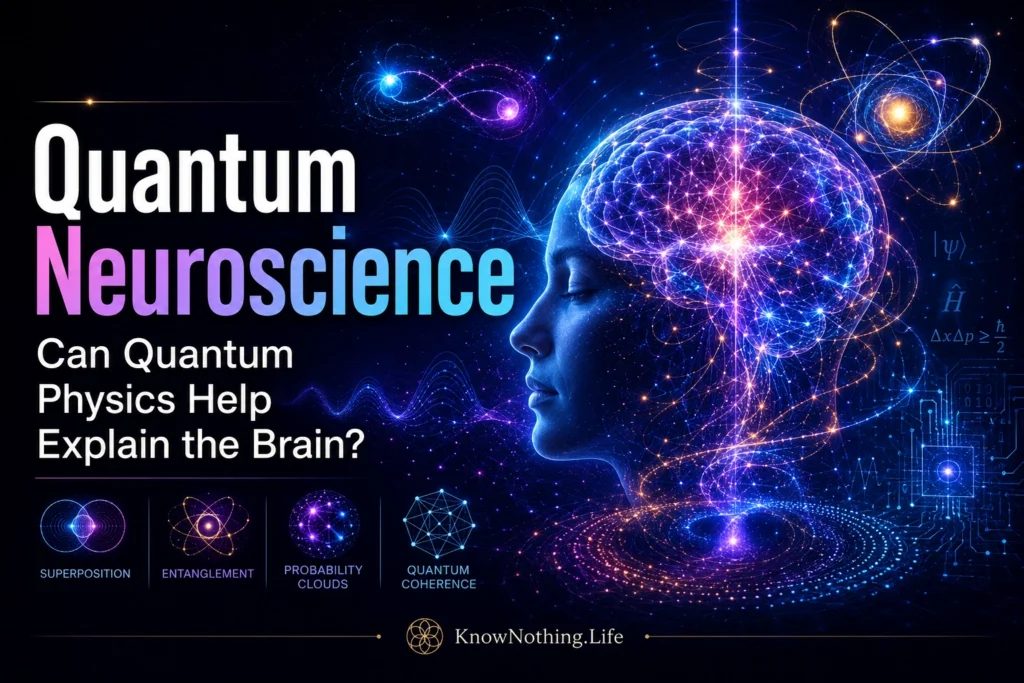
Quantum neuroscience asks whether quantum-mechanical effects play a functional role in neural activity, cognition, or consciousness. At the smallest scale, every chemical bond, receptor interaction, and ion-channel process in the brain follows quantum physics. That fact alone does not mean the brain operates as a quantum computer. Conventional neuroscience explains action potentials, synaptic transmission, network oscillations, and learning through molecular biology and largely classical models. The narrower question is whether coherence, tunneling, superposition, or entanglement can remain organized long enough inside neural tissue to influence information processing in a distinct and measurable way.
The term also includes a more established enterprise: using quantum technology to study the nervous system. Magnetic resonance imaging depends on nuclear spin, and new magnetoencephalography systems use atomic quantum sensors to detect the weak magnetic fields produced by neuronal currents. Quantum neuroscience therefore contains two different projects. One uses proven quantum principles to build better instruments. The other proposes that the brain itself exploits nonclassical information processing. The first is already productive; the second remains speculative.
Quantum Effects in Living Systems
Living tissue is warm, wet, and chemically active, conditions that usually destroy delicate quantum states through decoherence. Quantum biology has nevertheless shown that some organisms may exploit quantum effects at molecular scales. Research on photosynthetic energy transfer has described quantum-assisted transport, while radical-pair chemistry offers a plausible mechanism through which cryptochrome proteins could respond to weak magnetic fields during animal navigation. These examples show that evolution can use quantum behavior when molecular structure and reaction timing provide the right conditions.
Their relevance to the brain is limited. A brief quantum effect in a protein is not the same as sustained quantum computation across neurons. Neural signaling unfolds over milliseconds and involves enormous numbers of ions, water molecules, membranes, and proteins interacting with their surroundings. A credible theory must identify a physical substrate, show that its quantum state survives long enough to matter, explain how it affects neuronal firing, and make predictions that differ from classical neuroscience.
The Decoherence Problem
Decoherence is the strongest general objection to quantum-brain theories. A quantum system loses its distinctive superpositions or entanglement when information about its state spreads into the environment. In neurons, thermal motion, collisions, electrical fields, and molecular interactions provide constant opportunities for this to occur. Max Tegmark estimated in 2000 that proposed quantum states involving ion positions or microtubule polarization would decohere in approximately 10^-13 to 10^-20 seconds, far shorter than the millisecond timescale of neural signaling. He concluded that ordinary brain dynamics should be treated as effectively classical.
These estimates do not prove that every biologically useful quantum effect is impossible. Protected nuclear spins, rapid chemical reactions, or molecular shielding could behave differently from the states Tegmark analyzed. The burden of proof nevertheless rests with the proposed mechanism. Researchers must demonstrate realistic coherence times and show that manipulating the relevant quantum variable changes neural or behavioral function as predicted.
Microtubules and Orch OR
The best-known quantum theory of consciousness is orchestrated objective reduction, or Orch OR, developed by Stuart Hameroff and Roger Penrose. It proposes that tubulin proteins within neuronal microtubules support orchestrated quantum states whose objective physical reduction produces moments of conscious experience. Microtubules are essential cellular structures involved in transport, shape, and neuronal organization, but their proposed role as quantum computational elements remains unverified.
The theory has faced substantial criticism. Laura McKemmish and colleagues argued that known tubulin dynamics do not provide the rapid, coherent switching required by the model, while decoherence calculations and the absence of direct evidence remain major obstacles. Supporters have revised aspects of Orch OR and pointed to microtubule vibrations and quantum biology as reasons to continue testing it. No experiment, however, has established that quantum computation in microtubules generates consciousness.
Nuclear Spins and Posner Molecules
Physicist Matthew Fisher proposed a different mechanism in 2015. He suggested that phosphorus-31 nuclear spins might function as biological qubits because nuclear spins can be less vulnerable to environmental disruption. In the model, entangled phosphate ions become protected inside calcium-phosphate clusters called Posner molecules. Spin-dependent binding and dissolution could influence calcium release and neurotransmitter secretion, connecting quantum information with neuronal activity.
The Posner model remains unconfirmed. Computational studies have explored possible structures and spin dynamics, but the required clusters have not been shown to store and process quantum information in living brain tissue. A 2020 mouse experiment tested predicted effects of calcium concentration and calcium isotopes on anesthetic sensitivity and found no isotope dependence, which the authors interpreted as evidence against a central version of the hypothesis. The result does not eliminate every nuclear-spin proposal, but it demonstrates the value of specific, falsifiable tests.
Anesthesia as a Test Case
Anesthesia is attractive to quantum neuroscience because anesthetic drugs can reversibly eliminate consciousness while leaving many cellular processes intact. Quantum-consciousness theories have proposed that anesthetics interfere with quantum activity in proteins or microtubules. Mainstream anesthesiology instead explains their effects mainly through ion channels, receptors, and large-scale brain networks. A quantum contribution would have to explain observations that those established mechanisms cannot.
A provocative 2018 study examined xenon isotopes. Na Li and colleagues reported that isotopes possessing nuclear spin were less potent anesthetics in mice than spin-zero isotopes, despite having nearly identical conventional chemical properties. Nuclear spin is a quantum property, so the finding suggests that spin-sensitive chemistry may influence xenon anesthesia. It does not demonstrate entanglement, quantum consciousness, or brain-wide quantum computation, and replication plus a molecular mechanism are still needed.
Quantum Cognition Is a Different Idea
Quantum cognition uses the mathematics of quantum probability to model judgment, memory, and decision-making. Classical probability assumes that beliefs can be represented within one fixed set of outcomes. Quantum probability allows context, incompatibility, and question order to change the state being modeled, sometimes describing human decisions more effectively. Most researchers using this framework do not claim that neurons contain physical qubits.
The word “quantum” here refers to a mathematical structure, not necessarily a microscopic brain mechanism. A successful quantum-cognition model may reveal useful principles of contextual reasoning while providing no evidence for microtubule coherence or nuclear-spin entanglement. Keeping these ideas separate prevents psychological modeling from being misrepresented as proof of a literal quantum brain.
Quantum Technologies for Neuroscience
The clearest achievements come from quantum measurement. MRI uses nuclear-spin behavior to create detailed brain images. Optically pumped magnetometers use quantum states of atoms to detect neural magnetic fields without the cryogenic equipment required by traditional MEG. In 2018, Elena Boto and colleagues demonstrated a wearable OPM-MEG helmet that recorded brain activity at millisecond resolution while participants moved, drank, stretched, and played a ball game.
Diamond sensors containing nitrogen-vacancy centers may eventually detect neural magnetic fields at microscopic scales. A 2023 proof-of-principle study recorded signals associated with action potentials traveling through mouse corpus-callosum tissue and verified them with simultaneous electrophysiology. These devices do not show that the brain performs quantum computation; they use controllable quantum systems outside the brain to observe ordinary electrical activity with exceptional sensitivity.
The Future of Quantum Neuroscience
Progress depends on connecting a defined quantum state to a measurable biological effect. Researchers would need to identify candidate molecules in living neural tissue, measure their coherence or spin lifetimes under physiological conditions, manipulate the proposed quantum variable without broadly disrupting chemistry, and demonstrate predictable changes in synaptic, circuit, or behavioral outcomes. Isotope substitution, magnetic-field perturbation, ultrafast spectroscopy, nuclear magnetic resonance, and nanoscale quantum sensors may enable such tests.
Quantum mechanics unquestionably underlies the molecules of the brain, and quantum technology already provides powerful ways to image and measure neural activity. Whether evolution has also built a functional quantum-information processor inside the nervous system remains unanswered. Current evidence does not justify describing consciousness as a demonstrated quantum phenomenon, but it does support carefully testing narrow molecular hypotheses. The responsible approach is to distinguish established quantum tools, plausible quantum biology, and speculative theories—and allow reproducible experiments to determine where the boundary lies.