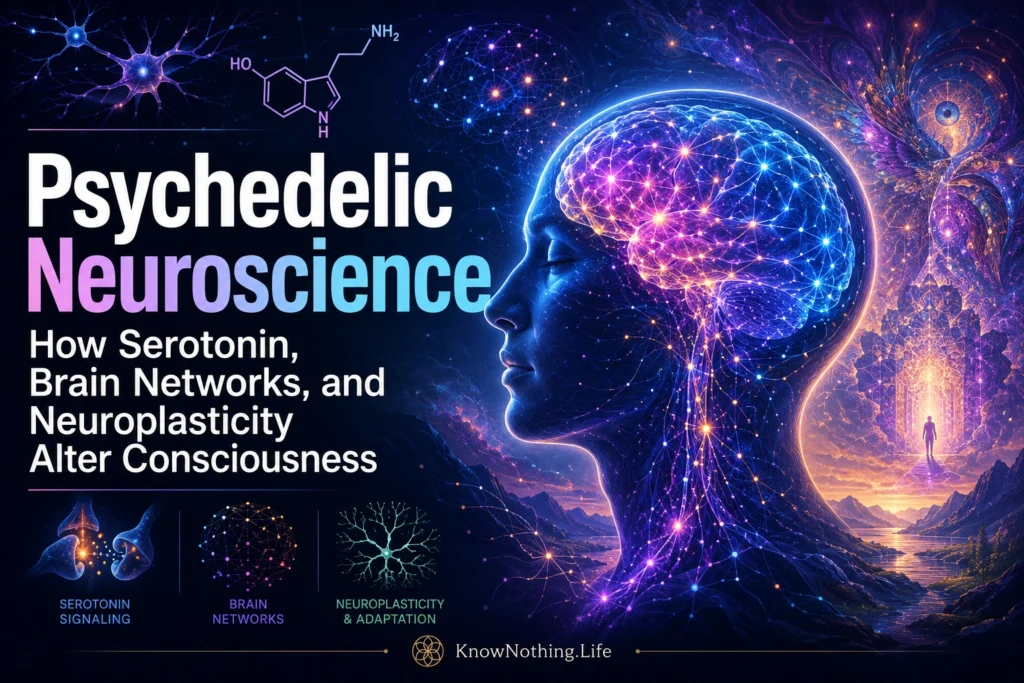
Psychedelic neuroscience investigates how certain psychoactive compounds temporarily alter perception, emotion, cognition, self-awareness, and brain-network organization. Classic serotonergic psychedelics include psilocybin, lysergic acid diethylamide, mescaline, and N,N-dimethyltryptamine. Although these substances differ in potency, duration, and receptor-binding profile, their characteristic effects depend substantially on activation of the serotonin 2A receptor. Researchers use molecular biology, brain imaging, electrophysiology, behavioral testing, and clinical trials to understand how this receptor-level event develops into such extensive changes in conscious experience.
The field must distinguish classic psychedelics from drugs that are sometimes placed under the same broad cultural label. Ketamine primarily acts through glutamatergic mechanisms, while MDMA produces prominent effects through serotonin release and is usually classified as an entactogen. Psychedelic neuroscience focuses not only on unusual subjective experiences but also on what those experiences reveal about ordinary brain function. By temporarily disrupting stable patterns of perception and self-processing, psychedelics provide an experimental tool for studying how the nervous system constructs reality, identity, emotional meaning, and behavioral flexibility.
Serotonin Receptors and Cortical Signaling
Classic psychedelics resemble serotonin closely enough to interact with several serotonin-receptor subtypes, but the 5-HT2A receptor is especially important. These receptors are highly expressed on cortical pyramidal neurons, including cells within association regions involved in perception, attention, cognition, and self-reflection. Their activation alters excitatory signaling and the balance between incoming sensory information, internal predictions, and communication among cortical layers. The result is not simply increased or decreased activity. Different neuronal populations may become excited, inhibited, desynchronized, or connected in unfamiliar ways.
A 2019 positron-emission tomography study led by Martin Madsen provided direct human evidence connecting receptor engagement with subjective effects. Eight volunteers received psilocybin doses ranging from 3 to 30 milligrams. Psilocin concentration, cerebral 5-HT2A receptor occupancy, and the reported intensity of the psychedelic experience closely tracked one another, with receptor occupancy reaching as high as 72 percent. Other human experiments have found that ketanserin, which blocks 5-HT2A receptors, reduces several cognitive and subjective effects of psilocybin. These findings establish 5-HT2A stimulation as a major initiating mechanism, although additional receptors and signaling pathways may influence the final experience.
Brain Networks and the Changing Sense of Self
Normal consciousness depends partly on the brain’s ability to maintain specialized networks. Visual, auditory, motor, attentional, and self-referential systems develop recognizable patterns of internal communication. Psychedelics temporarily weaken some of these familiar boundaries. In a 2012 functional MRI study, Robin Carhart-Harris and colleagues found that psilocybin reduced blood flow and organized activity within several high-level network hubs, including regions associated with the default mode network. These results challenged the assumption that a more intense mental state must arise from a simple global increase in brain activity.
Later studies revealed a combination of disintegration and unusual integration. Enzo Tagliazucchi and colleagues reported in 2016 that LSD increased global connectivity in association cortices and the thalamus while increasing communication between networks that are usually more distinct. The extent of this global connectivity correlated with ego dissolution, an experience in which the boundary between the self and the external environment becomes less stable. A 2024 precision-imaging study led by Joshua Siegel similarly found that psilocybin desynchronized activity across several spatial scales and temporarily reduced the distinctions separating brain networks, with especially strong effects in the default mode network and hippocampal connections.
Perception, Prediction, and Psychological Flexibility
The brain does not passively record the world. It uses prior experience to predict what sensory signals mean, updating those predictions when new information arrives. Psychedelic states may alter the balance between established expectations and incoming signals. Ordinary objects can appear unusually vivid or significant, music may evoke intense imagery, and thoughts or memories may connect in unfamiliar ways. Visual effects do not necessarily arise because the eyes receive different information; they can emerge because cortical systems organize that information differently.
Several theories propose that psychedelics temporarily reduce the dominance of rigid, high-level models of reality. This may allow sensory data, emotions, memories, and alternative interpretations to exert greater influence on conscious experience. The idea is compatible with findings of increased brain-signal complexity, weakened network modularity, and broader communication among normally segregated systems. A 2026 exploratory study of 28 psychedelic-naive volunteers found that 25 milligrams of psilocybin increased acute EEG signal entropy. Greater acute entropy predicted psychological insight the following day and improved well-being one month later, although the small study was designed to generate hypotheses rather than establish a universal mechanism.
Psychedelics and Neuroplasticity
Psychedelic effects last for several hours, but some behavioral and therapeutic changes have been reported weeks or months later. Neuroplasticity—the nervous system’s ability to modify its structure and function—may help bridge this difference in timescale. In 2018, Calvin Ly and colleagues found that several psychedelic compounds increased dendritic growth, spine formation, and synaptic measures in cultured neurons and animal models. These structural effects resembled some changes produced by rapidly acting antidepressant treatments, leading the researchers to describe psychedelics as psychoplastogens: compounds capable of promoting neural plasticity.
Ling-Xiao Shao and colleagues provided more direct in vivo evidence in 2021 by repeatedly imaging dendritic spines in the frontal cortex of living mice. A single psilocybin dose increased spine size and density by approximately 10 percent, and part of the new growth remained detectable one month later. Later experiments suggested that psychedelics can stimulate plasticity through intracellular 5-HT2A receptors, while another line of research proposed that LSD and psilocin enhance brain-derived neurotrophic factor signaling by binding to its TrkB receptor. These mechanisms remain under investigation, and neuronal growth in laboratory animals cannot by itself prove therapeutic change in humans.
Subjective Experience and Emotional Meaning
Psychedelics can produce experiences involving unity, altered time, emotional release, awe, fear, or a reduced sense of personal boundaries. In a landmark 2006 experiment, Roland Griffiths and colleagues administered psilocybin or methylphenidate to healthy volunteers under supportive, double-blind conditions. Psilocybin produced mystical-type experiences that many participants later rated as highly meaningful. At a 14-month follow-up, 58 percent described the experience as among the five most personally meaningful events of their lives, while 64 percent reported increased well-being or life satisfaction.
Subjective intensity alone does not guarantee benefit. Experiences of fear, confusion, or loss of control can also occur, especially when the surroundings feel unsafe or the person is poorly prepared. “Set” refers to expectations, personality, mental state, and intention, while “setting” includes the physical and social environment. These factors can influence what psychological material becomes prominent and how it is interpreted. In clinical research, preparatory meetings, continuous supervision, and post-session integration are not decorative additions to the drug. They are part of the intervention being evaluated.
Clinical Research and Therapeutic Potential
Clinical studies have produced encouraging but incomplete evidence, particularly for depression and substance-use disorders. In a 2021 randomized trial involving 59 participants with depression, two psilocybin sessions were compared with a six-week course of escitalopram, with both groups receiving psychological support. The primary depression outcome did not differ significantly between the groups, although several secondary outcomes favored psilocybin. A larger 2022 trial in treatment-resistant depression found that a single 25-milligram dose reduced depressive symptoms more than a 1-milligram control at three weeks, but adverse events occurred and the advantage was not sustained equally across every time point.
Addiction research has also suggested that a psychedelic experience may support changes in learned behavior when combined with therapy. In a 2022 randomized trial of 93 treated participants with alcohol-use disorder, Matthew Bogenschutz and colleagues combined two medication sessions with motivational and cognitive-behavioral therapy. Participants receiving psilocybin had heavy-drinking days on 9.7 percent of follow-up days, compared with 23.6 percent in the diphenhydramine control group. Because both groups received extensive psychotherapy, the result supports a combined treatment model rather than proving that the drug alone produced the improvement.
Risks, Limitations, and the Future
Psychedelics can acutely increase anxiety, blood pressure, heart rate, nausea, confusion, and emotional vulnerability. Clinical trials generally exclude people with certain cardiovascular conditions or histories suggesting elevated risk of psychosis or mania, meaning their safety results cannot automatically be generalized to every population. Psychedelic studies also face an unusual blinding problem: participants and therapists can often guess who received the active drug. Expectations, intensive professional attention, carefully selected volunteers, and psychotherapy may therefore contribute to the large effects reported in early trials.
Future research must determine which biological and psychological elements are necessary for lasting benefit. Scientists are investigating whether the subjective experience is essential, whether non-hallucinogenic compounds can retain useful plasticity-promoting properties, and how therapy should be structured during the period of increased flexibility. Larger trials, longer follow-up, diverse participant samples, and direct comparisons with established treatments will be necessary. Psychedelic neuroscience has already shown that consciousness is more biologically flexible than it ordinarily appears. Its clinical promise will depend on turning that insight into treatments that are reproducible, carefully supervised, and supported by evidence rather than cultural enthusiasm.