The default mode network, often shortened to DMN, is one of the most influential discoveries in modern cognitive neuroscience because it changed how researchers think about the resting brain. For much of the twentieth century, the brain was studied mainly by asking what regions “turn on” during tasks: reading a word, solving a puzzle, moving a hand, recognizing a face, or making a decision. The assumption was simple enough: important brain activity happens when a person is doing something. The discovery of the default mode network complicated that assumption. It showed that the brain is highly active even when a person is lying still, looking at a blank screen, or apparently doing “nothing.” In fact, some brain regions become more active during inward thought and less active during demanding external tasks.
Marcus E. Raichle and colleagues gave this idea its classic formulation in the 2001 PNAS paper “A Default Mode of Brain Function,” arguing that “a default state of brain activity exists” when a person is awake, alert, and not focused on an attention-demanding task. This was not merely a technical observation about brain scans. It suggested that the mind has an organized background mode: a system involved in self-reflection, memory, imagination, social understanding, future planning, and the quiet stream of thought that fills consciousness when attention is not captured by the outside world. The DMN became a scientific way to study what earlier philosophers and psychologists called introspection, reverie, mind-wandering, or the inner life.
Discovery and Scientific Background
The default mode network emerged from a puzzle in brain imaging. Researchers using PET and later fMRI noticed that certain regions of the brain repeatedly decreased their activity during many different tasks. These decreases appeared across visual tasks, language tasks, memory tasks, and other goal-directed activities. At first, such decreases were treated as background noise or methodological inconvenience. Raichle later explained that the concept arose from the need to explain consistent activity decreases when passive fixation or eyes-closed rest was used as a control state. In other words, scientists were not initially looking for a “resting network.” They found it because the brain’s so-called baseline turned out to be structured, metabolically meaningful, and surprisingly consistent.
The 2001 work of Raichle, MacLeod, Snyder, Powers, Gusnard, and Shulman helped define the default mode as a baseline condition of the normal adult brain. Their paper emphasized the importance of identifying a control state in the brain, noting that “a baseline or control state is fundamental” for understanding complex systems. Around the same period, Debra A. Gusnard and Marcus E. Raichle published “Searching for a Baseline: Functional Imaging and the Resting Human Brain” in Nature Reviews Neuroscience, helping frame rest not as emptiness but as an active condition worthy of study. The phrase “default mode” therefore does not mean the brain is idle. It means that, in the absence of a demanding external task, the brain returns to a preferred pattern of internally oriented activity.
Major Brain Regions in the Network
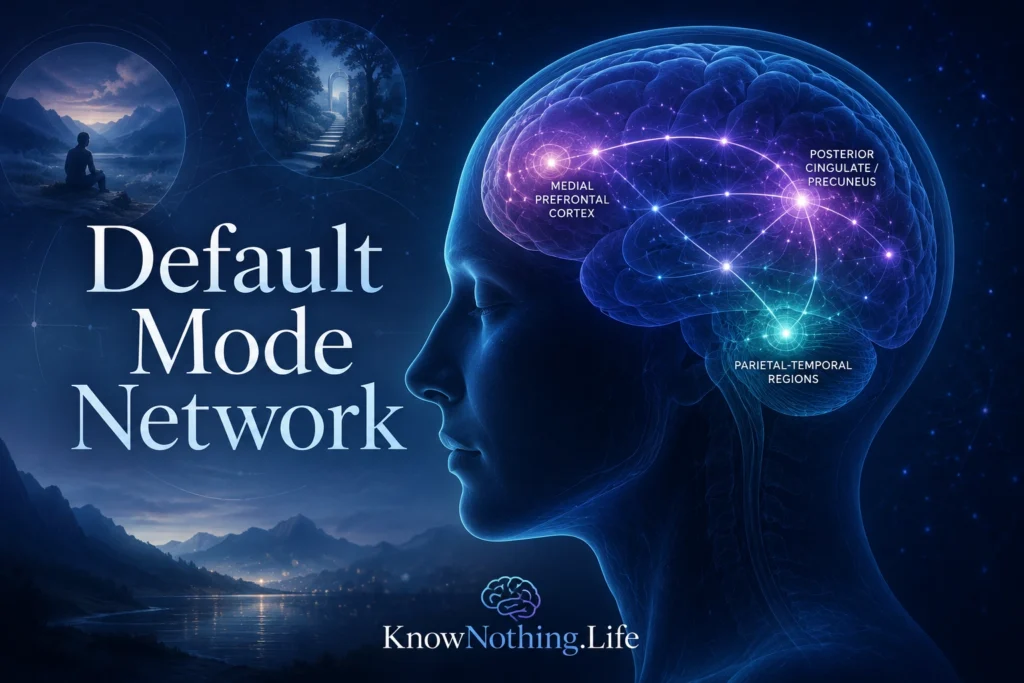
The default mode network is not a single brain location. It is a distributed system linking several major cortical and medial temporal regions. The most commonly discussed hubs include the medial prefrontal cortex, posterior cingulate cortex, precuneus, inferior parietal lobule, lateral temporal cortex, and parts of the medial temporal lobe, including memory-related structures. Randy L. Buckner, Jessica R. Andrews-Hanna, and Daniel L. Schacter described the default network as a specific anatomical system that is especially active when individuals are not focused on the external environment. Their 2008 review, “The Brain’s Default Network,” became one of the central syntheses of the field, linking anatomy, function, memory, social cognition, and disease.
Each major region appears to contribute something different to the overall system. The medial prefrontal cortex is often associated with self-referential thought, personal evaluation, and social meaning. The posterior cingulate cortex and precuneus are central hubs involved in integrating memory, attention, and internal awareness. The medial temporal lobe contributes autobiographical memory and scene construction, allowing the mind to revisit the past or simulate future possibilities. The parietal and temporal components help support perspective-taking, conceptual knowledge, and the construction of meaningful narratives. This is why the DMN is often described as the brain’s “inner theater,” not because it produces one simple function, but because it supports the mental stage on which memory, identity, imagination, and social understanding meet.
Mind-Wandering, Self, and Autobiographical Memory
One of the most important functions associated with the default mode network is self-generated thought. When the mind drifts away from an immediate task, it often moves toward personal concerns: unfinished plans, remembered conversations, imagined futures, emotional interpretations, social worries, and private narratives. This type of cognition was once difficult to study scientifically because it seemed too subjective. The DMN provided a biological framework for investigating it. Buckner, Andrews-Hanna, and Schacter argued that the network is involved in internally directed cognition, including remembering the past, imagining the future, and thinking about other people’s minds.
Daniel Schacter’s broader work on memory is especially relevant here. In memory research, Schacter emphasized that remembering is not a passive replay of stored recordings but an active reconstruction. That idea fits closely with the DMN: the same system that helps reconstruct the past also helps imagine possible futures. This connection gave rise to the concept of episodic simulation, the mind’s ability to build imagined scenes from fragments of memory. When a person pictures a future conversation, replays an embarrassing moment, imagines a different life path, or wonders what someone else thinks, the default mode network often participates. The DMN is therefore not simply a “daydreaming network.” It is a system for constructing personally meaningful mental worlds.
The Default Mode and Task-Focused Attention
The DMN is often contrasted with brain systems involved in external attention and executive control. During demanding tasks, default mode activity commonly decreases, while attention and control networks become more active. This pattern led to the idea that the brain shifts between internally oriented and externally oriented modes. When a person solves a math problem, follows directions in traffic, edits a sentence carefully, or reacts to a sudden sound, the mind must suppress some inward drift to stay engaged with the task. Greicius, Krasnow, Reiss, and Menon provided important evidence for the network’s coherence in their 2003 PNAS paper “Functional Connectivity in the Resting Brain,” which was described as an early resting-state connectivity analysis supporting the default mode hypothesis.
This does not mean the default mode network is bad for attention. A common misunderstanding is that the DMN only represents distraction. In reality, the relationship is more subtle. A wandering mind can interfere with task performance when attention is needed, but internally generated thought is also essential for creativity, planning, moral reflection, personal identity, and emotional processing. The problem is not that the DMN exists; the problem is whether it appears at the right time, in the right balance, and with the right connection to other networks. Healthy cognition depends on flexible switching. A mind that cannot disengage from internal rumination may suffer, but a mind that cannot turn inward may lose depth, continuity, and imagination.
Clinical Importance and Mental Health
The default mode network has become important in research on depression, anxiety, schizophrenia, Alzheimer’s disease, autism, ADHD, and other conditions. In depression, for example, excessive self-focused rumination has often been linked to altered DMN activity or connectivity. The person becomes trapped in repetitive inward thought: regret, guilt, self-criticism, or imagined future failure. In anxiety, the same internally oriented machinery may become dominated by threat simulation. In Alzheimer’s disease, regions of the default network overlap with areas vulnerable to early pathology, which has made the DMN important in research on memory decline and neurodegeneration. Buckner’s later review on the default network emphasized that discoveries over two decades connected association cortex regions to memory, cognition, and disease relevance.
Still, responsible interpretation matters. The DMN should not be treated as a simple diagnostic marker or a one-cause explanation for mental illness. Brain networks are dynamic, and psychiatric conditions rarely map neatly onto one circuit. The value of the DMN is that it gives researchers a way to study patterns of self-reference, memory, social thought, and rumination at the neural level. It helps explain why disorders of mood and identity often feel so internal: the suffering is not only about reactions to the outside world but also about the mind’s ongoing model of the self. In that sense, DMN research bridges neuroscience and lived experience.
Creativity, Imagination, and the Inner Life
Beyond pathology, the default mode network has deep implications for creativity and meaning. Many creative insights occur when attention loosens: during a walk, a shower, a quiet drive, or a moment of relaxed reflection. The mind recombines memories, concepts, emotions, and images without the rigid pressure of immediate task performance. The DMN is often discussed in relation to this kind of spontaneous cognition. It does not create art or ideas by itself, but it helps supply the autobiographical and imaginative material from which creative thought can emerge.
This is where the DMN becomes philosophically interesting. The network suggests that the self is not a fixed object hidden somewhere in the brain. Instead, selfhood may be an ongoing construction: a narrative process linking memory, bodily feeling, social identity, moral evaluation, and imagined possibility. William James, long before modern neuroimaging, described consciousness as a “stream,” emphasizing its flowing and personal character. DMN research gives that old psychological insight a modern biological dimension. The resting mind is not empty space between useful moments. It is one of the places where the person is continually assembled.
Final Thoughts
The default mode network transformed neuroscience by revealing that the brain’s resting state is organized, active, and psychologically meaningful. What looked like background activity became a major clue to memory, identity, imagination, social thought, and mental illness. From Raichle’s foundational work on a “default mode of brain function” to Buckner, Andrews-Hanna, and Schacter’s broader synthesis of the brain’s default network, the field has shown that rest is not the absence of cognition but a different form of cognition.
The DMN matters because much of human life happens inwardly. People remember, rehearse, regret, imagine, judge themselves, interpret others, and build possible futures long before they act. The default mode network is not the whole explanation for these experiences, but it is one of the most important neural systems for understanding them. It reminds us that the brain is not merely a machine for responding to the world. It is also a world-making organ, constantly building the private landscapes through which human beings understand who they are, where they have been, and what they might become.