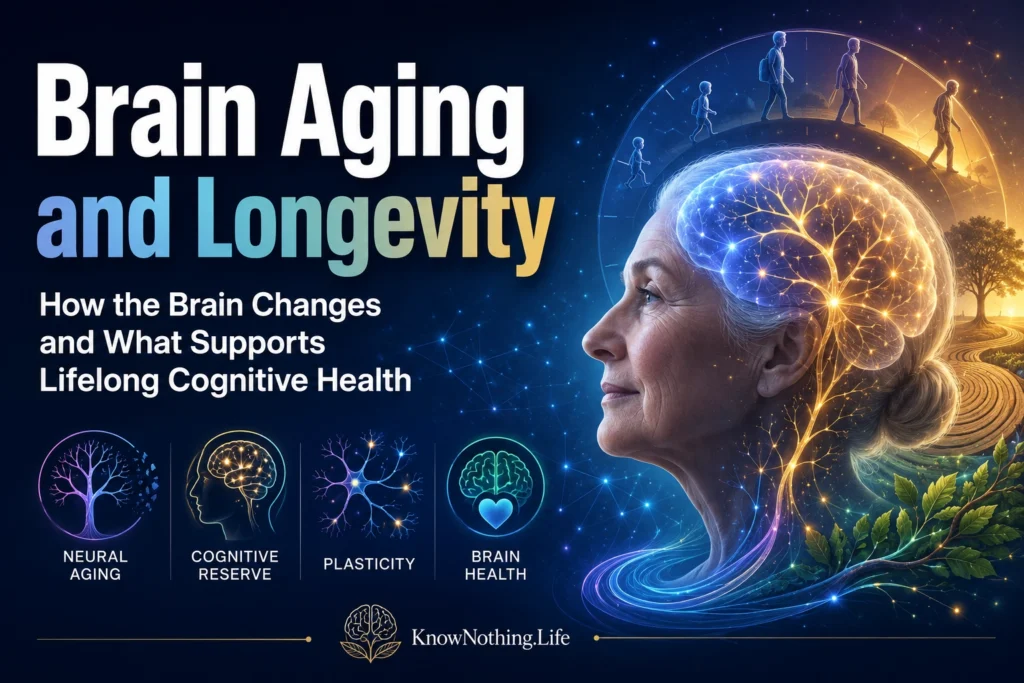
Brain aging is the gradual biological change that occurs in neural tissue across adulthood. It affects neurons, glial cells, blood vessels, white matter, synapses, metabolism, and cellular repair. Common changes include slower processing speed, more difficulty recalling names quickly, and reduced flexibility when switching between demanding tasks. These shifts are not the same as dementia. Healthy older adults can preserve language, knowledge, judgment, emotional regulation, and the ability to learn, even when learning requires more time.
The rate of brain aging varies substantially among individuals. Genetics matters, but so do cardiovascular health, education, physical activity, sleep, illness, and accumulated stress. Longevity should therefore mean more than surviving to an advanced age. The more useful goal is brain healthspan: preserving memory, independence, adaptability, and quality of life for as much of the lifespan as possible. No single scan, blood test, supplement, or “brain age” score can fully predict how one person will function decades later.
Structural Changes Across Adulthood
The aging brain does not shrink evenly. In a five-year longitudinal MRI study, Naftali Raz and colleagues found substantial average volume loss in the caudate, cerebellum, hippocampus, and association cortices, with wide differences among participants. Hypertension was associated with greater shrinkage in some regions. A later study led by Lori Driscoll found declines across multiple brain volumes, with accelerated change in frontal and parietal regions and more rapid temporal and hippocampal loss among people who developed mild cognitive impairment.
White matter also changes as myelin, small blood vessels, and long-range axonal pathways become more vulnerable. This may reduce the speed and coordination with which distant regions communicate, contributing to slower processing even when accumulated knowledge remains strong. Average volume loss is not a direct measure of intelligence or future dementia. Some people function well despite visible pathology, while others experience difficulty with less obvious structural change. Brain aging reflects the interaction of tissue integrity, network organization, and the capacity to compensate.
Cellular Aging, Inflammation, and Repair
At the cellular level, aging is associated with reduced energy efficiency, impaired protein maintenance, DNA damage, altered immune signaling, and weaker removal of dysfunctional cellular components. Mitochondria must continually supply neurons with energy, while lysosomes and related systems remove damaged proteins and organelles. When maintenance becomes less efficient, oxidative stress and molecular waste can accumulate. Neurons may lose synaptic complexity without necessarily dying, and glial cells may become less effective at supporting communication and repair.
Microglia, the brain’s resident immune cells, also change with age. A 2020 study by Tony Marschallinger and colleagues identified lipid-droplet-accumulating microglia in aged mouse and human brains; in mice, these cells showed impaired phagocytosis and elevated inflammatory signaling. Cellular senescence is another emerging target. In a 2025 mouse study, reducing p16-related signaling in microglia and endothelial cells limited neuroinflammation, vascular abnormalities, tau pathology, and cognitive impairment. These findings are important, but they do not yet show that senolytic drugs can safely slow normal human brain aging.
Blood Vessels and Metabolic Health
The brain depends on continuous blood flow to deliver oxygen and glucose. Hypertension and small-vessel disease can damage cerebral tissue, contributing to strokes, microscopic infarcts, white-matter lesions, and cognitive impairment. Vascular and neurodegenerative processes often occur together, making cardiovascular protection one of the most evidence-based approaches to preserving brain health. Longitudinal imaging has also associated hypertension with greater regional brain-volume loss.
The SPRINT MIND randomized trial tested whether more intensive blood-pressure treatment could reduce cognitive outcomes in adults at elevated cardiovascular risk. Intensive control significantly reduced mild cognitive impairment and the combined outcome of mild cognitive impairment or probable dementia, although it did not significantly reduce probable dementia alone during the original follow-up. A 2025 long-term analysis continued to support a lower risk of cognitive impairment. The appropriate blood-pressure target still depends on falls, medication effects, frailty, and individual medical history.
Sleep and Brain Maintenance
Sleep supports memory consolidation, metabolic regulation, immune balance, and restoration of attention. Sleep quality and continuity can become more difficult to maintain with age, while insomnia, sleep apnea, pain, medication, and illness may further disrupt rest. Poor sleep can impair cognition the following day, and persistent sleep disorders may interact with vascular and neurodegenerative processes. Sleep problems should therefore be assessed and treated rather than dismissed as an unavoidable part of aging.
In 2013, Lulu Xie and colleagues showed in mice that sleep expanded interstitial space and accelerated the clearance of metabolites, including amyloid-beta, through a fluid-transport pathway often called the glymphatic system. The study provided a plausible mechanism linking sleep with brain maintenance, but measuring this process directly in living humans remains difficult. Sleep should not be described as a nightly “detox” that guarantees dementia prevention. Its value is broader: it supports cognition, vascular health, emotional regulation, and cellular recovery.
Cognitive Reserve and Lifelong Learning
People with similar levels of brain pathology can display very different degrees of impairment. Cognitive reserve describes the capacity to use networks, strategies, and knowledge efficiently enough to maintain performance despite age-related or disease-related change. Education, complex work, literacy, mentally engaging activities, and social participation are often used as indirect measures. The concept does not imply that puzzles can prevent all cognitive decline or that dementia reflects a failure to keep the mind active.
Robert Wilson and colleagues followed 2,899 older adults and found that education was associated with a higher level of cognitive function before old age but was not strongly associated with a slower rate of decline after accounting for neuropathology. Education may help a person enter later life with stronger skills or tolerate more pathology before symptoms become visible without directly slowing every biological process. Continued learning remains valuable, but no single mental exercise has been shown to make the brain permanently resistant to disease.
Exercise and Multidomain Prevention
Physical activity influences the brain through cardiovascular fitness, insulin sensitivity, inflammation, mood, sleep, and neurotrophic signaling. In a randomized trial involving 120 older adults, Kirk Erickson and colleagues found that one year of aerobic exercise increased anterior hippocampal volume by approximately 2 percent, while the stretching control group experienced volume decline. The increase was associated with improved spatial memory and higher levels of brain-derived neurotrophic factor. The study does not prove that exercise reverses every form of aging, but it demonstrates that older neural tissue retains meaningful plasticity.
The Finnish FINGER trial assigned 1,260 older adults at elevated dementia risk to general health advice or a two-year program involving diet, exercise, cognitive training, social activity, and vascular-risk management. The multidomain group showed greater improvement or maintenance of overall cognitive performance. The study did not prove permanent dementia prevention, but it supported the principle that brain longevity is unlikely to depend on one nutrient, game, or medication. Several risk factors often need to be addressed together.
Superagers, Centenarians, and the Future
Research on “superagers” challenges the assumption that severe memory decline is inevitable. Theresa Harrison and colleagues studied adults over 80 whose episodic memory matched that of people decades younger. These individuals had thicker cortex than typical age-matched adults and unusually preserved anterior cingulate regions. A 2024 longitudinal study found that superagers also showed better-preserved white-matter microstructure and slower deterioration across several pathways. They are uncommon and cannot yet be produced through a known lifestyle formula, but they demonstrate that brain-aging trajectories vary greatly.
Centenarian studies reveal both resistance and resilience. Some people reach extreme old age with little Alzheimer-type pathology, while others maintain cognition despite substantial amyloid and tau accumulation. A 2023 analysis found that neuropathological burden did not correspond closely with cognitive performance in centenarians, suggesting that protective cellular or network mechanisms can sometimes compensate. Research is investigating genetics, immunity, vascular integrity, and cellular senescence, but no treatment has been proven to stop or reverse human brain aging.
The practical message is less dramatic than anti-aging marketing but more useful. Brain aging is neither completely preventable nor entirely predetermined. The best-supported approach is to protect vascular health, remain physically active, treat sleep and hearing problems, avoid smoking, manage metabolic disease, maintain meaningful cognitive and social engagement, and seek evaluation for persistent changes in memory or daily function. The aim is not to keep the brain biologically young forever. It is to preserve enough resilience and adaptability for a long life to remain independent and mentally engaged.